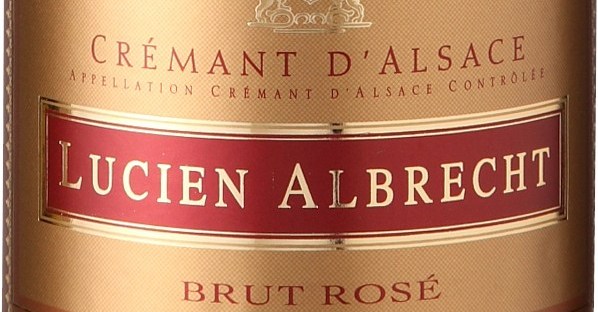
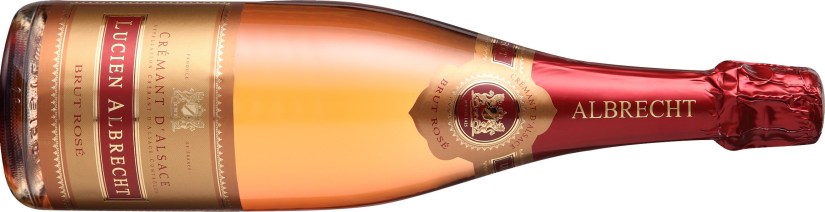
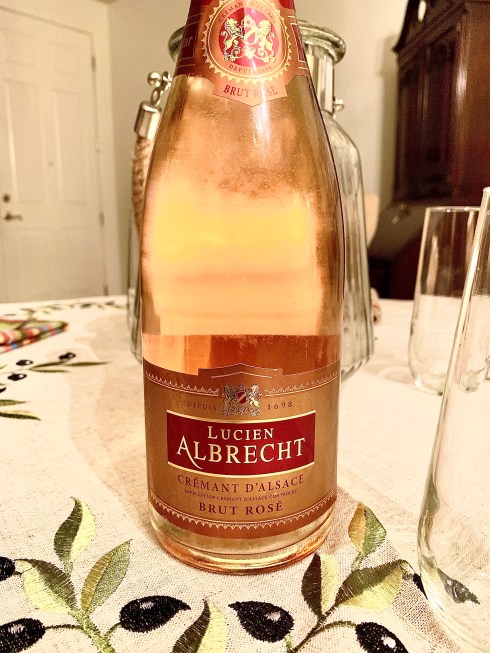
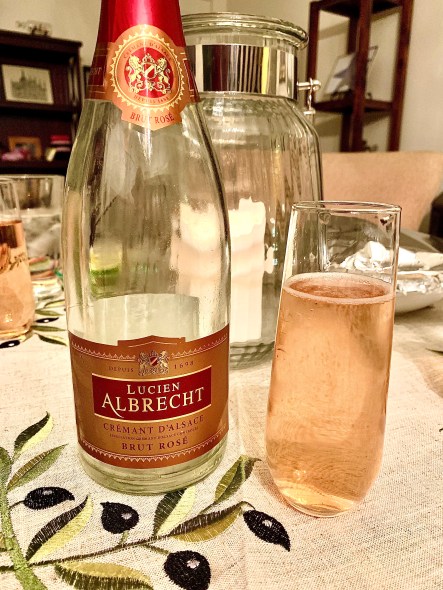
The holidays are once again upon us, and just like last year, we have a tasty and festive sparkling wine for you. Last year we reviewed the Lucien Albrecht Crémant d’Alsace Brut, and gave it our hearty recommendation. This year, we received a media sample of the Lucien Albrecht Crémant d’Alsace Brut Rosé.
Photo credit Lucien Albrecht Grand Vin d’Alsace
The following wine was provided as a media sample for review. All reviews, descriptions, and opinions are our own. We received no additional compensation.
As you may recall from our previous review, Crémant refers to a sparkling wine, made in France in the méthode tranditionalle (the way Champagne is made), that is not made in the Champagne region. Crémant sparkling wines are often of comparable quality, but much more affordable than their more famous cousin.
Lucien Albrecht is a name synonymous with Alsace wine. The Lucien Albrecht story dates back hundreds of years. Over the generations, the Albrecht family has been among the pioneers of innovation and advancement in Alsace winemaking. Albrecht believes in respecting nature and the grapes to produce wines of distinction, showcasing the unique terroir.
Lucien Albrecht Crémant d’Alsace Brut Rosé is made from 100% Pinot Noir grapes. The whole clusters are crushed, and the free run juice is fermented and bottled. After the second fermentation in the bottle, the wine is aged on the lees for 14-16 months. The result is a wine that is dry and crisp, with a creamy texture and long finish. At just $23 SRP, this is a terrific value and worthy of any holiday table.
We have been big fans of Lucien Albrecht wines, both still and sparkling, for a long time. Confident of a satisfying experience, we popped our bottle and were immediately impressed with the quality. We were definitely not disappointed! Here’s what we thought of it.
Pale salmon color. Bountiful, vigorous bubbles that fade in a few minutes, though still ample throughout. Aromas and flavors of raspberry, strawberry, rose petal, hints of orange blossom. Dry with bright acidity. Long finish. Great with fish and shrimp tacos, and will complement a variety of traditional holiday favorites.
Lucien Albrecht Crémant d’Alsace Brut Rosé is widely available at your favorite retailer. Next time you’re in, grab a bottle, put it on ice, and impress your holiday guests with your exquisite taste.
Cheers!
Except where noted, all text, photos, and video by Kent Reynolds and Robyn Raphael-Reynolds
When I first heard about Vivino, way back on Thanksgiving Day, 2014, I thought it was a pretty good idea. The concept is simple: users upload pictures of wine labels, give the wine a rating from 1 – 5 stars, and write up a brief review. The label recognition technology is pretty good, so if a wine is already in the database, the user doesn’t have to manually enter it. With a global crowd-sourcing base, the database is extensive and I rarely have to manually enter a new wine. With this database of wine ratings, users can look up a wine and check scores and ratings and reviews before they buy it. If a wine has a low rating, and the reviews don’t sound promising, you might want to pass on it.
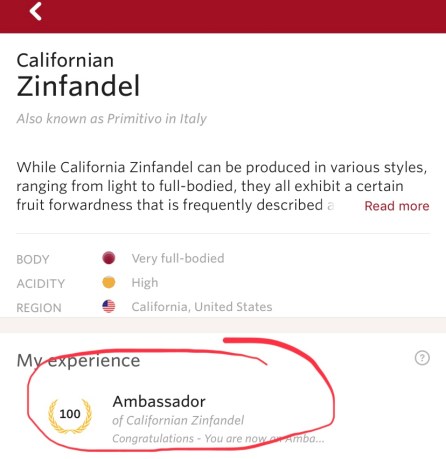
Within Vivino, users themselves are ranked. Using a complex algorithm I’ve yet to fully comprehend, but generally based on number of wines rated, quality of reviews, and participation in the social platform (liking other users’ reviews), users are assigned a ranking within their country; Number 3,421 in the U.S, for example. Also, users can earn distinctions based on how many of a given wine style they have rated. These ranks start with Explorer after your first rating, to Enthusiast after rating six wines, to Expert after 26, to the pinnacle, after rating 100 wines of a regional style: Ambassador.
After using the app for awhile, I noticed my ranking was getting higher and higher. Suddenly my normally docile competitive spirit kicked in. I wanted to see how high I could get in numerical and regional ranking. I started trying more and different wines from around the world. I was obnoxiously diligent in taking pictures of every label of every wine I tasted, be it at the wine shop, a restaurant, a friend’s house, or anywhere else. Eventually, I made it as high as 124 in the U.S.! As of today, I’ve slipped down to 143, largely because I’ve been a little busy getting married. According to data from October 2018, there are 32.8 million Vivino users worldwide. The U.S. has the highest number of users, followed by Brazil. It’s hard to find information on number of users per country, but by my estimation, there are more than 5 million in the U.S. So 143 is still respectable, and I’m working my way back up!
Due to the wide variety of wines I was rating, however, my regional-wine ranking was slower to evolve. California Cabernet Sauvignon and Zinfandel were always my top two, but I was enjoying other varietals and regions as well. Then one day, earlier this month, I rated a California Zinfandel, and saw that it was my 99th review. I was about to become an Ambassador!
As I was getting ready to write this post, I went back to the beginning to recall which wine was my first rating. To my amusement, it was a Zinfandel! Back then I was a member of NakedWines.com, and a big fan of winemaker Leigh Meyering. Her “ElegantLeigh” Zinfandel 2013 was my very first Vivino entry.
My reviews have gotten more descriptive since then!
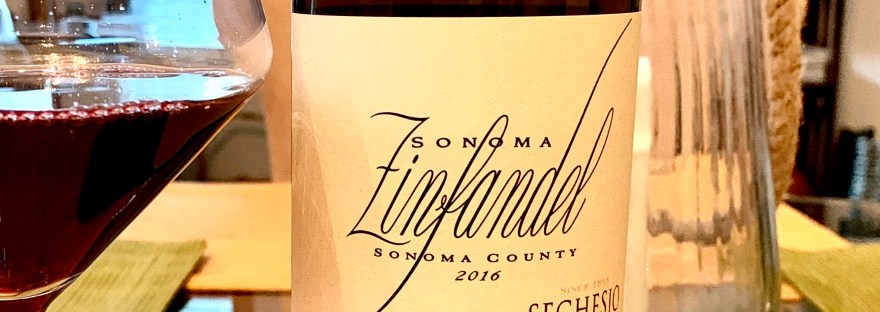
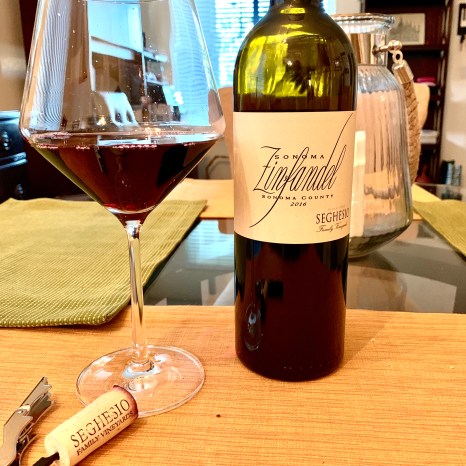
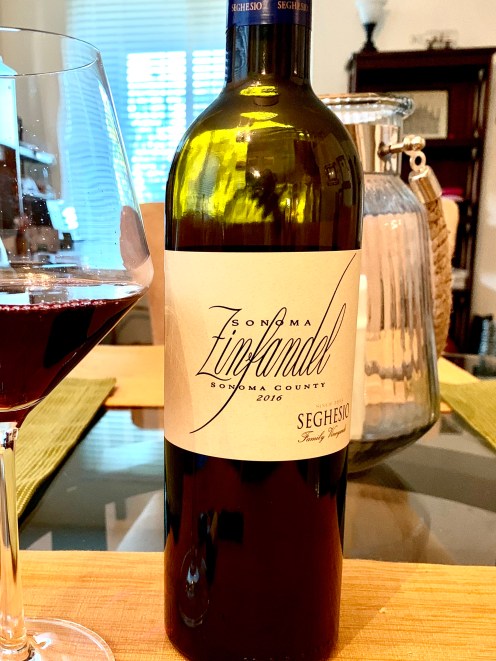
For my 100th California ZInfandel, I selected the Seghesio Sonoma Zinfandel 2016. I’ve only had Seghesio a few times, but have always enjoyed it, and it’s widely known and recognized for its quality.
Seghesio Family Vineyards has been in operation for more than 120 years, across five generations. In 1895, Edoardo Seghesio planted a Zinfandel vineyard in Alexander Valley. In 1902, Edoardo and his wife, Angela, built a winery and began making wine. Seghesio Winery was born. The winery flourished and gained a reputation for quality, and even managed to survive during Prohibition. Once Prohibition ended, Edoardo re-opened the doors for commercial winemaking. Fourth generation brothers, Ted and Pete Seghesio now run the operation, and are committed to quality over quantity. Ted’s nephew, Ned Neumiller, is now working in the family business; the fifth generation to do so.
With over 300 estate vineyards planted to Zinfandel and Italian varieties, Seghesio continues to produce high-quality wines and expand their reputation in the wine world. I know I was impressed when I opened my 100th Zinfandel!
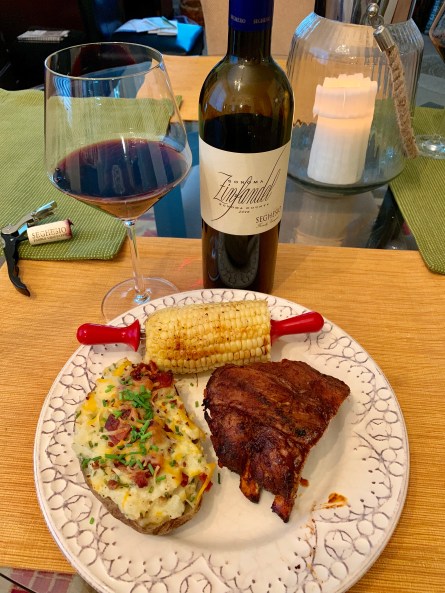
Deep purple color, with ruby rim. Aromas of blackberry, blueberry, and baking spice. On the palate, ripe blackberry, cassis, blueberry, cherry, baking spice, black pepper, and vanilla. There’s a lot going on here. Definitely one of the more complex Zinfandels I’ve had in awhile. Big, bold, and full bodied with bright acidity and medium tannins. The finish is spicy with black fruit notes, and goes on for days. Perfect with baby back ribs!
The aforementioned Baby Back ribs, with a twice-baked potato and corn on the cob! I do love summer eats.
If you haven’t tried Seghesio Zinfandel yet, you really ought to. Pop a bottle, download the Vivino app, and rate and review it! Your California Zinfandel Ambassador recommends it. 🙂
We do love Cabernet Sauvignon. Though we don’t know too many people who don’t. It’s the King of Grapes for a reason. So popular, so food friendly, so ageworthy and collectable, and so…expensive!
Not necessarily. If you’re shopping for Napa Cabernet, maybe. But what if we told you about a high quality Cabernet Sauvignon, from a California appellation, that you could enjoy for a mere $22 per bottle?
The following wine was provided as a media sample for review. All reviews, descriptions, and opinions are our own. We received no additional compensation.
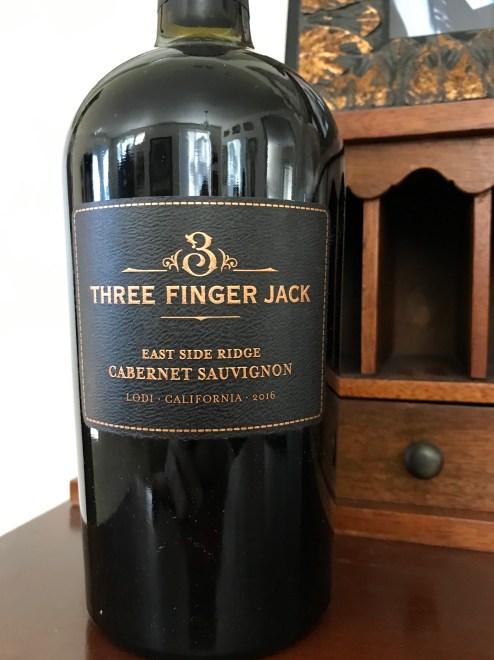
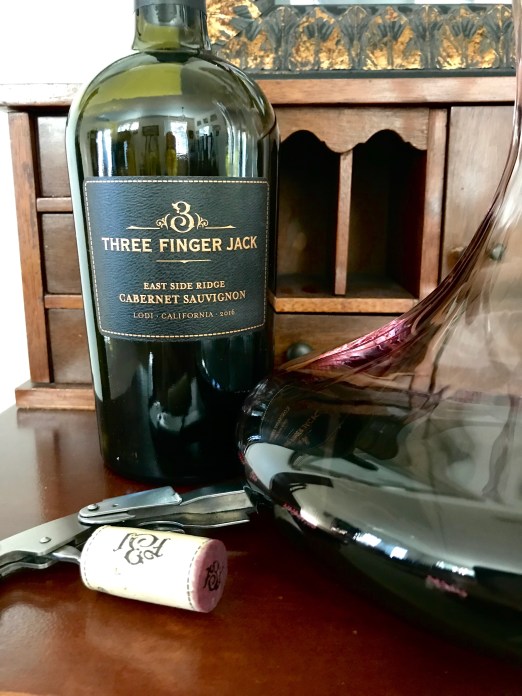
Recently, we received a bottle of Three Finger Jack East Side Ridge Cabernet Sauvignon 2016. Where is the East Side RIdge? We wondered the same thing. It is located on the East Side (obviously) of Lodi! Now, we don’t normally think of Lodi when we are craving a Cabernet, and we bet you don’t either. This bottle has surely changed our way of thinking!
Yes, that is an interesting, rather squat bottle.
Most of the Lodi region has deep, loamy soil, good for Rhone varieties. However, up on the East Side, the soil is more rocky, with cobblestones and soil low in nutrients. You know how Cabernet shines brightest when it struggles!
Next you may be asking, who is this “Three Finger Jack?” The name comes from a legendary outlaw from the Gold Rush era, who sought his fortune in the Sierra Nevada foothills. Little is known about the mysterious man; nobody really knows how he lost his fingers, but his legend lives on in the Lodi area.
As for the wine that bears his name, the Three Finger Jack East Ridge Cabernet Sauvignon 2016 is rugged and structured, as a famed outlaw should be.
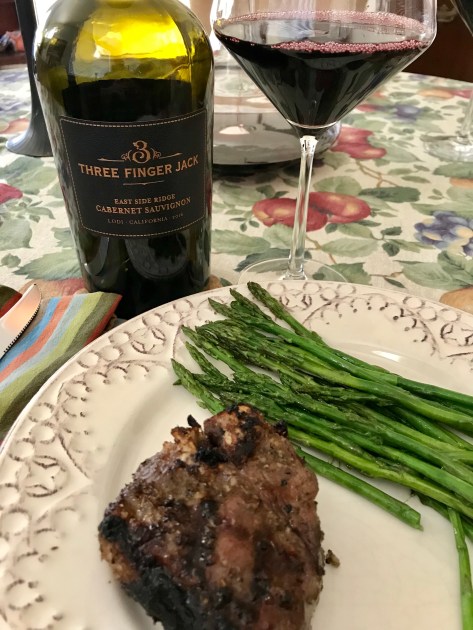
We actually held onto this for awhile, waiting for suitable weather for a big, bold red. The summers in NorCal can be hot; calling more for crisp whites and rosés. Finally, an unseasonably cool (well, not hot) weekend arrived when we felt we could best enjoy this wine. Certainly a BBQ wine, which would pair well with steak, ribs, or brats, we opted to pair this with marinated lamb chops. The pairing did not disappoint.
Inky purple with ruby rim. Aromas of blackberry, blueberry, cassis, and vanilla. In the palate, boysenberry, blackberry, and cassis, with vanilla and caramel notes. Tannins are very soft with mild acidity. Smooth, full bodied, with a medium finish of dark berry and spice.
Honestly, we don’t typically think of Lodi for Cabernet. This one is nicely balanced with good flavor and soft tannins.
Though summer is waning, it’s not too late to track down some Three Finger Jack and pair it with your favorite grilled beast. A fantastic value from a region not often considered for Cabernet Sauvignon; lesson learned – think outside the box and you will be rewarded.
According to Google Translate, the French word Sosie is translated to English as Doppelganger. As you may know, a doppelganger is a look-alike; a body double; a twin.
Sosie Wines founders, Scott MacFiggen and Regina Bustamonte, have appreciated good wine and food for years. Regina recalls her grandmother mixing a bit of wine with some fizzy water for the kids during Sunday lunches. Scott’s grandfather owned a farm in Upstate New York. It was there that Scott learned how amazing farm-fresh produce tastes. These early experiences provided the inspiration for Sosie wines.
As adults, Scott and Regina traveled to France and became enamoured with the French countryside, the wines, and the Old World traditions that make the wines so great. So when they decided to launch their own wine brand, Scott and Regina wanted to bridge the gap between New World vineyards and Old World style wines.
Sosie Wines uses a minimal intervention winemaking style. They want the fruit to speak for itself, using native fermentation, and letting the natural aromas, flavors, and acidity shine through. Made in very small batches, with lower alcohol and higher acidity, in the Old World style, these wines are food friendly, with deep, complex character.
They were so committed to creating French-inspired, Old World-style wines, they chose their name, Sosie, as an indication that their wines are look-alikes to their French counterparts. They even designed their logo as a marriage of French and Californian influences: the California grizzly bear, featured on the state flag, with a proud French rooster standing upon the bear’s back.
Credit: Sosie Wines
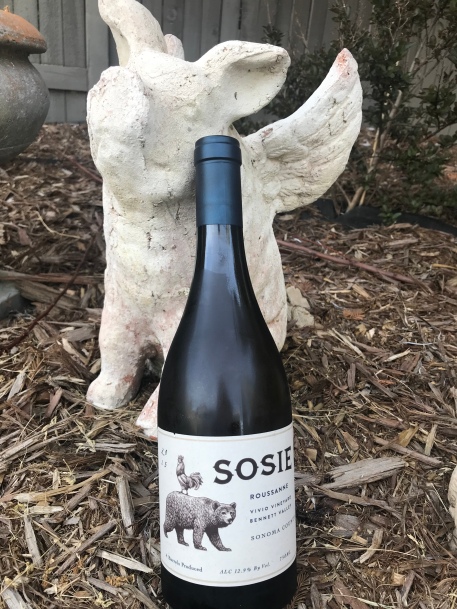
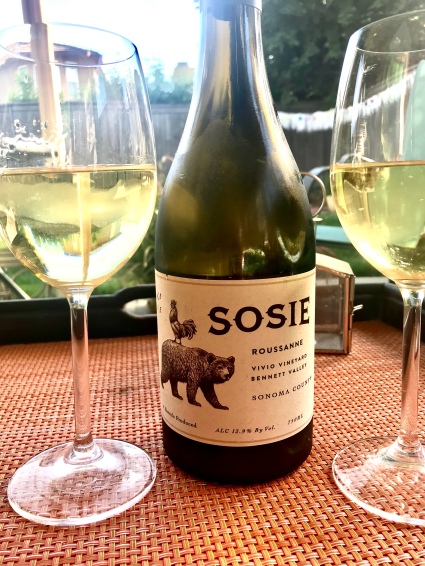
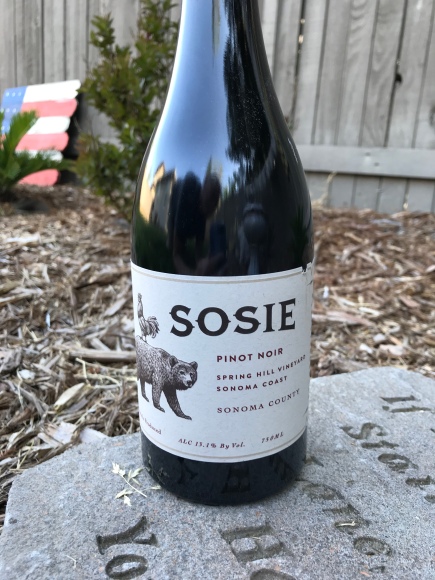
We recently received two bottles of Sosie wines as media samples for review; their 2015 Roussanne, Vivio Vineyards, Bennett Valley, Sonoma County, and the 2015 Pinot Noir, Spring Hill Vineyard, Sonoma Coast.
The following wines were provided as a media sample for review. All reviews, descriptions, and opinions are our own. We received no additional compensation.
Roussanne is a white grape from the Rhone Valley in France. It is traditionally blended with Marsanne, to make tasty Rhone white wines. A 100% Roussanne is relatively uncommon.
I’m not gonna lie, when I (Kent) saw the Roussanne, I was skeptical. I’ve only had a couple of 100% Roussanne wines before, and neither one impressed. Both had a distinct “funky” smell and taste, almost metallic or chemical in nature. The first bottle I tried, I returned and got a replacement. The replacement bottle tasted the same. I tried a different producer, and while it was slightly better, it still ranks as one of fewer than 10 wines I’ve ever poured down the drain. So, you can see why I was skeptical. I really thought that the day I found a Roussanne I liked, would be the day that pigs fly!
Well, that skepticism was blown away with the Sosie Roussanne. Hold on to your hats because that might be a Berkshire flying overhead! On initial pour, it did have just a momentary, slight funkiness (making Kent nervous), but that faded within seconds, leaving a clean, bright, fruity, and delicious wine that most definitely impressed! Here are our tasting notes:
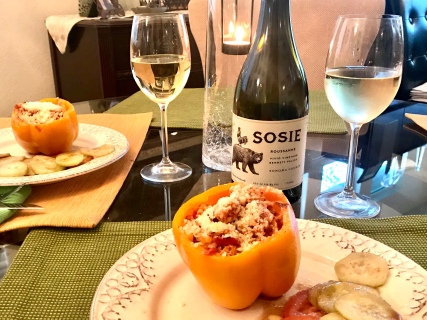
The first 100% Roussanne we’ve actually enjoyed! Golden color in the glass. Initial aromas are ripe apricot and nectarine. As it open up, there is some floral and herbal notes. On the palate, flavors of pear, honeysuckle, apricot, and some black tea notes. Medium body with a soft mouthfeel and bright acidity. Paired with turkey-stuffed grilled bell peppers, an amazing combination.
Only four barrels produced. Now that’s small batch! SRP: $38.00
We’re kinda particular about our Pinot Noir. Many these days are overripe, overly extracted, and just too heavy. Almost like they’re trying to make it taste like Cabernet Sauvignon. We think Pinot Noir is meant to be balanced and elegant. The Sosie Pinot Noir is exactly that! Reminiscent of a Burgundian wine, as would be expected from a wine crafted in the Old World style, this wine has fresh fruit, balanced with earthy notes, smooth tannins, and soft acidity.
An exquisite, elegant Pinot Noir. Brick red color. On the palate, there are aromas of raspberry, clove, and tobacco smoke, with hints of earth. On the palate, flavors of raspberry, dark cherry, baking spice, smoke, and forest floor. Velvety smooth tannins with bright, perfect for food pairing. Long finish of red fruit, earth, and smoke. Paired with grilled marinated pork chop and Brussels sprouts with pancetta, it was a match made in heaven!
Five barrels produced. SRP: $43.00
Sosie also produces a Syrah, a Rosé of Syrah, and a Cabernet Franc. I have no doubt that all are outstanding, and we hope to try them all! Sosie wines are available for purchase on their website. They care enough about your satisfaction, that they only ship when weather conditions warrant.
Give Sosie wines a try. Let us know, in the comments, how you enjoyed them.
This is a repost of a project I published in 2017, in collaboration with Bri’s Glass of Wine. Sadly, I recently discovered that Bri has taken her site down. So I am posting this now on our site, because, frankly, I refer to it in a couple of subsequent blog posts, here and here. Plus, I happen to think it’s a pretty good post! Please enjoy!
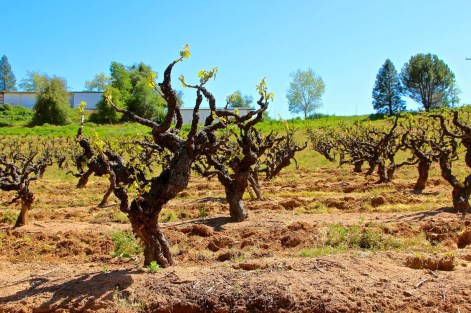
Nestled in the heart of Sierra Foothills wine country lie what are reportedly America’s oldest producing Zinfandel vines. The Original Grandpère Vineyard (OGP for short) can trace its roots to the California Gold Rush era, with documentation dating back to 1869, and vines predating even that year. In keeping with Wild West tradition, the story of these vines is mixed with history, intrigue, and conflict.
Located in the beautiful, rolling hills of the Shenandoah Valley in Amador County, historical records identify the original owners of the vineyard as the Upton family. Over the years, ownership changed hands, Prohibition came and went, and White Zinfandel happened. In the 1970’s and early ’80s, the grapes produced in the vineyard were largely sold to make White Zin. In 1984, Scott and Terri Harvey purchased the land. At the time, Scott worked for Renwood winery. He named the vineyard Grandpere in honor of its age – Grand-père is French for Grandfather.
OGP Vineyard, photo credit: Randy Caparoso
While working at Renwood, Scott Harvey produced wine from his Grandpère Vineyard for the Renwood label. Meanwhile, Renwood Winery trademarked the name “Grandpère”, and using cuttings from the original vineyard, started producing Grandpère Vineyard Zinfandel from their own vines in a different vineyard. Through a series of events, including disputes, lawsuits, settlements, and divorce, Scott Harvey and Renwood parted ways; the use of the name “Grandpère” is legally protected and limited; and Terri Harvey owns the 1869 vineyard on her own. That Gold Rush era vineyard, with its 1869 heritage, is now known as the Original Grandpère Vineyard. The terms of a settlement agreement require that vintners using these grapes must use that entire name, or nothing at all.
Fast forward to 2017, and the few producers who are fortunate enough to source fruit from the Original Grandpère Vineyard are making some outstanding, elegantly restrained, nearly 150-year-old, Old Vine Zinfandel wines. I recently attended a Small Plates & Vertical Tastings event, accompanied by my daughter and her friend, that was hosted by three of those wineries making Original Grandpère Vineyard Zinfandel: Vino Noceto, Andis Wines, and Scott Harvey Wines. By no small coincidence…OK, no coincidence at all…Zinfandel is one of my favorite grape varieties. According to my Vivino stats, Zin is second only to Cabernet Sauvignon as my favorite varietal wine.
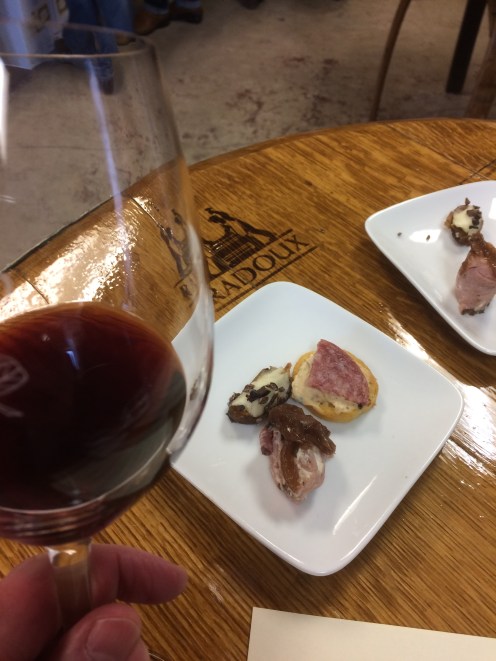
Each of the wineries poured a number of their OGP Zinfandel wines, paired with small bites to complement each vintage. We started at Vino Noceto…
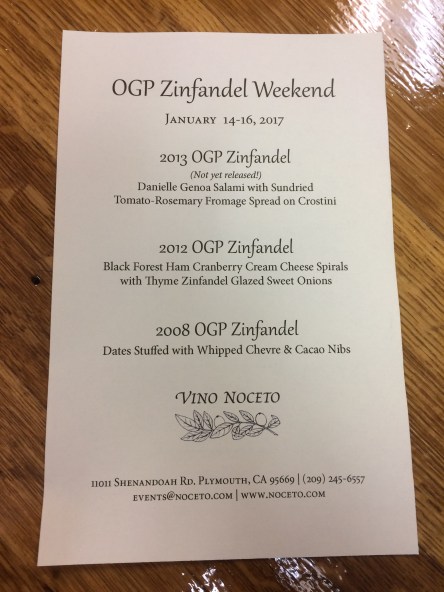
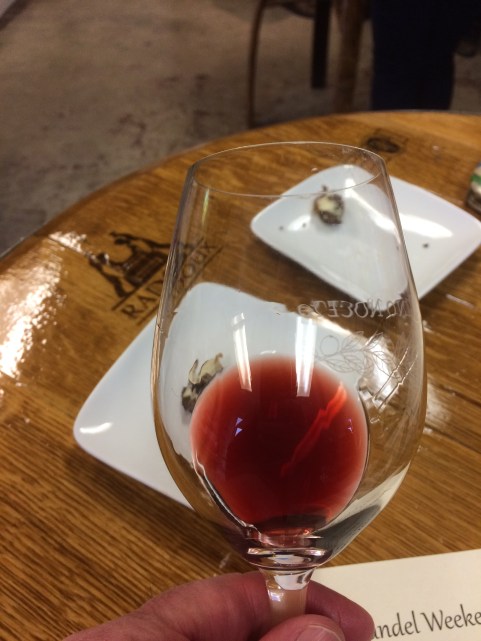
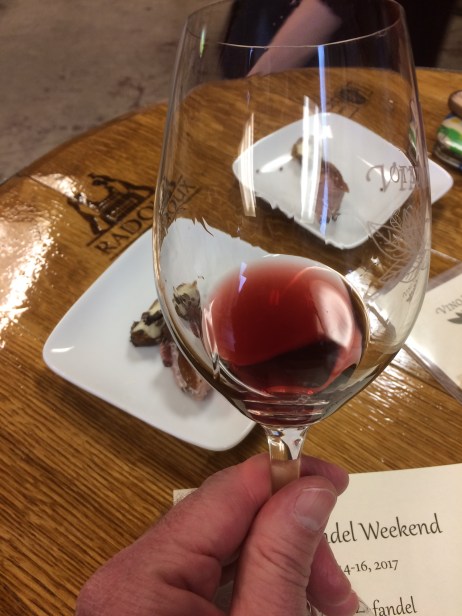
Our host, Bret, set us up at a cozy high-top bistro table, and got us started with the yet-to-be-released 2013 vintage, followed by the 2012 and 2008. The small bites for pairing included Genoa Salami with Sundried Tomato-Rosemary Fromage on Crostini (with the 2013), a Black Forest Ham and Cranberry Cream Cheese Spirals with Thyme Zinfandel Glazed Sweet Onions (with the 2012), and Dates Stuffed with Whipped Chevre & Cocoa Nibs (with the 2008).
The bites were perfect pairings for each wine; drawing out the nuances of the tannins, acids, and flavors in the wines.
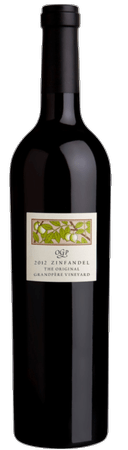
Vino Noceto OGP Zinfandel 2013 ($32 retail)
Violet color in the glass. Aromas of blackberry and soft oak on the nose. Flavors of blackberry, boysenberry, cherry, and blueberry, with notes of spice and black pepper. Bright acidity with full, firm tannins. Long finish with dark berry, black pepper, and cherry notes.
Vino Noceto OGP Zinfandel 2012 ($32 retail)
Ruby color with brick colored rim. Aromas and flavors of raspberry, cherry, and ripe strawberry. Very soft tannins with light acidity. Medium finish with red berry and spice notes. (It was very interesting to notice the contrast one year makes; from 2013 black fruit and firm tannins, to 2012 red fruit and soft tannins.)
Vino Noceto OGP Zinfandel 2008 ($49 retail)
Brick red color. Nose of cherry and raspberry, with a hint of oak. Flavors of bing cherry, ripe raspberry, and spice. Tannins are soft and silky, balanced with bright acidity. Long, zesty finish with red fruit and spice.
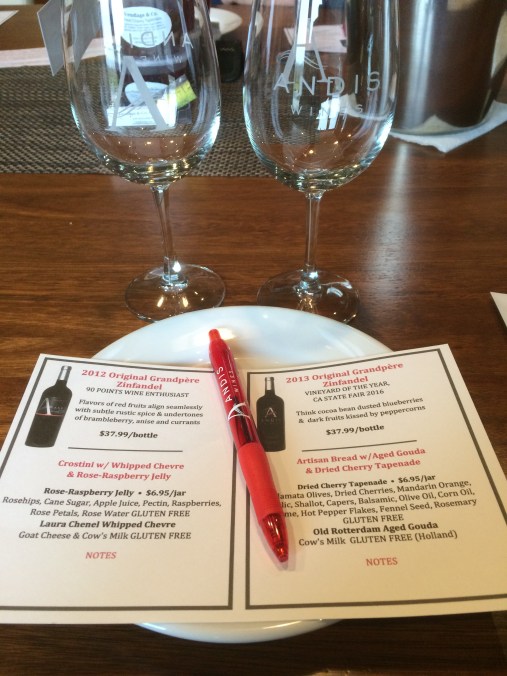
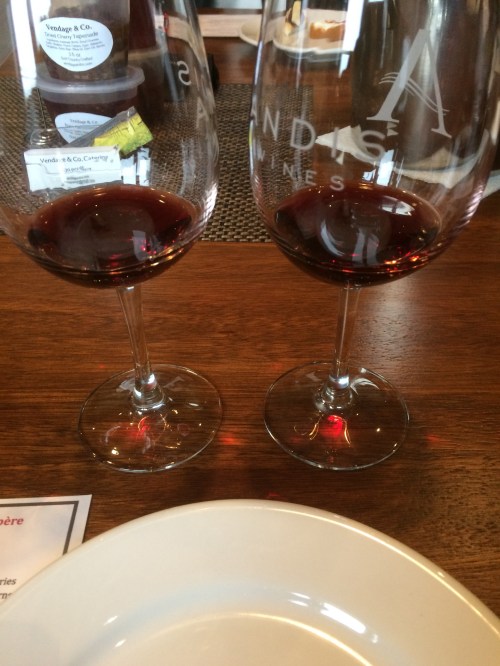
Next we traveled all the way across the road to Andis Wines. Here, we were seated at a large table in a private room with other guests, and treated to a detailed history lesson by our host, Art. He confirmed my earlier research, outlined above, and then poured us two samples and distributed the matching small bites to complement the wines. At Andis, we enjoyed the 2012 and 2013 vintages. Art explained that the 2012 vintage was made entirely by the original Andis winemaker, Mark McKenna; however, the 2013 was started by McKenna, but completed by Napa winemaker Doug Hackett. McKenna used non-traditional methods; fermenting in stainless steel, then adding oak chips and dust to introduce the oak influences. Hackett is more traditional, aging in oak barrels. The contrast in winemaking styles was definitely apparent. With the 2012, we enjoyed a Crostini with Whipped Chevre and Rose-Raspberry Jelly. With the 2013, the pairing was Artisan Bread with Aged Gouda and Dried Cherry Tapenade. Again, the pairings were excellent.
Andis Wines Original Grandpère Vineyard Zinfandel 2012 ($37.99 retail)
Ruby color. Nose of fresh raspberry and cherry, with a hint of soft oak. Flavors of sour cherry, raspberry, and ripe strawberry. Bright acidity with smooth tannins and a medium finish of red fruit flavors. My overall impression of this wine was “soft.”
Andis Wines Original Grandpère Vineyard Zinfandel 2013 ($37.99 retail)
Deep purple color. Nose of blackberry and spice. Flavors of blackberry, ripe raspberry, black cherry, and toasty oak. Medium acidity with firm tannins and a long, spicy finish. My overall impression of this one was “bright.”
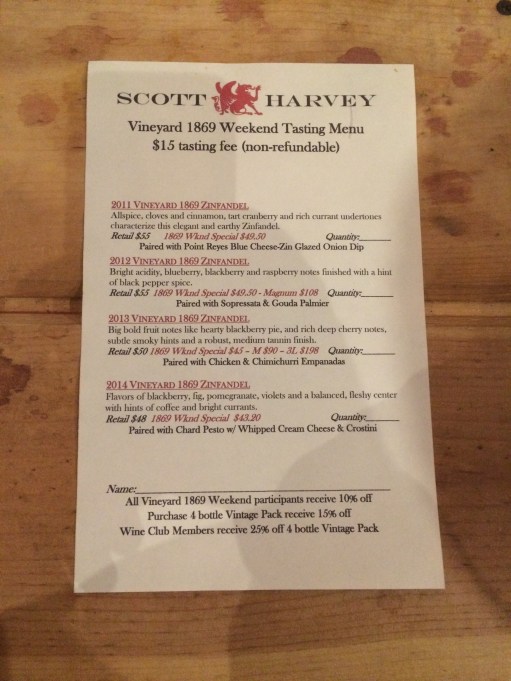
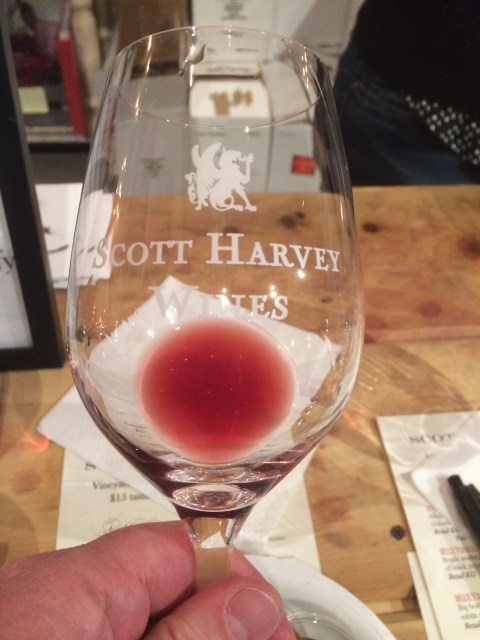
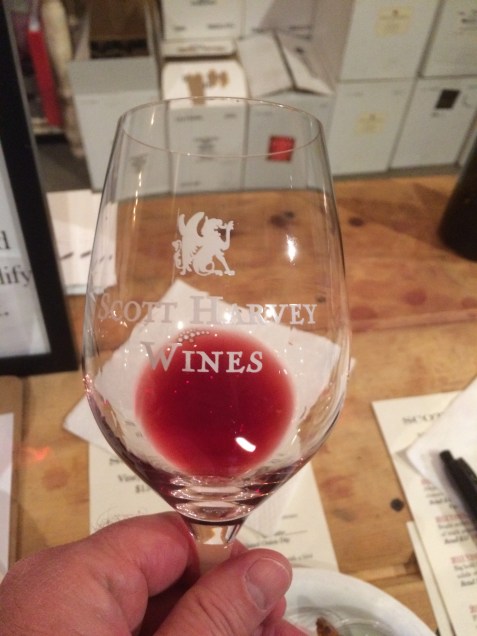
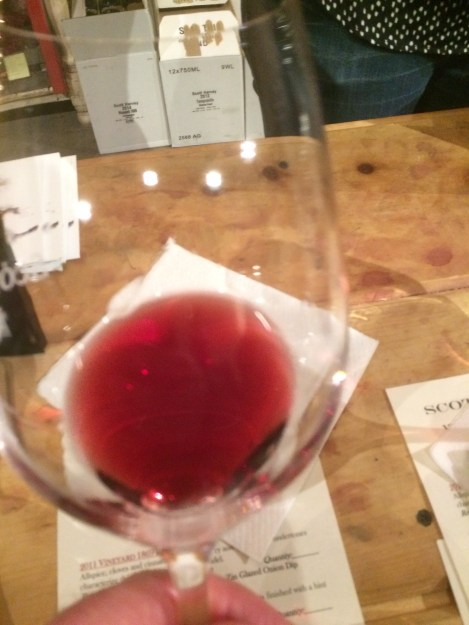
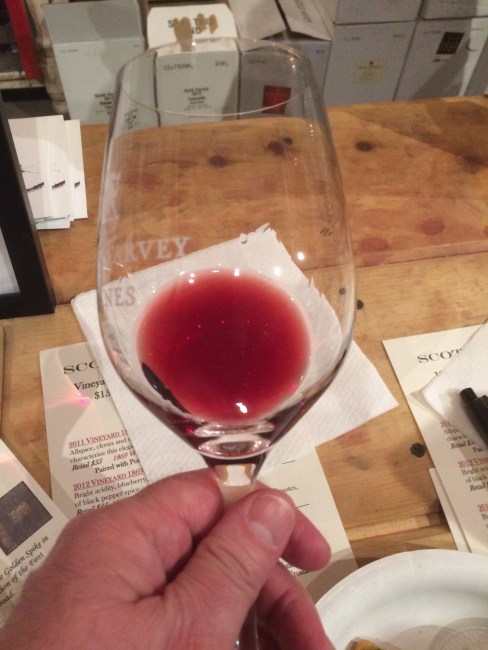
To finish out the day, we traveled the few hundred yards down the road to Scott Harvey Wines. Here, host Kelsey greeted us at the tasting bar as set up our tasting and small plates. Scott Harvey presented their vertical in the reverse of the traditional order, starting with 2011 and moving forward through 2014. Scott Harvey wines are aged in neutral French oak. The tastes included Potato Chips with Point Reyes Blue Cheese-Zin Glazed Onion Dip (2011), Sopressata & Gouda Palmier (2012), Chicken & Chimichurri Empanadas (2013, and Chard Pesto with Whipped Cream Cheese and Crostini (2014.)
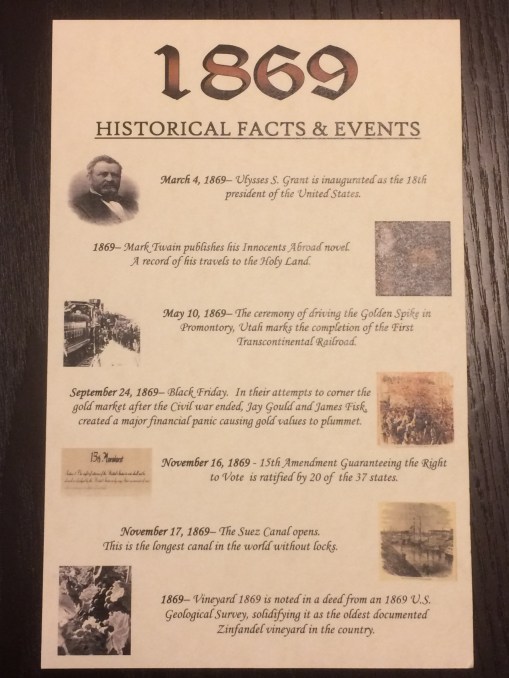
As an added bonus, Scott Harvey Wines compiled a “This Year in History” handout to highlight some other historical events that occurred in 1869. Did you know the Suez Canal opened the same year that the Original Grandpère Vineyard was recorded? Neither did I!
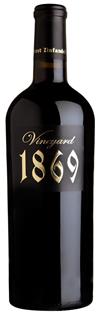
Given that Scott Harvey was in the middle of the multiple lawsuits surrounding the Grandpère name, he has abandoned the name entirely, and has dubbed his wines “Vineyard 1869.”
Scott Harvey Vineyard 1869 Zinfandel 2011 ($55 retail)
Bright ruby color. Aromas and flavors of raspberry, bing cherry, blackberry, and spice. Soft tannins with smooth acid, and a long finish with red fruit, spice, and black pepper.
Scott Harvey Vineyard 1869 Zinfandel 2012 ($55 retail)
Bended with 6% Barbera. Ruby color. Bing cherry, raspberry, and stewed strawberry. Medium acidity and light, soft tannins. Long finish with red fruit flavors.
Scott Harvey Vineyard 1869 Zinfandel 2013 ($50 retail)
Bright ruby color. Flavors of raspberry, cherry, and white pepper. Bright, lively acidity with medium tannins. Long finish with red fruit and black pepper.
Scott Harvey Vineyard 1869 Zinfandel 2014 ($48 retail)
Brick red color. Blackberry and black pepper on the nose. Flavors of raspberry, blackberry, and baking spice. Lively acidity with medium tannins. Long finish of red fruit and spice.
This was a fun, educational event, exploring the history and evolution of winemaking in the Sierra Foothills. The event weekend starts on Friday and includes a Prix-Fixe dinner with wine pairings, and a walking tour of the Original Grandpère Vineyard on Saturday afternoon. I was only able to attend the Small Plates and Vertical Tasting on Sunday, but I hope to go again next year to participate more fully. This is an annual event, so if you are in Northern California in January, look into getting tickets and enjoy a taste of California winemaking history.
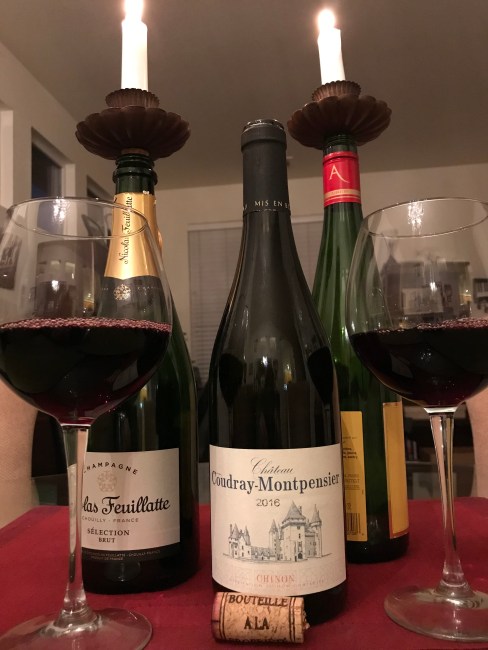
Well, we’ll admit that as we write this, it’s sunny and 72 degrees at our home in Northern California. Spring is definitely upon us here. However, other parts of the country as still in the harsh grip of winter. Besides, it was a couple of weeks ago when we opened and enjoyed this sample; on a cold, rainy, winter’s night. Plus, readers in the Southern Hemisphere are headed into winter, and will be needing some Warm Reds for their Cold Nights, soon.
For the third in our four part series of Warm Reds for Cold Nights, we travel to France. When most people think of big red wines from France, they think Bordeaux, Burgundy, or the Rhone. Yet in our ongoing quest for the lesser-known, our travels today take us to the Loire Valley, specifically to the communes that make up the region of Chinon.
The red wines of Chinon are crafted from Cabernet Franc grapes. Many of you may know Cabernet Franc as one of the two parents of Cabernet Sauvignon. (The other half of the greatest marriage in viticulture is Sauvignon Blanc.) Used as a blending grape in Bordeaux and other regions, Cabernet Franc stands, and shines, on its own in Chinon wines.
The following wine was provided as a media sample for review. All reviews, descriptions, and opinions are our own. We received no additional compensation.
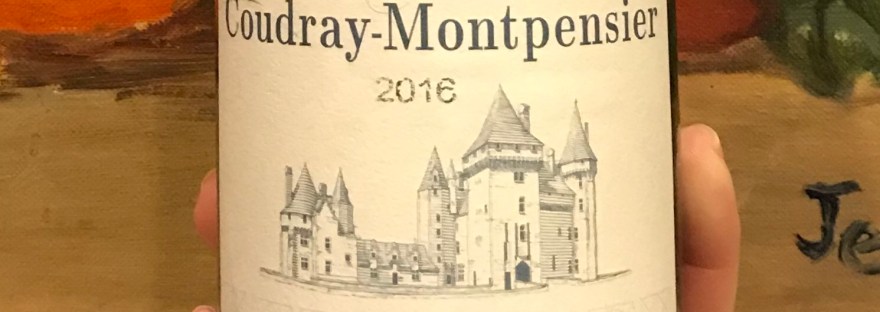
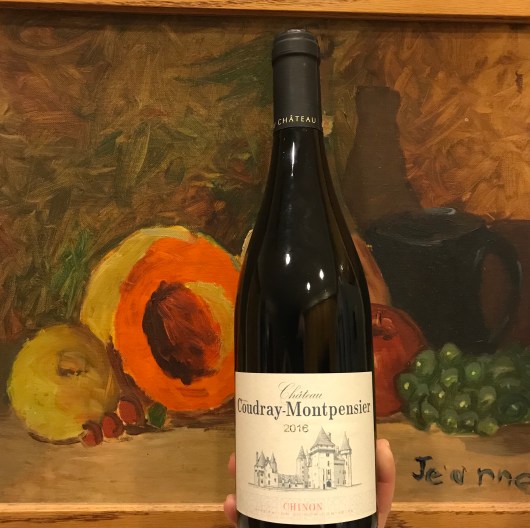
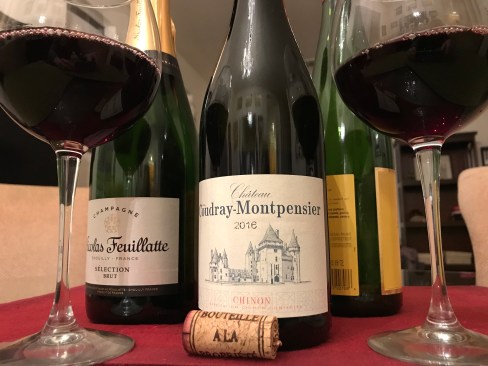
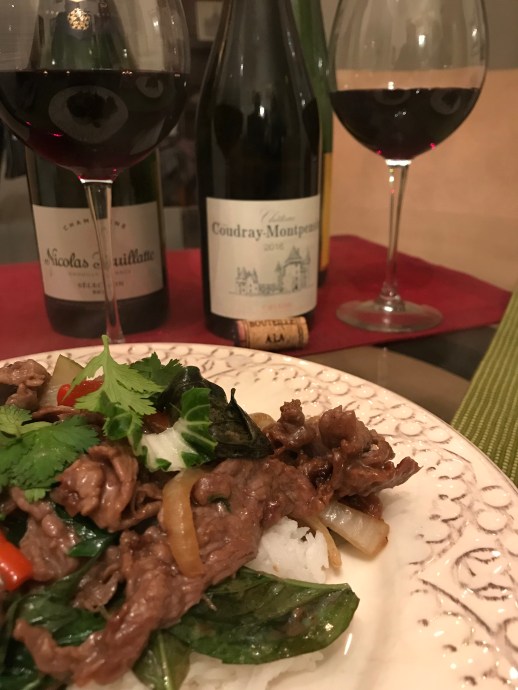
Chateau Courday-Montpensier dates back to 1090 AD, though the current castle on the site was built in the 14th century. There are 30 hectares of vineyards at the chateau, all planted to Cabernet Franc. The Chateau du Courday-Montpensier Chinon Rouge 2016 is 100% Cabernet Franc, that spent between 6 and 12 months in barrel before bottling. It is a classic representation of Chinon, quite delicious and food friendly.
Rather than going with a more traditional food pairing with this Cabernet Franc, we opted for more of a Franco-Asian fusion menu: homemade Thai Basil Beef. The pairing was exceptional, with the exotic, savory beef complementing the rich, hearty wine, and vice-versa.
Inky purple color. Aromas of ripe blackberry, raspberry, and black cherry. On the palate, fruit forward with blackberry, blueberry, raspberry, and cherry, with secondary notes of licorice, black pepper, and vanilla. Tannins are big and chewy, but melt away with food. Brisk acidity livens the senses and further enhances the food pairing. Excellent this winter’s evening with Thai Basil Beef. Definitely warming and satisfying. Wine Searcher average price: $16.00.
Even if spring has sprung in your neighborhood, don’t overlook the opportunity to enjoy a big, warming red wine with your BBQ or other hearty meal. Until next time…
While some parts of the country are starting to see signs of spring, other regions are still being pummeled by harsh winter storms. Yes, some of the trees and bushes in our neighborhood have buds and blooms, but there is another major winter storm bearing down on Northern California as we write this.
The following wine was provided as a media sample for review. All reviews, descriptions, and opinions are our own. We received no additional compensation.
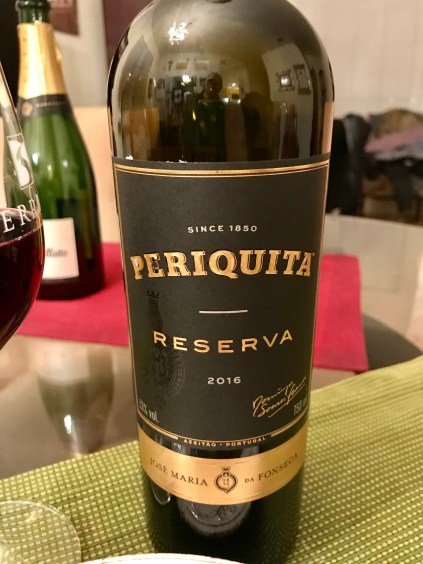
For the second installment of our four-part mini-series, we journey to Portugal. Portugal and her wines are trending strongly of late, and for good reason. Portugal is the sunniest country in Europe, and features amazing wine, food, and culture, miles of coastline, and warm, welcoming people. With more than 200 indigenous grapes, there is a wide variety of outstanding wine available at attractive prices. So we were quite pleased when we received a sample of José Maria da Fonseca Periquita Reserva 2016 for tasting and review.
José Maria da Fonseca has a family history spanning nearly two centuries. Since 1834, the family has been carrying on the passion and commitment of the founder, as the oldest producer of table wine in Portugal. Not a family to rest on their laurels, the José Maria da Fonseca family invests in research and the latest technology in winemaking. Yet with all the advances, the passion of crafting fine wine shines through in the wine.
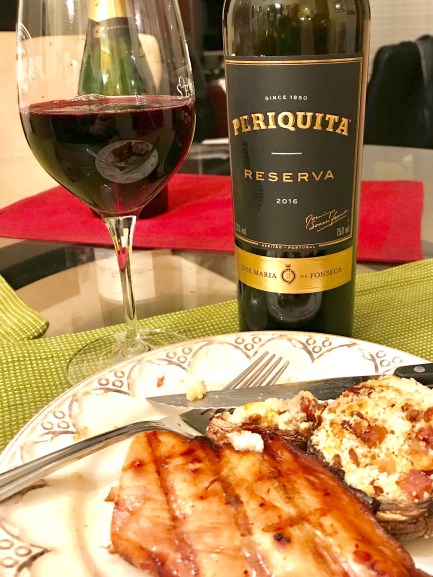
An alluring blend of 56% Castelao, 22% Touriga Nacional, 22% Touriga Francesca, the José Maria da Fonseca Periquita Periquita 2016 is aged for 8 months in French and American oak. We opened it to pair with grilled chicken, marinated in a locally produced Basque-style marinade and gorgonzola & bacon stuffed portobella mushrooms. Yes, grilled. As in, outdoors. It’s never too cold or too stormy for grilling at the Appetite for Wine house!
Deep ruby color. On the nose there are aromas of raspberry, cherry, cedar, and earth. On the palate, complex and integrated flavors of blackberry, black cherry, cranberry, and red currant, with oak and cedar notes. Full bodied with a luscious, round mouthfeel and brisk acidity. Long, lingering finish of red fruit and white pepper. Paired with our grilled, marinated chicken and mushrooms, it was exquisite! Vivino average price: $15.99.
We are quite happy to have these warm reds to help us through these cold nights. Chapter three will be posted soon. In the meantime, check out José Maria da Fonseca, and let us know what you think.
I’m very excited and honored to announce that the good people at Wine Tourism in Portugal asked me to write a guest post. I’m now officially published on a professional wine website! Please check out the article and let me know, in the comments, what you think.
Special thanks to John & Irene Ingersol of Topochines Vino, Kristy Harris of CaveGrrl and husband Andy, and good friend Edward Decker, for their input and first-hand experiences for this project.
While the East Coast is being blasted by yet another major winter storm, and the Pacific Northwest is experiencing record snowfall, here in Northern California, it’s, well, pouring rain. But I mean really pouring! We’re expecting 3-6 inches of rain in the next 48 hours. The winds are also howling, up to 40 mph. And it’s cold…by NorCal standards. Overnight lows in the 30’s, and highs only in the 50’s. Brrr. By NorCal standards.
So in light of winter’s harsh punch to the Northern Hemisphere, what better way to stay warm than to enjoy some big, bold, warming red wines on these cold winter nights? This is the first of a four-part mini-series, featuring reds from around the world that were provided as media samples.
The following wine was provided as a media sample for review. All reviews, descriptions, and opinions are our own. We received no additional compensation.
What better place to start this journey than South America? Afterall, there, it’s summer! From the Maule Valley in Chile, comes the Erasmo Barbera-Grenache 2016, a unique and delicious blend of 60% Barbera, 30% Grenache, and 10% Carignan. Using all organic grapes and wild yeast for fermentation, this wine captures the essence of the Maule Valley terroir.
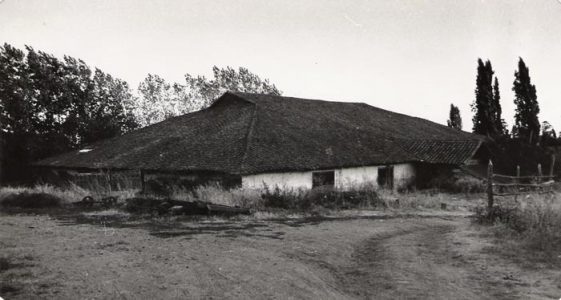
The original cellar at what is now Erasmo winery was built at the end of the 19th century. The mud-wall construction provided excellent insulation for maintaining a proper wine cellar temperature. In 2005, after years of neglect and inactivity, Count Francesco Marone Cinzano set out to restore this historic building. Now complete, and filled with modern winemaking equipment, “La Reserva de Caliboro” lives on, and is the home to high quality, organic wines.
Before…and After. Photo Credit Erasmo Organic Vineyard and Winery http://erasmo.bio/en/
On one particularly cold and stormy night, we paired this delightful, warming wine with a seared Garlic-Butter Brazilian Skirt Steak and Garden Salad. (You can’t forego your greens just because it’s cold out!) What an amazing pairing! Sheer perfection!
Deep purple color with brick rim. Aromas of ripe raspberry, blackberry, and clove. On the palate, there are flavors of blackberry, blueberry, cherry, and cranberry, with baking spice, cedar, and vanilla notes. Tannins are firm but balanced, with lively acidity and a long finish of black and red fruit and white pepper.
Vivino Average Price: $22.99
Stay tuned for the next in this Warming Reds for Cold Nights series. In the meantime, tell us, in the comments below, what you are enjoying to stay warm during these cold winter nights.
Cheers!
By Kent Reynolds and Robyn Raphael
Photo Credit, unless otherwise noted, Kent Reynolds
What do a Norwegian ship owner, a verdant Chilean valley, and sustainable farming have in common?
Wine!
What did you think we were going to say? This is a wine blog, afterall.
More than 25 years ago, Norwegian Armador (that’s “ship owner” in case you were wondering) Dan Odfjell discovered the Maipo Valley in Chile. Well, not discovered in the Viking explorer sense; he found it for himself. Dan fell in love with this little corner of the planet, far from home both in distance and climate. He settled in the valley, and began pursuing his passion for wine.
Today, sons Laurence and Dan Jr. are at the helm, managing 284 acres of 100% certified organic and biodynamic vineyards in the heart of the Chilean wine country. They carry on the family mission of producing unique quality wines in a sustainable way.
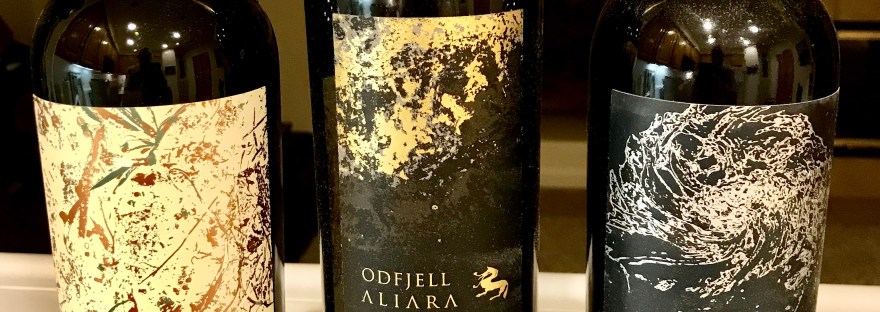
Recently, we were given the opportunity to experience their craft. Odfjell Premium Organic Wines are offered in three different tiers, with labels representing Land, Water, and Fire. We were fortunate to receive samples of each.
The following wines were provided as a media samples for review. All reviews, descriptions, and opinions are our own. We received no additional compensation.
I really don’t know what happened to our photos. Sorry, but it’s your loss. The marinated flat iron steak was delicious with this Cabernet!
2016 Odfjell Armador Cabernet Sauvignon (SRP $15)
From the website: In the bygone days of sailing ships, wine was the drink of choice on long voyages. Today Dan Odfjell, a Norwegian shipowner, perpetuates his legacy by making wines to sail from Chile across the seven seas.
Winemaker’s Tasting Notes: Ruby-red in color with a hint of violet. Red-fruit aromas recall strawberries and plums, along with notes of licorice and anise. Perfectly balanced on the palate with ripe tannins and a long, refreshing nish.
Here’s what we thought:
Inky purple color in the glass. Aromas of blackberry, bramble, and cassis. On the palate, there are flavors of ripe blackberry, raspberry, bramble, black currant, and cherry, with oak, cedar, tobacco, and black pepper, with earthy notes mid-palate. Tannins are firm and chewy, balanced with bright acidity. Full bodied with a long, spicy finish of black fruit, earth, and smoke. Outstanding paired with balsamic marinated flat iron steak.
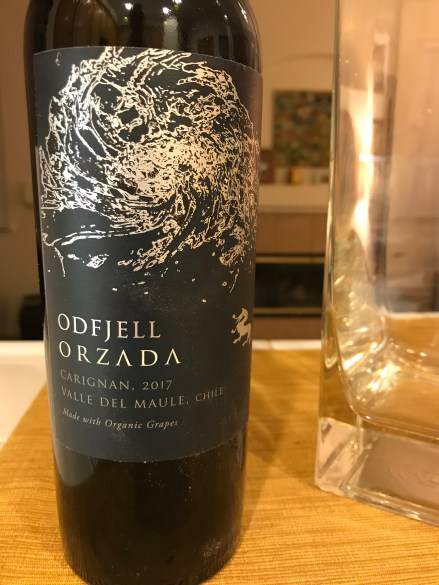
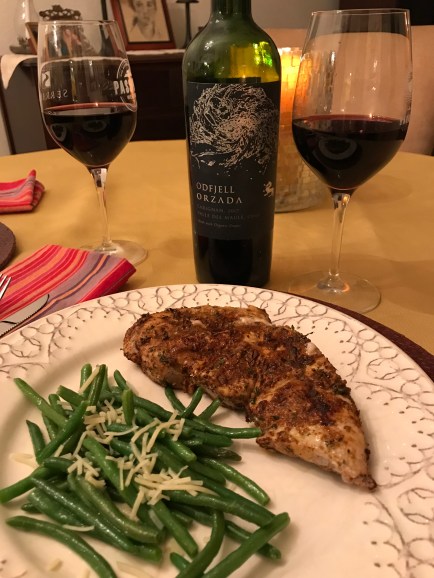
2017 Odfjell Orzada Carignan (SRP $23)
From the website: When the Norwegian shipowner Dan Odfjell founded our winery, he embarked upon adventure filled with challenge and promise. Orzada is a nautical term for sailing up against the wind before setting a direction. Our Orzada wines reflect our staking a course in pursuit of a beautiful and memorable wine.
Winemaker’s Tasting Notes: Dark red in color. Intense and complex on the nose, with spices and ripe red fruits such as cherries, raspberries, and plums mixed with aromas of blackberries and anise. The palate is juicy and powerful with velvety-soft tannins and a long finish.
Now we’re talking!
Here’s what we thought:
Deep purple color with a brick rim. Aromas of fresh-picked cherry, oak wood, and spice. On the palate there are flavors of raspberry, boysenberry, tart cherry, licorice, cedar, and black pepper. Soft tannins, medium body, and bright, lively acidity. The finish is long, with red and black fruit, oak, and spice. We paired this with grilled, chili-rubbed pork chops and it really complemented the meal nicely.
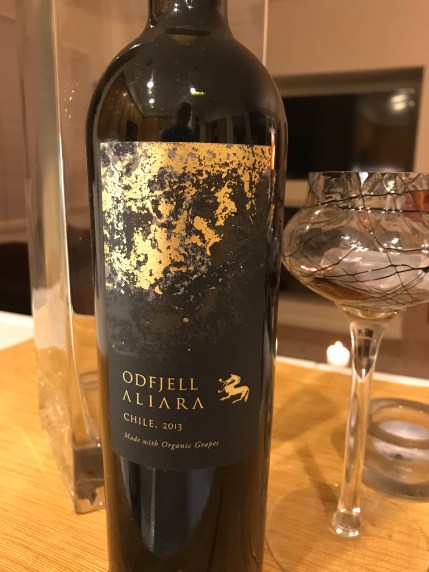
2013 Odfjell Aliara (SRP $44)
From the website: In the age of sail ships, safe and healthy provisions were crucial for the success of the adventure. A “liara” was a tin cup measurement for the crew´s daily ration of wine. Our Aliara is an assemblage made in small and precios quantitites as a tribute to this tradition.
Winemaker’s Tasting Notes: Concentrated deep violet in color. The nose is attractive and intense with a range of aromas from the different varieties in the blend, including nuts such as hazelnuts, dates, and dried figs, as well as floral notes recalling jasmine and roses. The palate is sophisticated, intense, and juicy and complemented by chocolate, coffee, and tobacco leaves. The finish is long with ripe and velvety tannins. An unforgettable experience.
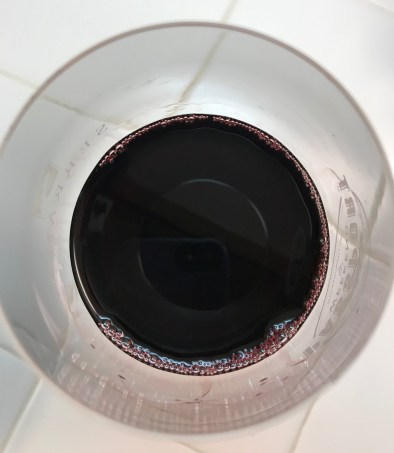
That’s some dark, inky wine.
Here’s what we thought:
A blend of 65% Carignan, 20% Syrah, and 5% Malbec. Deep, inky purple color. Aromas of blackberry bramble and plum. On the palate, flavors of blackberry, cherry, blueberry, and plum, with white pepper and cedar. Tannins are big and chewy. Medium acidity. Long finish of black fruit and black pepper. Outstanding with spice-rubbed grilled steak tacos.
The Odfjell is doing some remarkable things with organic, biodynamic wines in Chile. If you get the opportunity to try these wines, don’t let it pass you by!










 Appetite for Wine