Our appreciation for Russian River Valley wines has been on the rise lately. We’ve been exploring and drinking more wines from this region, and have been quite impressed with the quality and the distinct character of the wines, winemakers, and winery owners. So naturally, when we were offered samples of two bottles from Ron Rubin Winery, in the Russian River Valley, we gladly accepted.
The following wines were provided as media samples for review. All reviews, descriptions, and opinions are our own. We received no additional compensation.
The story of Ron Rubin Winery came to life in 2011, when Ron purchased a winery in the Green Valley neighborhood of the Russian River Valley. Ron got his start in the beverage industry at a young age, when as a child he would spend time in the warehouse of his family’s wholesale liquor company in Illinois. In 1971, Ron traveled to California to attend U.C. Davis to study viticulture and oenology. From this experience, and the exposure to the then-fledgling wine industry in California, Ron started to add California wines to the family portfolio. All this paved the way to his dream come true with the purchase of the Russian River Valley winery.
After purchasing the winery, Ron renovated the facility and employed the ancient principles of Fung Shui. He converted the estate vineyards to sustainable farming practices. The winery is now SIP-certified and Certified Sustainable by the California Sustainable Winegrowing Alliance. The estate is planted to 6.5 acres of Pinot Noir and 2.5 acres of Chardonnay. Certainly not enough for Ron Rubin’s dream, so he also sources grapes from five other growers in the neighborhood.
Ron Rubin calls himself a “beverage guy” and his experience proves this. Beyond wine and spirits, Ron has also distributed sparkling water and tea. In fact, he owns the Republic of Tea brand, which his son manages. His desire in winemaking is to produce affordable, high quality wines so people can enjoy “beautiful experiences.” He has a reputation of being unpretentious and welcoming, and has no interest in making high priced, exclusive wines. He wants people to be able to enjoy his wines for any occasion.
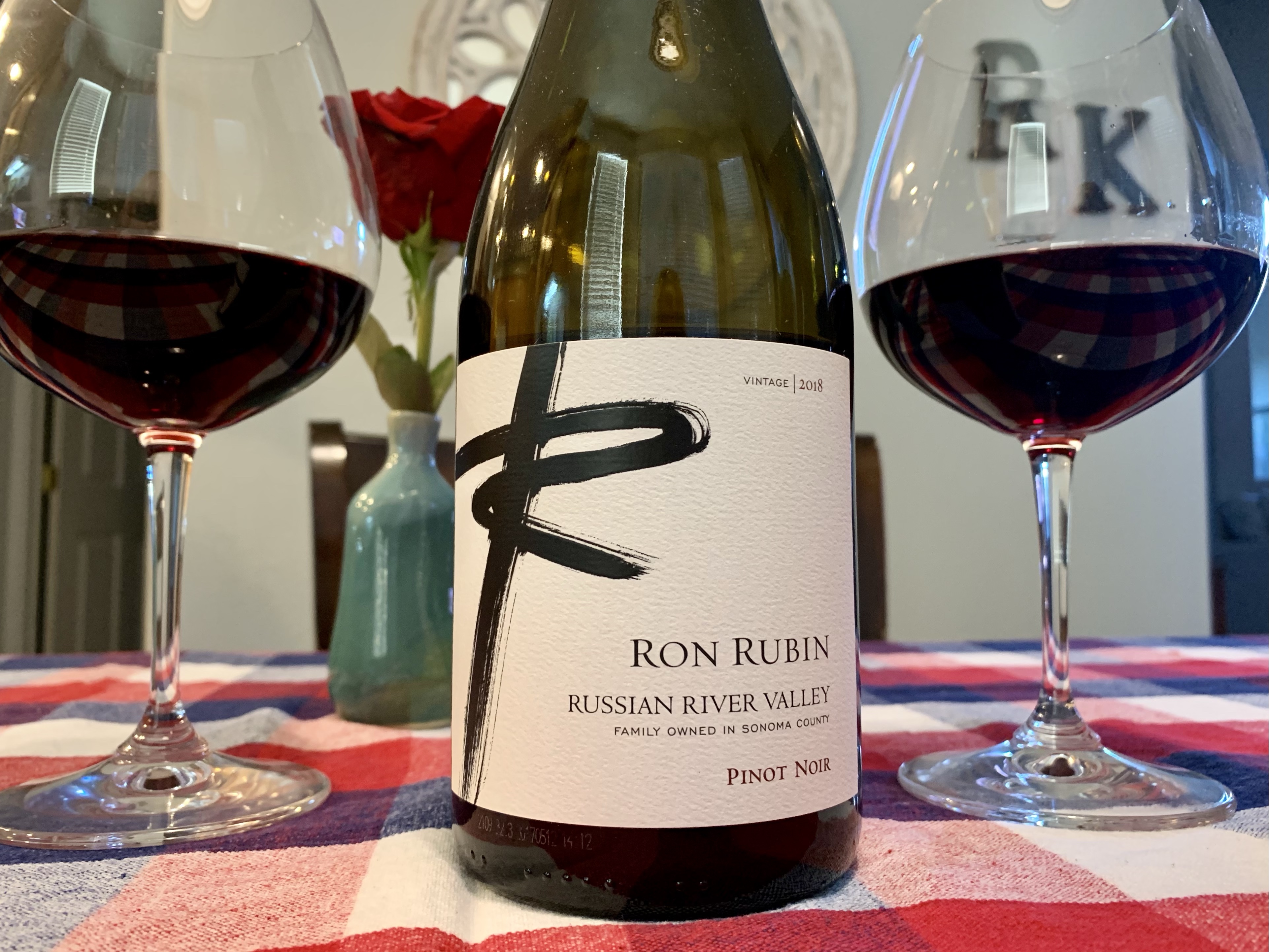
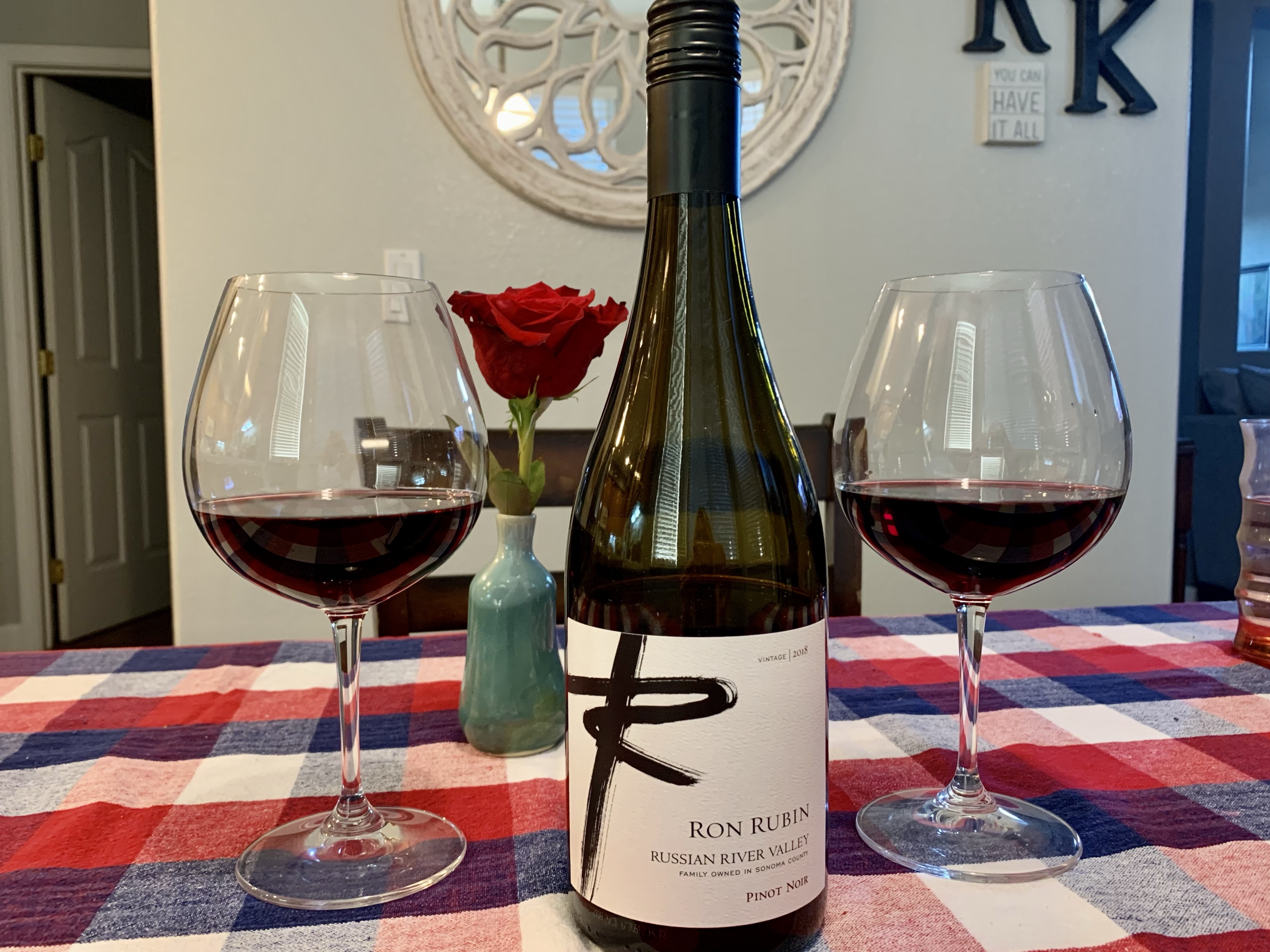
The wines we received were Pam’s UN-Oaked California Chardonnay 2020, and the Russian River Valley Pinot Noir 2018. Pam is Ron Rubin’s wife and first love. Like us, Pam has always preferred her Chardonnay to be unoaked, so he made it that way for her. We approve.
Ron Rubin Winery Pam’s Unoaked Chardonnay 2020
Golden straw color. The nose is floral and pear/apple notes. On the palate, yellow apple, pear, and elderflower. Medium body with a creamy mouthfeel and medium-minus acidity. Just a hint of sweetness on the finish. Very easy drinking, a great summer sip, with a fresh finish. (SRP: $14.00)
Ron Rubin Winery Russian River Valley Pinot Noir 2018
Brick red with an amber rim. The nose displays ripe red fruit and smoke. On the palate, black cherry, plum, raspberry, and some stewed plum notes, followed by tobacco smoke, cedar, and baking spice. Medium-minus body, soft tannins, bright acidity, and a long finish of red fruit, vanilla, and spice. A nice, budget-friendly Russian River Valley Pinot Noir. (SRP: $25.00)
Ron Rubin Winery wines are available directly from the Ron Rubin Winery website. In addition to the Ron Rubin Winery line, the winery also produces the River Road line of wines, available at Total Wine & More stores. Be sure to give them a try!
We head back to Spain this week for our Wine of the Week. This time we are exploring Ribera del Duero. Though red wines from Ribera del Duero feature the same Tempranillo grape as the arguably more famous Rioja region, there are subtle differences between the wines from the two regions. Ribera del Duero is at a higher elevation, cooler climate, and receives less rainfall than Rioja. As a result, the grapes tend to be smaller, with thicker skins and a more concentrated flavor. With less stringent rules on aging, Ribera del Duero wines can be fresher and lighter, and less acidic, with bright fruit flavors.
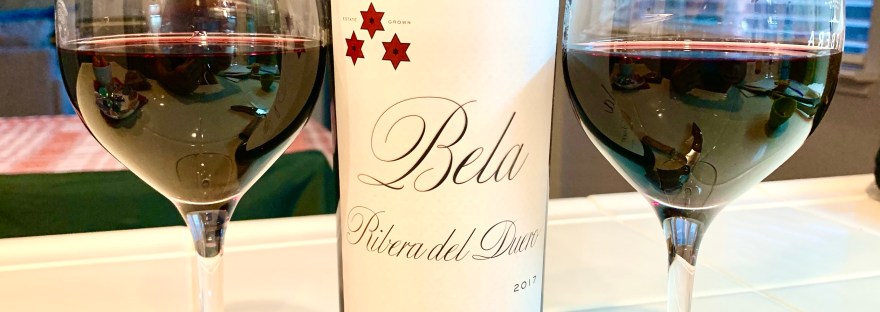
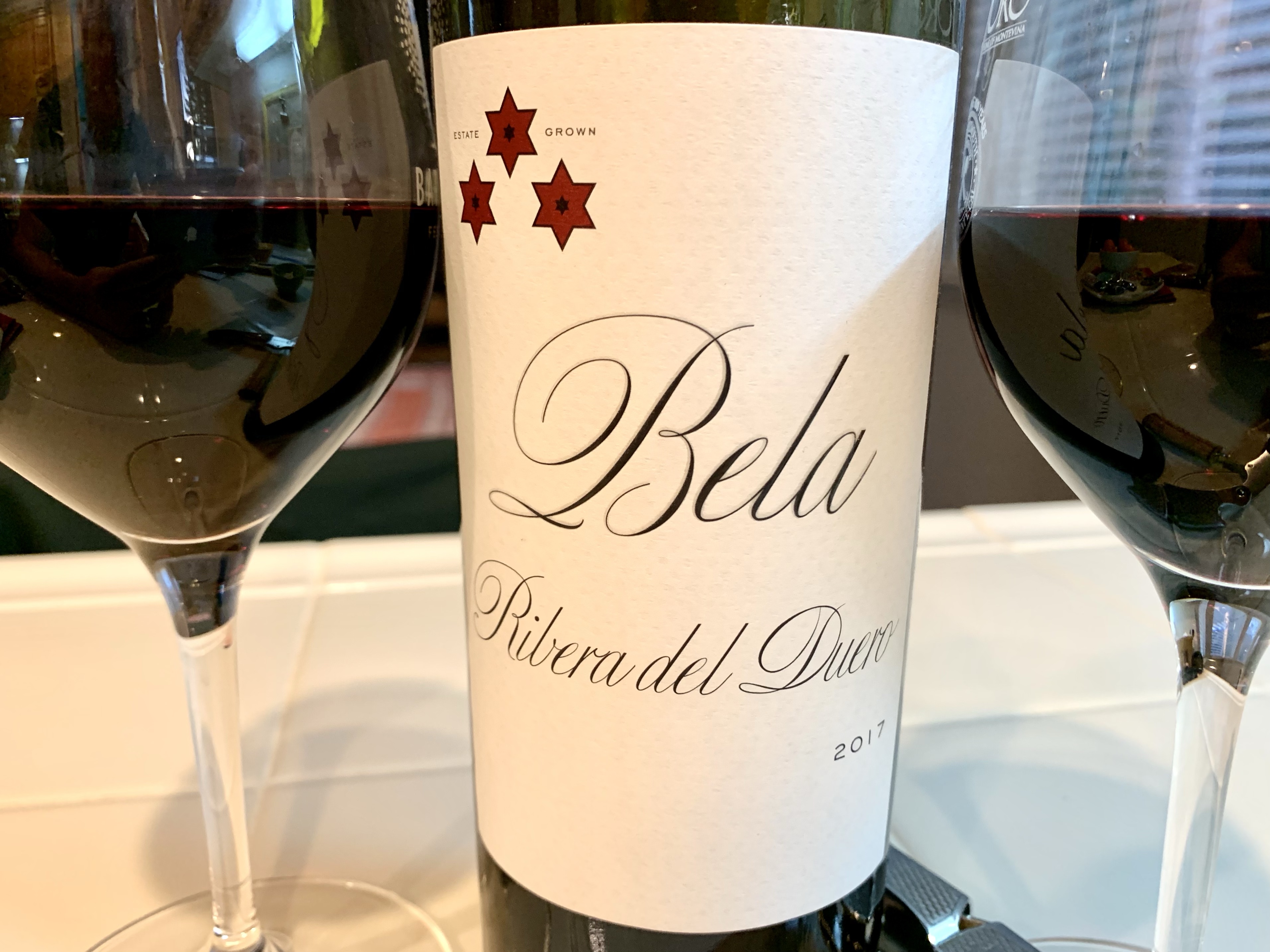
In our previous Wine of the Week from Spain, we reviewed Asúa Rioja Crianza 2016, part of the CVNE family of wines in Rioja. This week’s wine is a CVNE offspring, from Bela wines. Bela strives to emulate CVNE’s commitment to quality in Ribera del Duero. The official spec sheet explains the three stars on the Bela label represent the three children of CVNE’s founder, Sofia, Áurea, and Ramón. Sofia was known as Bela.
In the United States, Bela Ribera del Duero is distributed by Arano USA. Their website shares a few historical details about Bela. The winery was built in 1999, and the 74 hectare vineyard planted in 2002. The Bela Ribera del Duero 2017 is 100% estate hand harvested Tempranillo. After fermentation, the wine spent six months in new French and American oak barrels, followed by one year in neutral oak. The care and attention to detail in the wine making process shows clearly in the resulting wine.
Deep garnet color. Aromas of blackberry, boysenberry, vanilla, and baking spice. On the palate, blackberry, blueberry, cassis, plum, vanilla, and black pepper. Medium body with smooth tannins and fresh acidity. Soft and delicious, great with flank steak.
Next time you’re looking for a quality Spanish Tempranillo, give Ribera del Duero a try. The Bela Ribera del Duero 2017 is a shining example of what this region can produce.
In 1990, winemaker Jean Bousquet went on vacation to Argentina. A third-generation winemaker from Carcassonne, in southern France, Bousquet immediately fell in love with the Gualtallary Valley, in Mendoza. Though no vineyards existed there at the time, he recognized the winemaking potential in the region. The Gualtallary Valley is in the high mountains, with elevations reaching over 5,200 feet, an altitude many thought too high to grow grapes, but Bousquet felt differently. In 1997, he bought land and planted his first vineyard. In 2002, Bousquet’s daughter, Anne, and her husband, Labid Al Ameri, visited the area and saw the vision, as well. They joined Jean in the project, and in 2009 moved to Argentina full time, assuming ownership of the Domaine Bousquet winery in 2011.
We’ve known of Domaine Bousquet for some time, and have enjoyed many of their wines. So when we received an invitation to sample their debut vintage of a Rosé of Pinot Noir, we jumped at the chance.
The following wine was provided as a media sample for review. All reviews, descriptions, and opinions are our own. We received no additional compensation.
Domaine Bousquet is fully organic and sustainable, with 240 hectares (nearly 600 acres) under vine. At 4,000 feet elevation, these are cool climate vineyards, perfect for producing quality, balanced wines.
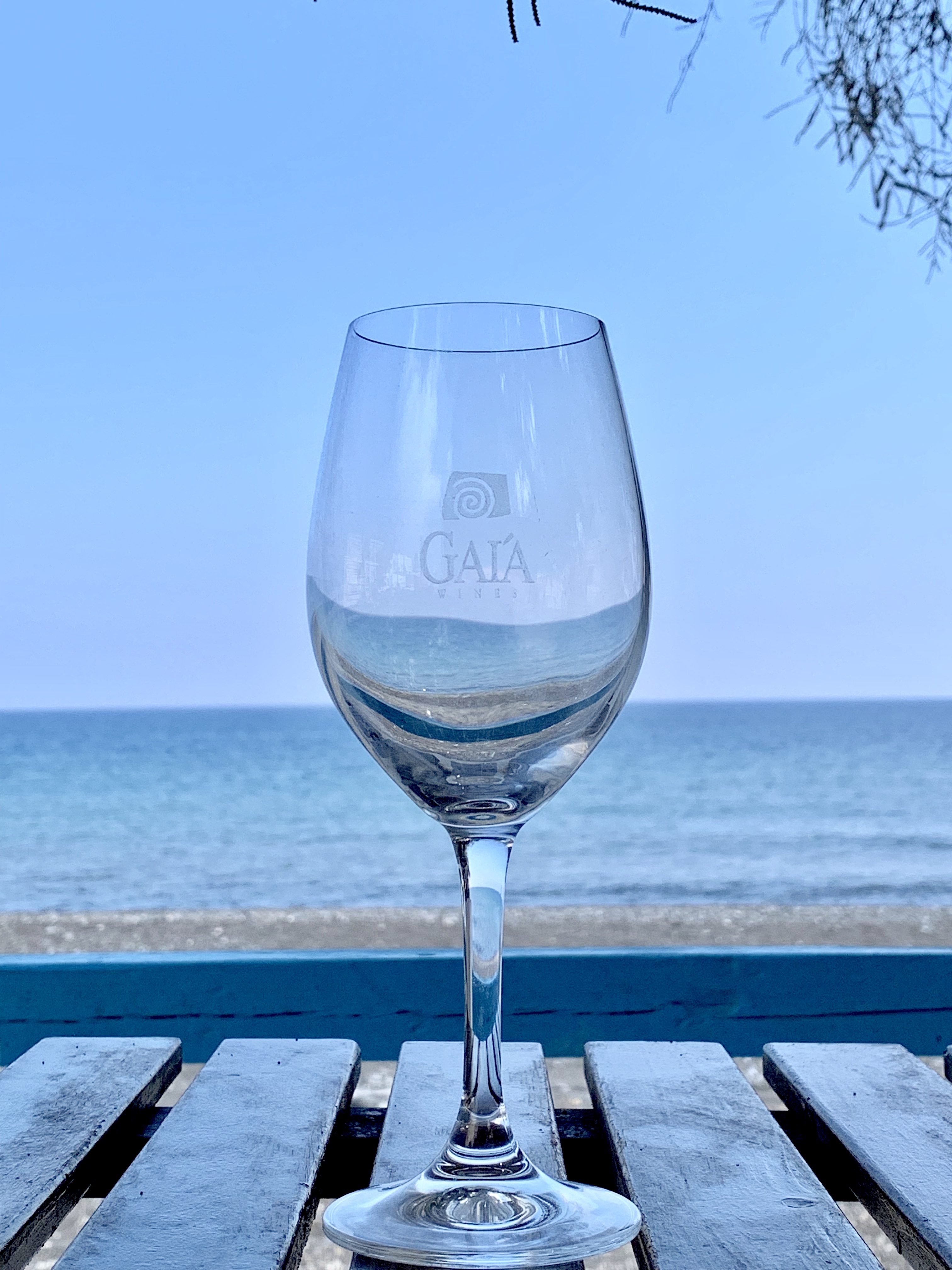
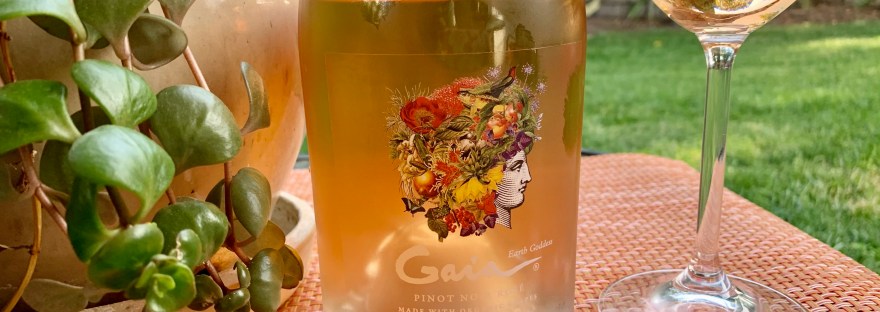
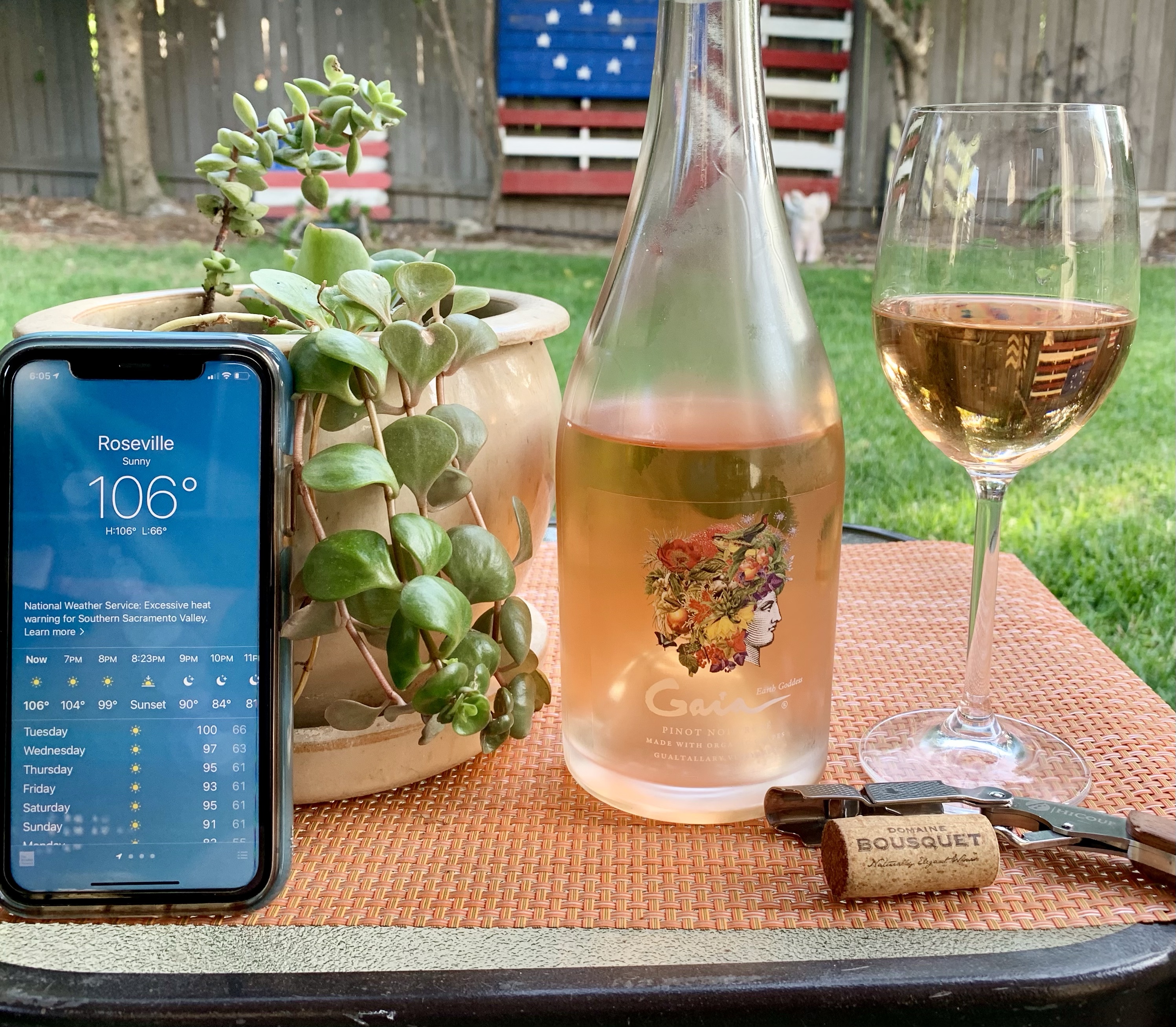
The Gaia line of wines is named for the Greek goddess of Earth, the family inspiration for the Domaine Bousquet. The Rosé of Pinot Noir 2020 is made from 100% estate grown Pinot Noir. The family history, now four generations of winemaking, blends Old World tradition with the New World terroir to produce a stunning and elegant Rosé.
(That’s hot! We were only out there long enough to snap these pics!)
Pale salmon color. On the nose, subdued aromas of peach, nectarine, and watermelon. On the palate, soft tannins and bright acidity and medium body, with flavors of white peach, nectarine, watermelon, strawberry, orange zest, and floral notes. Very refreshing on a hot (106F) afternoon. (SRP $20)
We thoroughly enjoyed the Gaia Rosé of Pinot Noir 2020, and will continue to seek out and enjoy wines from the Domaine Bousquet collection.
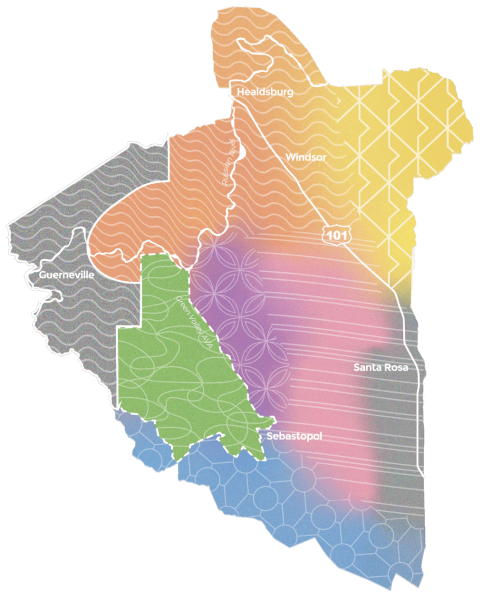
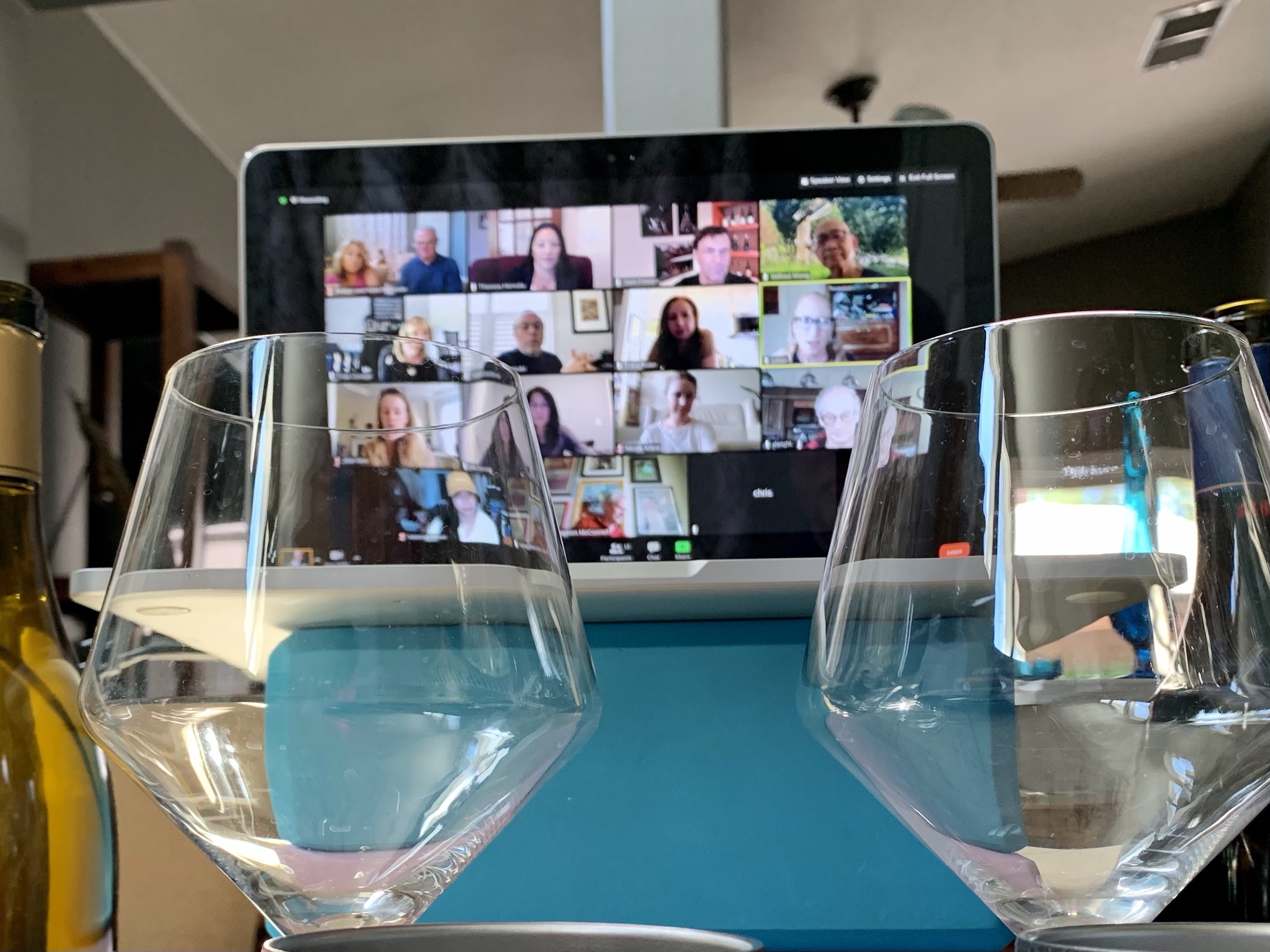
Most wine lovers are familiar with the notion of appellations; designated wine regions identified by geography and legal protection. In the United States, appellations are known as American Viticulture Areas, or AVAs. Within an appellation or AVA, there can be sub-regions that, though perhaps not legally identified, can present climate and growing conditions which contribute to a unique terroir. One notable and well known AVA in Northern California is the Russian River Valley AVA. We recently learned that the Russian River Valley Winegrowers (RRVW) has defined six smaller sub-regions which they call Neighborhoods. How did we come by this newfound knowledge? Well, we were invited to a virtual tasting of single-vineyard wines from Gary Farrell Winery, exploring each of the Russian River Valley Neighborhoods.
The following wines were provided as media samples for review. All reviews, descriptions, and opinions are our own. We received no additional compensation.
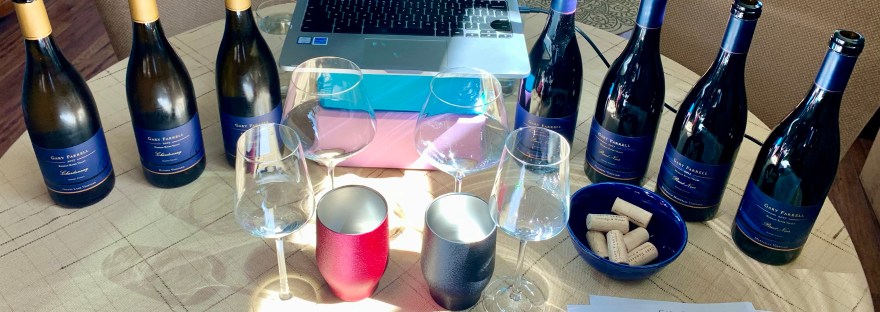
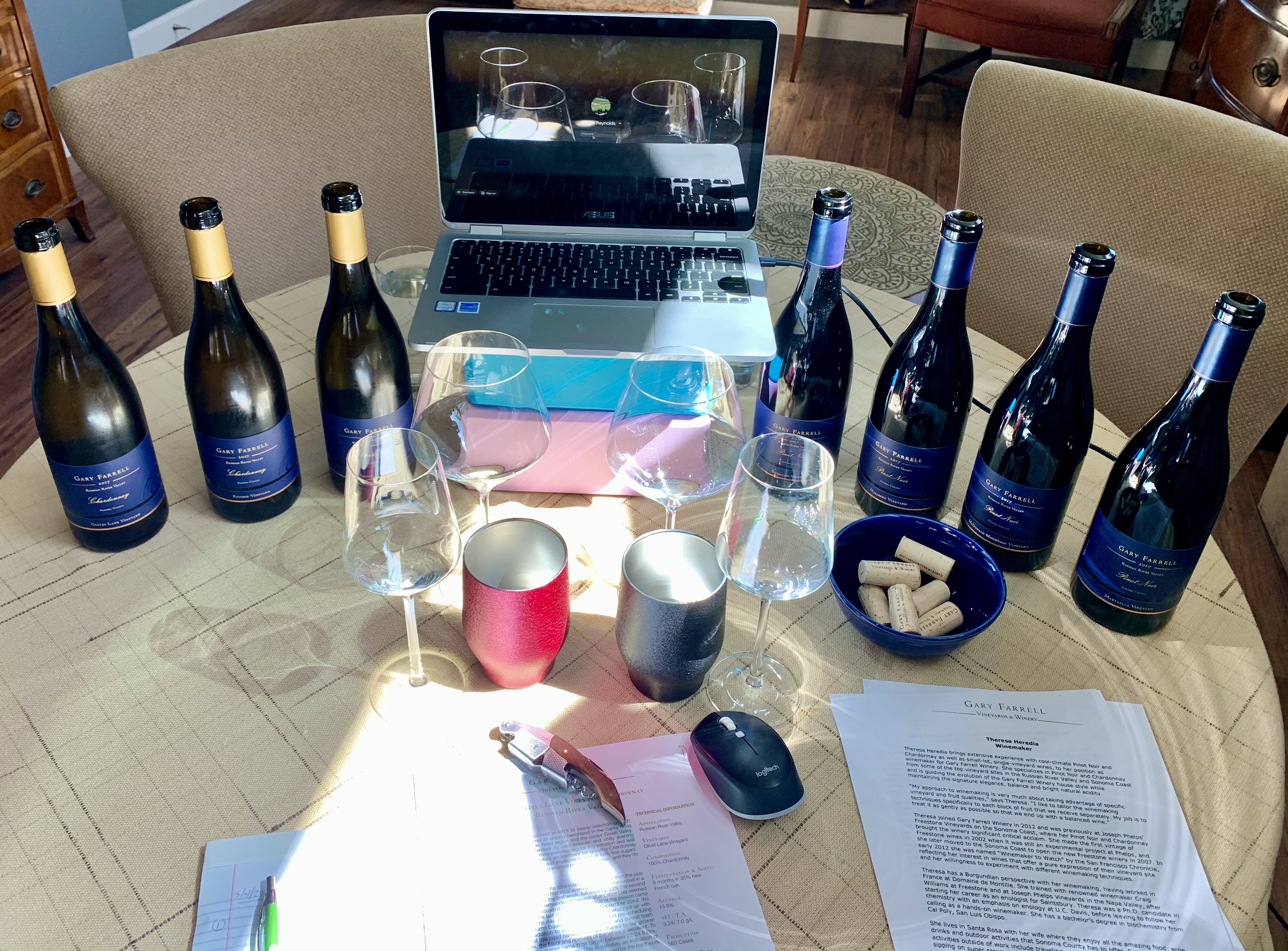
The event featured Gary Farrell Winery winemaker Theresa Heredia, who led us through history, geography lessons, and of course, tasting seven wines from the Gary Farrell Winery portfolio; three Chardonnays and four Pinot Noirs. As Theresa explained, although the wines are from the same respective grapes, grown in the same AVA, each neighborhood produces decidedly different wines with unique characteristics.
Gary Farrell started in the wine business in the late 1970’s, originally working with local wineries. In 1982, he produced the first wine under his eponymous wine label. Since then, Gary Farrell Winery has grown in reputation and prestige and is now one of the most notable small-lot producers of Chardonnay and Pinot Noir in the Russian River Valley. Though Gary Farrell sold the winery in 2004, the current owners are maintaining his legacy and standard of excellence.
Theresa Heredia started with Gary Farrell Winery in 2012. At that time, she brought with her a decade (now nearly two decades) of experience in cool-climate, small-lot Chardonnay and Pinot Noir production. Early in her career, she worked at Domaine de Montille, in Burgundy, France, where she gained an appreciation for the Burdunidan style of winemaking. Friendly and inviting, Theresa was an amazing host for our tasting.
In keeping with the Burgundian style, Theresa said that each of the wines in the tasting are terroir-driven, and aged in light-toast French oak barrels. The use of light toast oak is deliberate, since heavier toasts can mask the nuances of the wine itself. Theresa also mentioned, to our surprise, that the Russian River Valley AVA has more soil types than are found in all of France!
During a brief history lesson, Theresa shared her screen, and showed us the six Russian River Valley Neighborhoods on the RRVW website. This is an interactive site that allows you to explore each of the neighborhoods and see which characteristics define each one. Theresa mentioned that only one neighborhood, Green Valley, is a designated Sub-AVA within the Russian River Valley AVA. There are currently no plans to apply for AVA status for any of the other neighborhoods.
Image credit: Russian River Valley Winegrowers website
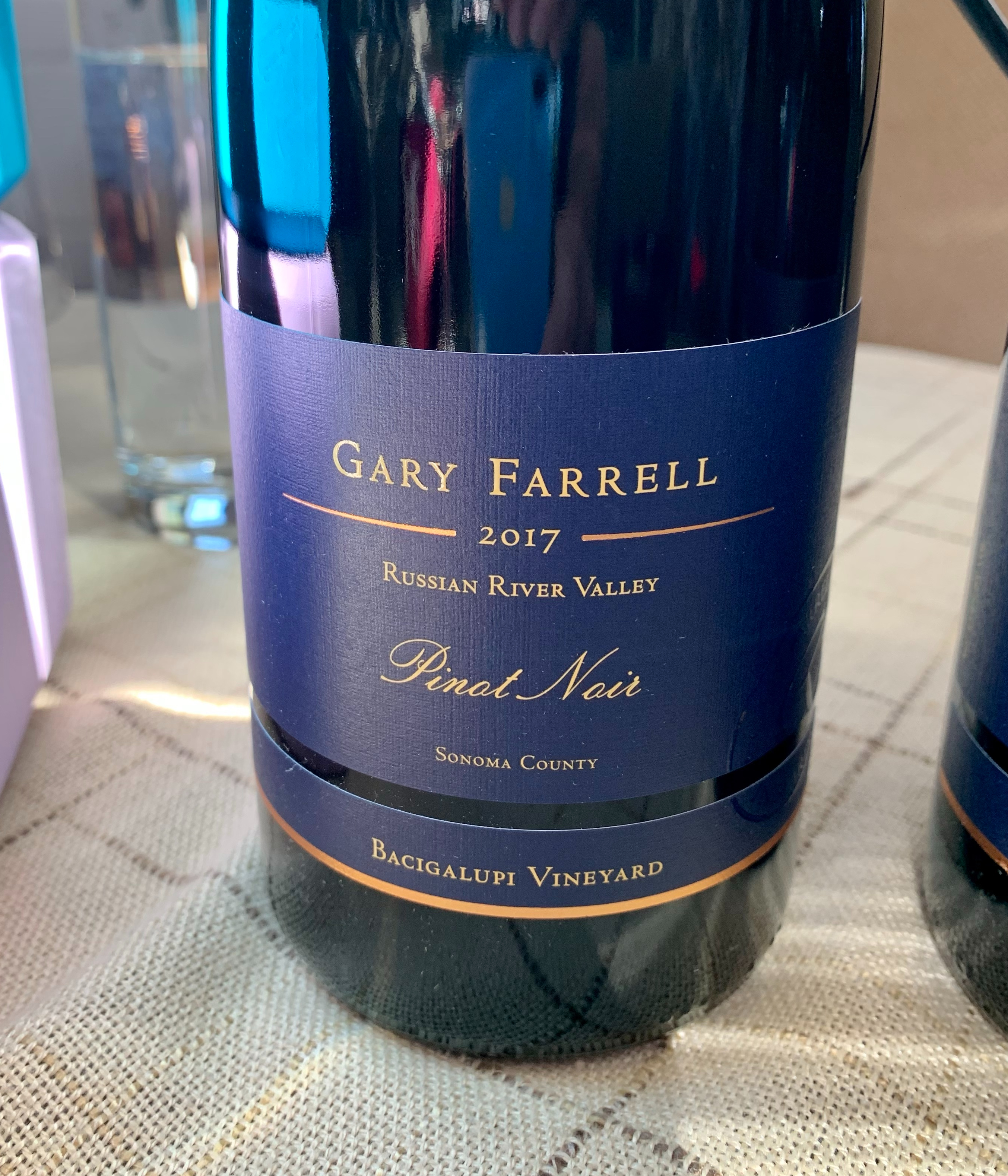
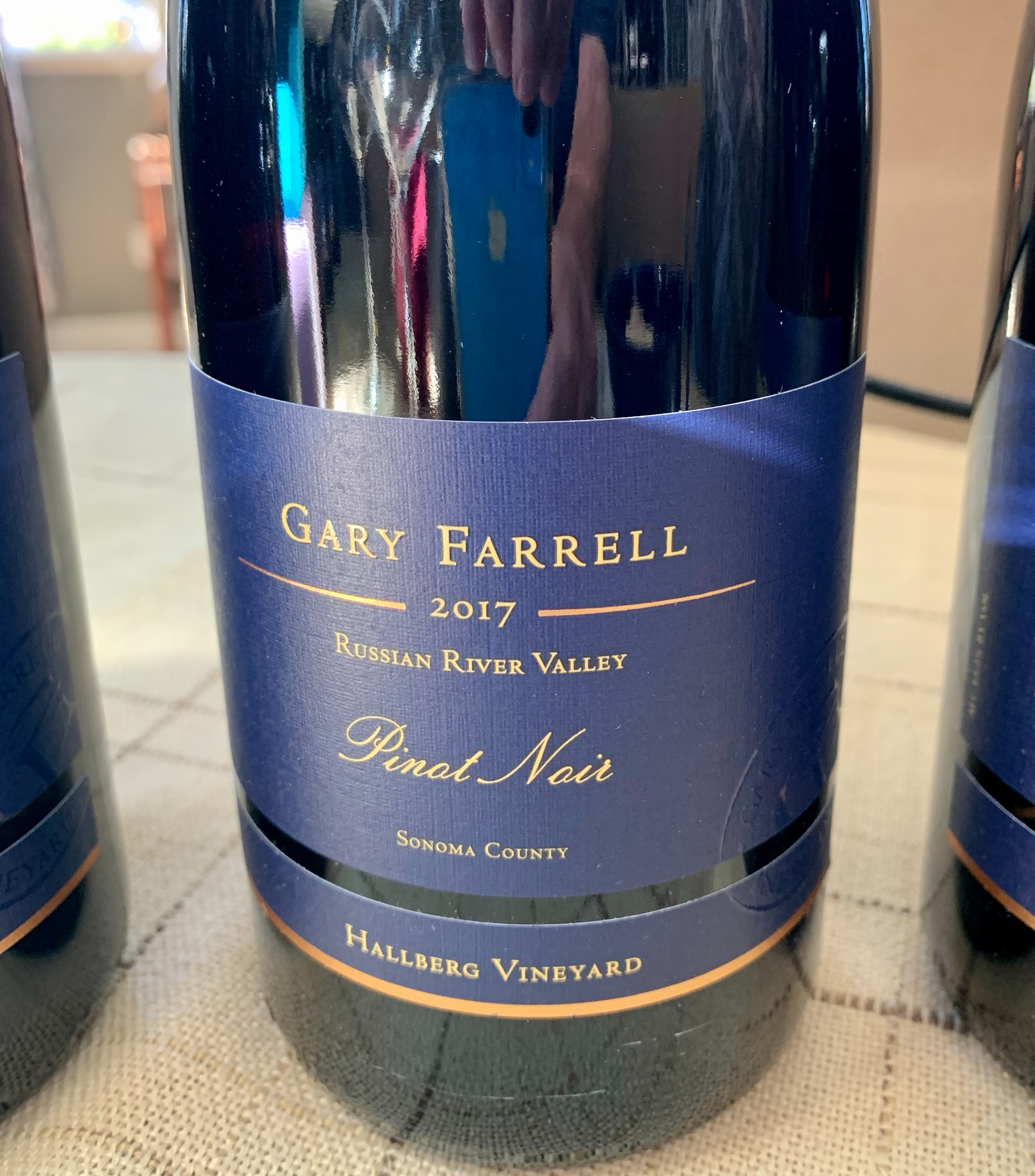
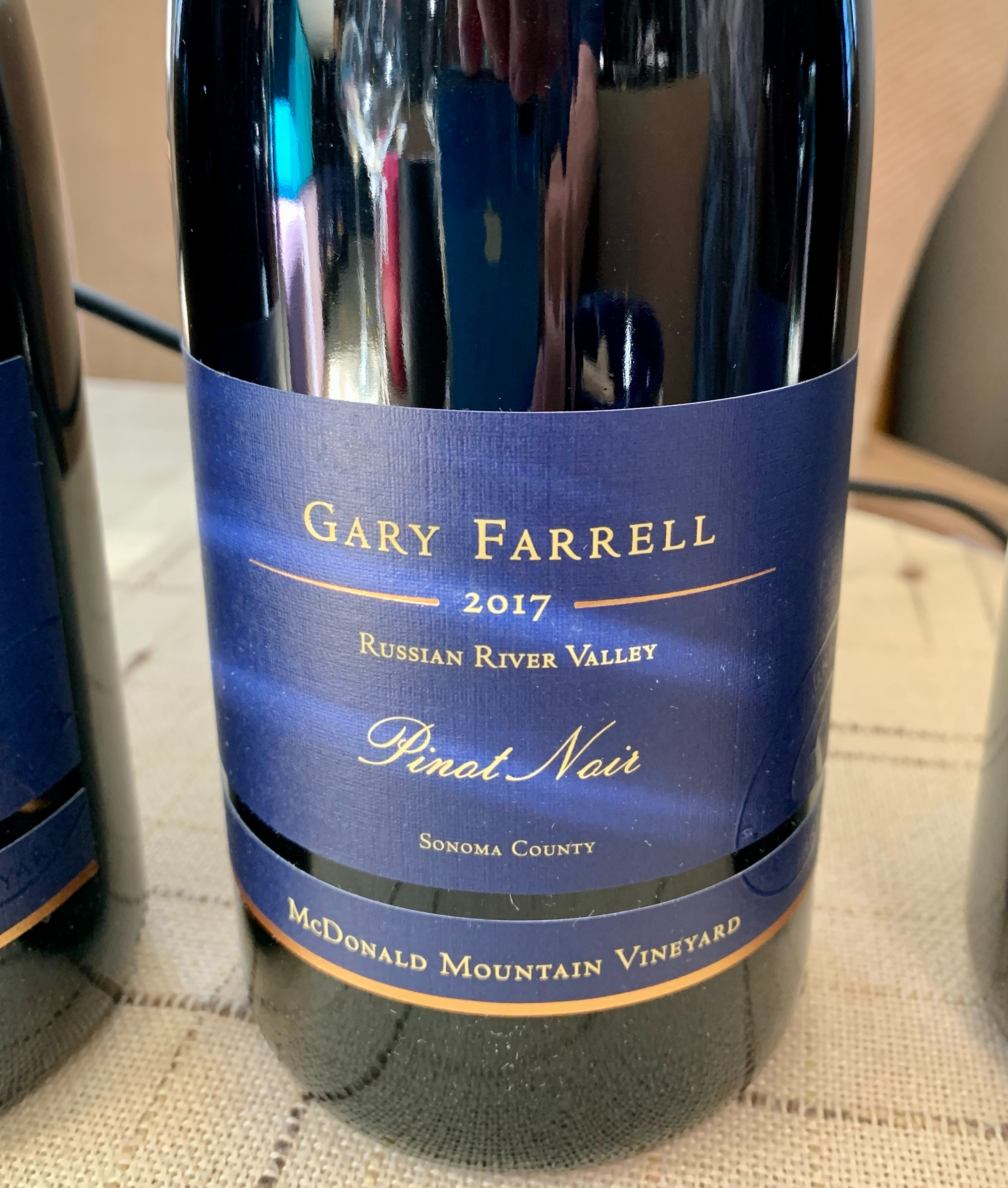
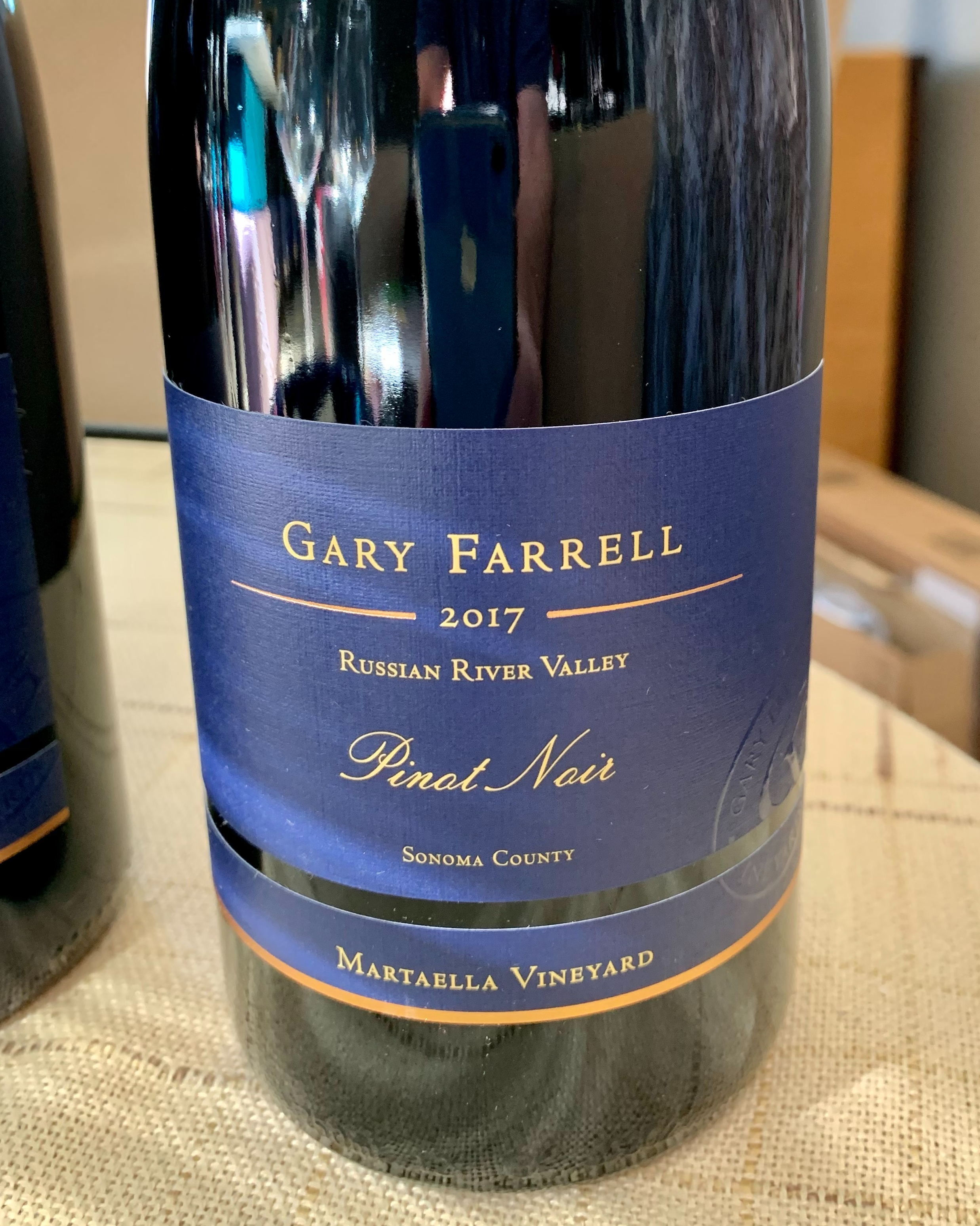
The seven wines we tasted, and the respective neighborhoods from which they hail, were, in order of tasting:
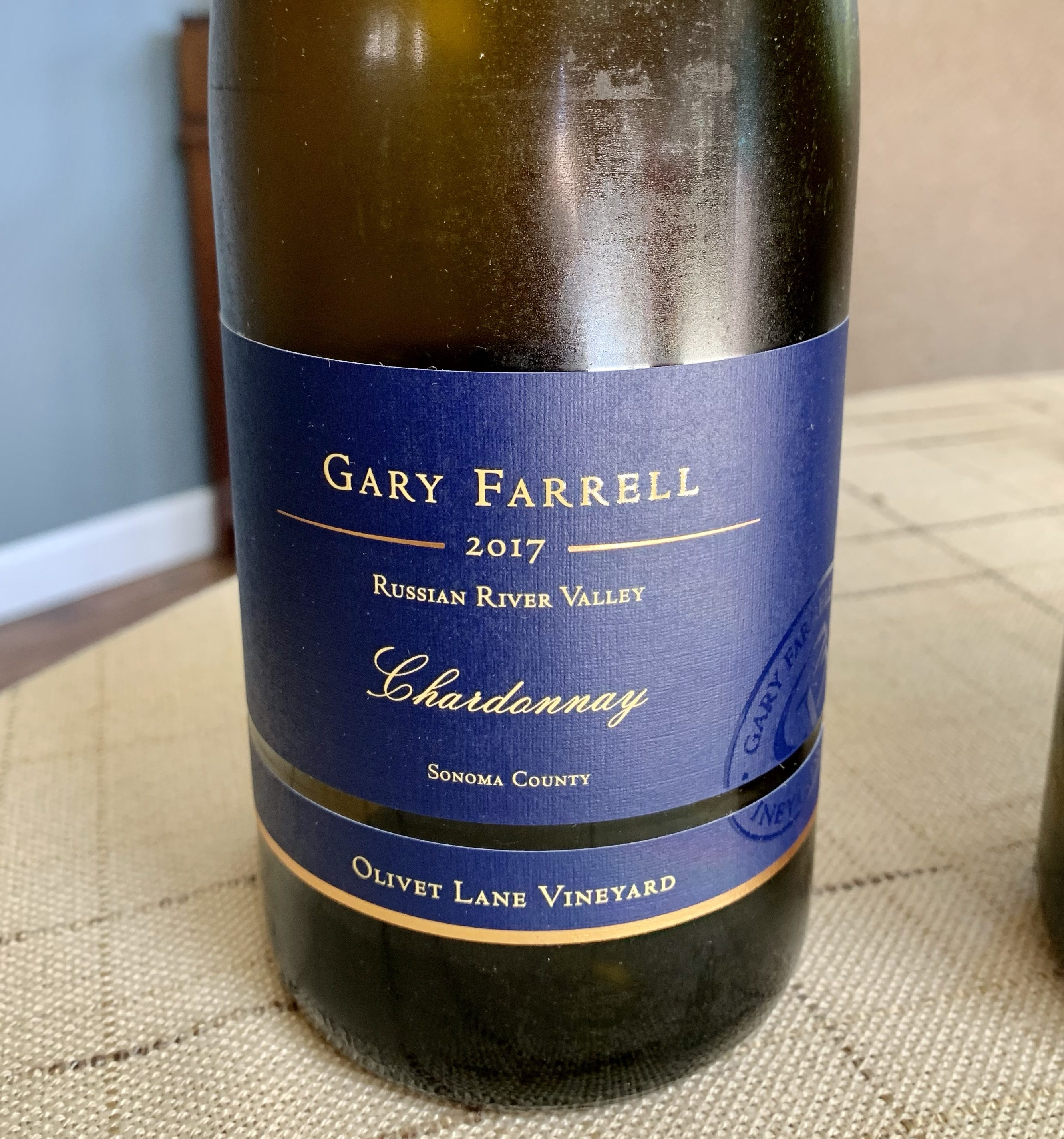
2017 Olivet Lane Vineyard Chardonnay – Santa Rosa Plains
2017 Martaella Vineyard Pinot Noir – Santa Rosa Plains
Ready to taste! (Behind the scenes at Appetite for Wine: yes, those are yoga blocks!)
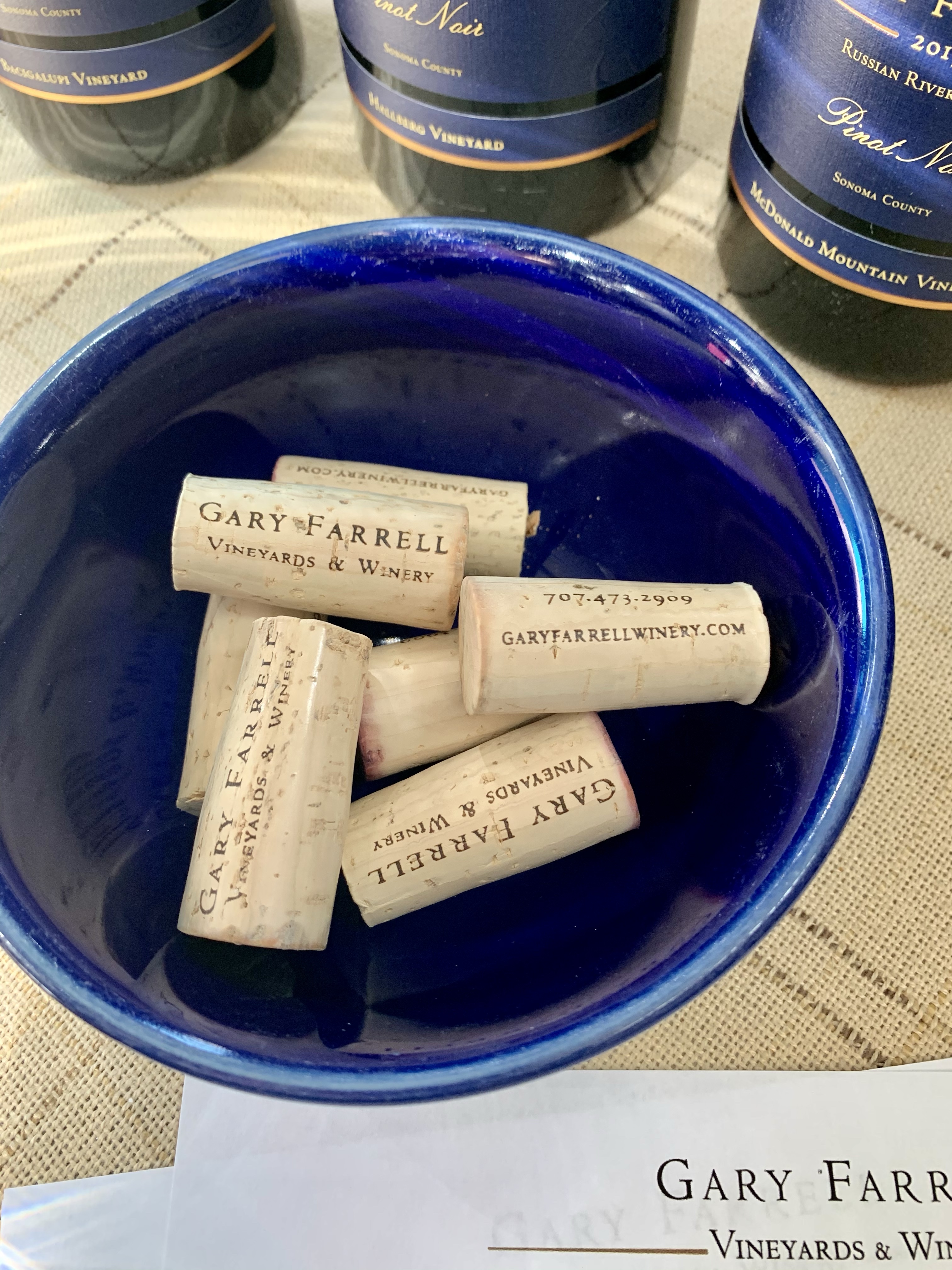
That’s a lot of corks for 11 am!
Why are those glasses empty?
The virtual tasting was packed with information; much more than can comfortably fit into a blog post anyone would actually read. Though it exceeded the allotted hour, it went much too fast. Since the tasting was at 11 a.m. Pacific, we sipped and spit, and re-corked the bottles, and then enjoyed them for the rest of the week! Here are our impressions of each wine:
2017 Olivet Lane Vineyard Chardonnay
Light and crisp, yet still exhibiting light buttery, toasty notes. Golden color. Aromas of apple, pear, and citrus. On the palate, apples, pear, pineapple, and floral notes. Medium body with bright acidity – more than most Cali Chards – nicely balanced. Full, lush, mildly creamy mouthfeel leading to a crisp finish of citrus and some light toast.
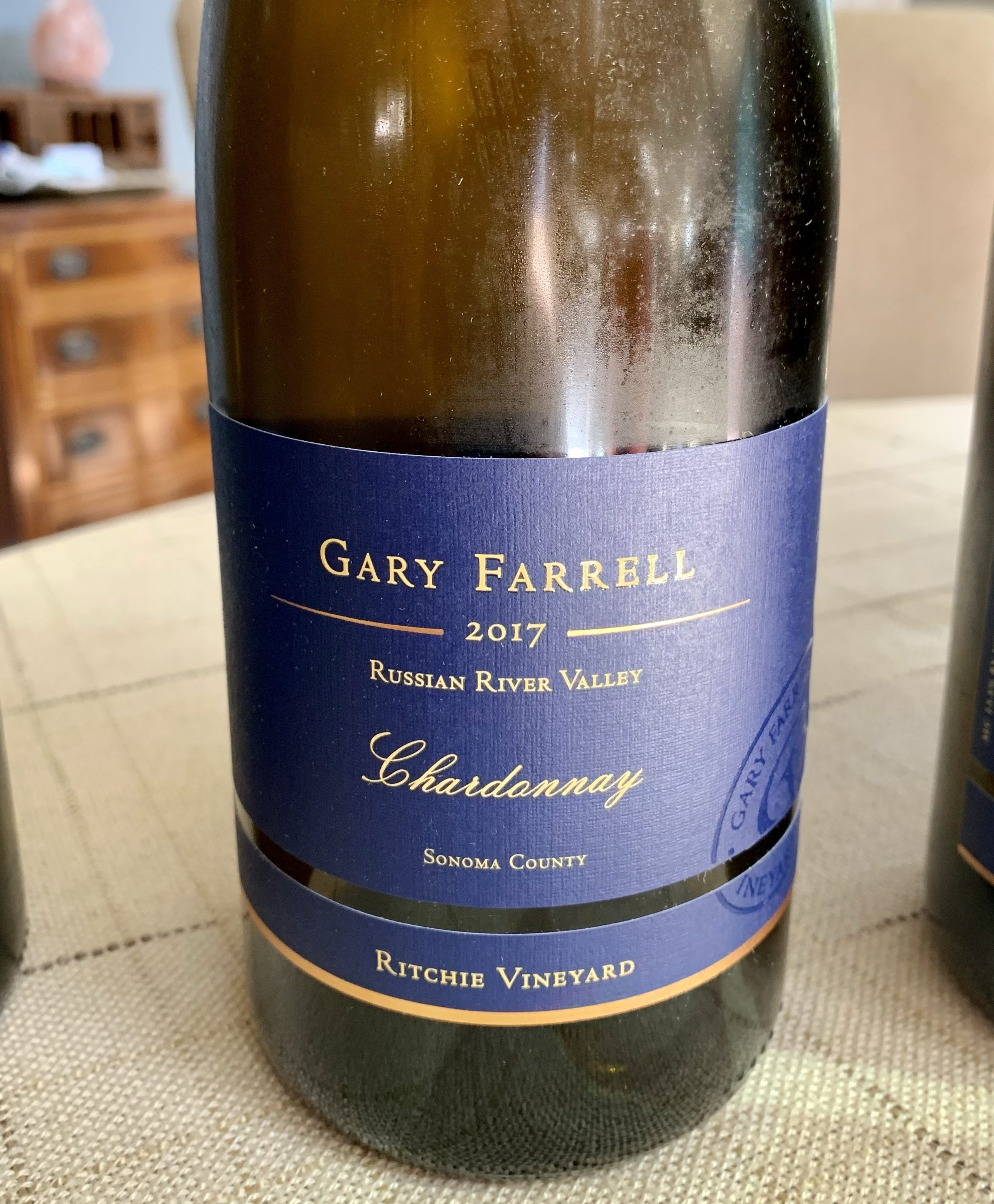
2017 Ritchie Vineyard Chardonnay
A classic but restrained California Chardonnay. Golden color with fresh pineapple the first aromas on the nose, followed by citrus and butter notes. On the palate, green apple, pear, pineapple and tropical notes, as well as citrus. Soft, creamy mouthfeel balanced with medium acidity. The finish has tropical fruit and just a hint of butter.
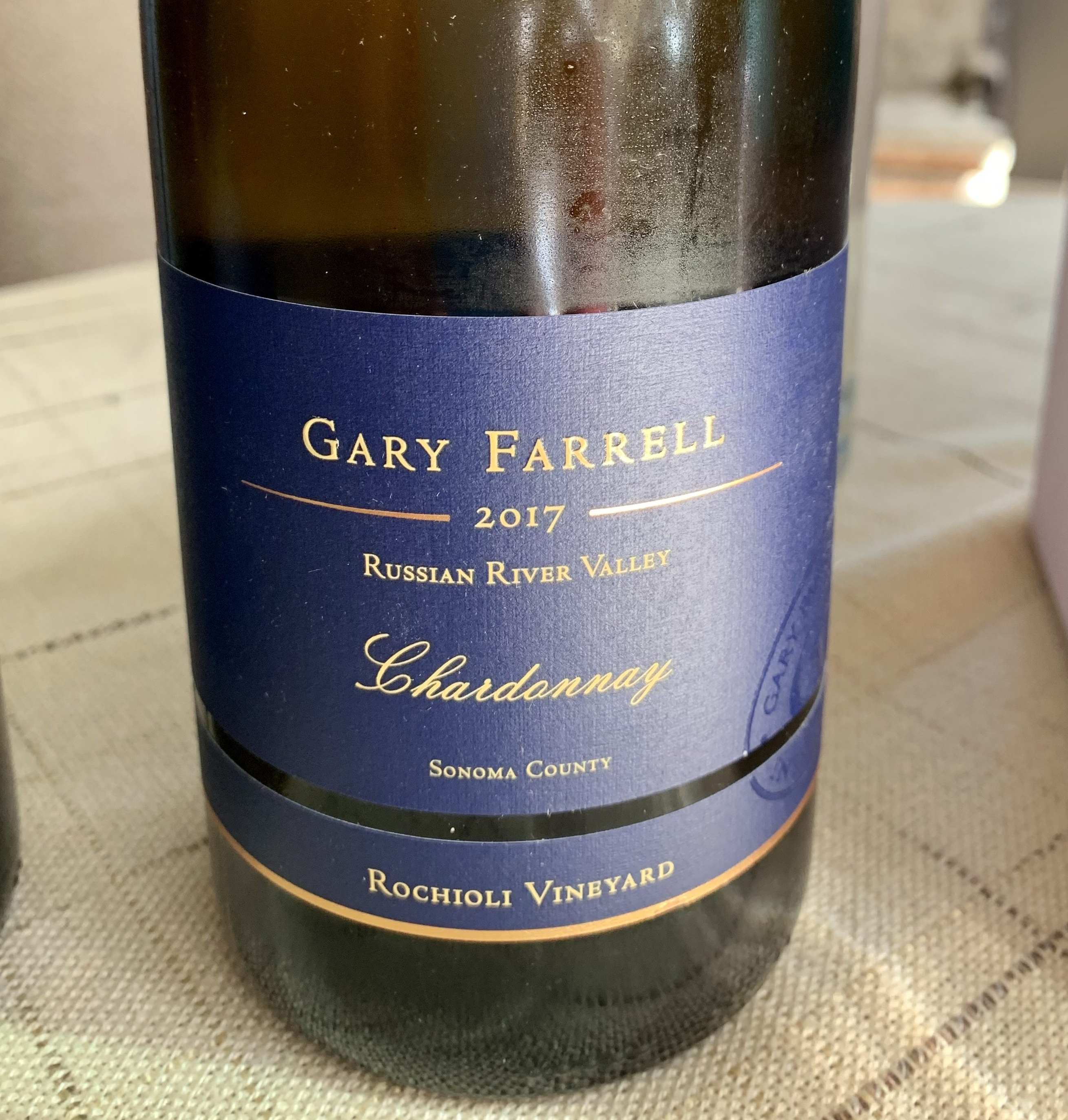
2017 Rochioli Vineyard Chardonnay
A more classic California Chardonnay, though in Gary Farrell style, subtle and elegant. On the nose, pineapple, pear, and citrus, with a whiff of butter. Surprisingly crisp acidity on the palate, with pear, apple, lemon curd, and butter, with a light toast note in the finish.
2017 Bacigalupi Vineyard Pinot Noir
Exquisite and our favorite of the tasting. The nose opens with cherry, raspberry, and cedar, with earthy notes. On the palate, the cherry leads the charge with raspberry, violet, cedar, and mushroom supporting. Medium body and acidity, with a long finish of red fruit and black tea.
2017 Hallberg Vineyard Pinot Noir
Beautiful Pinot Noir. The nose opens with black cherry and blueberry, with some earthy notes. On the palate, lush cherry, raspberry, and blueberry fruit mingles with mushroom, earthy notes, and a general funk that I’ve come to appreciate in a well structured PN. Medium body and acidity lead to a pleasing finish of red fruit, black tea, and smoke.
2017 McDonald Mountain Vineyard Pinot Noir
Quite interesting with herbal and vegetal notes up front, including bay leaf and eucalyptus, with red fruit following. On the palate, cranberry, pomegranate, and raspberry with the bay leaf enhancing the fruit. Medium body with bright, lively acidity. Long fresh finish.
2017 Martaella Vineyard Pinot Noir
Nice, fruit driven Pinot. Aromas of cherry, raspberry, and cranberry. On the palate, these red fruit flavors continue, joined by blueberry, cedar, and bay leaf. Soft and velvety, with bright acidity and a long finish of red fruit and rose petal.
We heartily recommend any and all of these wines, and we look forward to venturing out to the Russian River Valley to explore the neighborhoods in person.
————————————————————
We close on a somber note. We were sad to learn this week, as we prepared this post, that earlier this month, Gary Farrell Winery oenologist, Mark Osbourne, was killed after being struck by a motorist while riding his bicycle. Even more tragically, the motorist is accused of driving under the influence. Our hearts and prayers go out to the Gary Farrell Winery family.
It’s good to have good neighbors. Our neighbors helped us get through the COVID-19 pandemic, by joining with us in our front yards for socially distanced happy hours, and sharing the bounty of backyard gardens. It’s even better, though, to have good neighbors who work at a winery, especially when that winery is one of Napa’s internationally recognized producers!
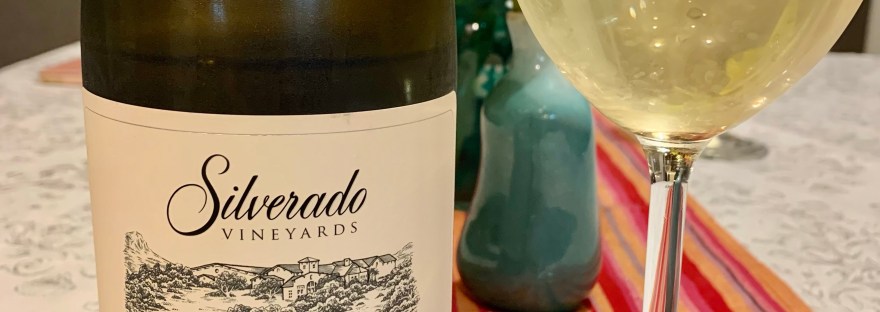
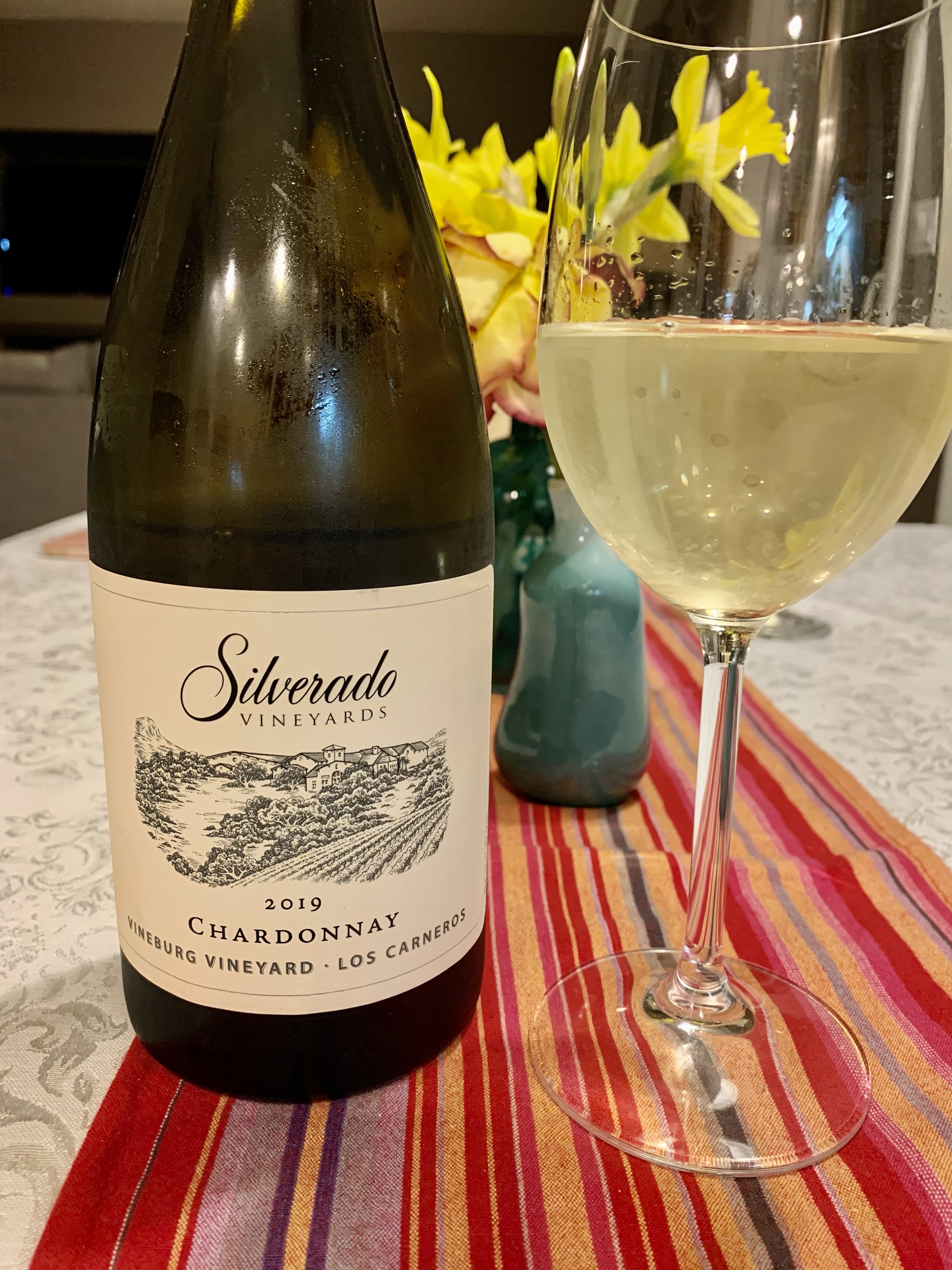
We have that neighbor, and he works at Silverado Vineyards. So naturally, when Adam and his wife Kim attend our socially distanced happy hours, there’s always some Silverado wine. In addition, Adam is always appreciative when we bring his family tomatoes, peaches, peach cobbler, peach pie (yes, we have two prolific peach trees in our backyard), and lemons, lemon bars, and lemon pound cake. (Yup, a high-yielding lemon tree, too.) So appreciative is he, that when we deliver the goods, Adam invariably and generously reciprocates with a bottle of…you guessed it…Silverado Vineyerds wine. During a recent exchange, we came home with a bottle of Silverado Vineyards Vineburg Chardonnay 2019.
Silverado Vineyards is a family-owned winery, established in 1981 by Ron and Diane Miller, and Diane’s mother, Lillian Disney. Yes, that Disney. Walt Disney was Diane’s father. As one might expect, Silverado Vineyards is located on the Silverado Trail, on the eastern side of the Napa Valley, in the Stags Leap District. For years before founding the winery, the family had sold their grapes to other wineries in the area. As the winery grew in production and reputation, the family acquired additional vineyards, including the Vineburg Vineyard in 2000.
We are pretty particular with Chardonnay. We are not fans of the big, butterball, in-your-face oaky style. We prefer unoaked or lightly oaked Chardonnay. Silverado Vineyards Vineburg Chardonnay is just that, lightly oaked, and the 2019 vintage is outstanding. It’s a Chardonnay for the ABC (Anything but Chardonnay) crowd, and just the thing to pair with roasted lemon-garlic chicken!
Pale straw color. The nose is subtle, with pear, yellow apple. and citrus. On the palate, Bartlett pear, apple, lemon lime, and hints of tropical fruit. Medium body and acidity, with fresh tree fruit and just a hint of toast on the finish.
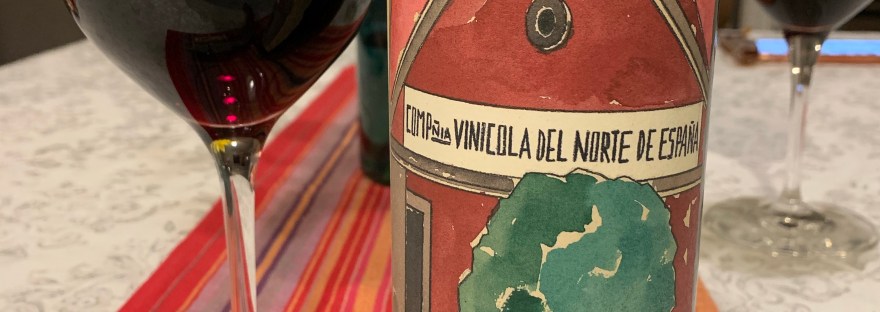
This week, our Wine of the Week takes us to Spain. Specifically, the Rioja region in Northern Spain. Rioja red wines are all Tempranillo based. There are many well known producers in Rioja, and wines from this region have gained wide popularity in recent years. One of the more historic Rioja wineries is Compañia Vinicola del Norte de España, abbreviated in their production and most of their labels as CVNE. Many of the CVNE wines are quite affordable, in the $20 or under range, while others are cellar-worthy, top cuvées, with correspondingly higher prices.
CVNE has been producing wine since 1879, and remains under a family owned and operated winery. They own 545 hectares (1,350 acres) of vineyards, and also source fruit from nearby independent vineyards.
In addition to the eponymous label, CVNE offers a number of others, one of which was recently featured by Total Wine & More as a “Top 20 Wines Under $20”: Asúa Rioja Crianza 2016. Eager to see what all the hubbub is about, we added a bottle to our cart and a few days later, pulled the cork.
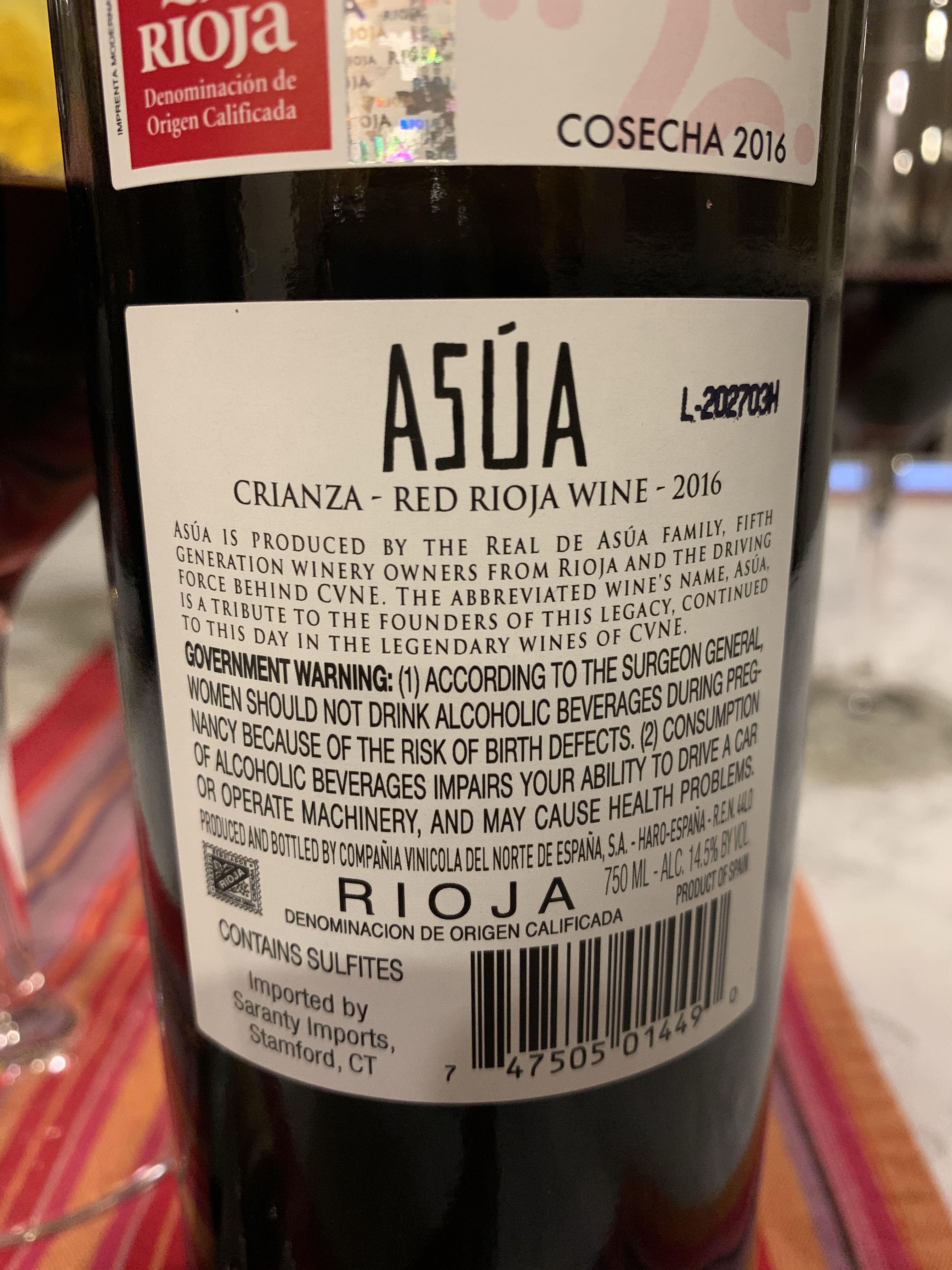
Despite being produced by CVNE, this wine is currently absent from their website, so finding information about it proved challenging. The back label declares:
“Asúa is produced by the Real de Asúa family, fifth generation winery owners from Rioja and the driving force behind CVNE. The abbreviated wine’s name, Asúa, is a tribute to the founders of this legacy, continued to this day in the legendary wines of CVNE.”
Rioja is one of the rare regions in the wine world where words like Reserva and Gran Reserva have meaning. In most of the world, those are mere marketing terms, with no regulation or control. But in Rioja, you will find these terms, plus Joven and Crianza, on the bottles, and each identifies the treatment and aging of the wine.
Joven wines are young and fresh, with little to no oak aging. They are intended for consumption within two years of production. Crianza wines must be aged in oak for at least one year, and an additional year in the bottle. Reserva wines also spend one year in oak, but must age in the bottle for three years before being released. Finally, Gran Reserva wines age for two years in oak, and another three years in the bottle. As one would expect, prices and ageability increase with each designation.
Asúa Rioja Crianza 2016
A young, fresh, and fruity Rioja. Garnet color with a ruby rim. On the nose, fresh raspberry and blackberry with hints of oak and vanilla. Flavors on the palate include bold, fresh blackberry, blueberry, and cherry, with clove, tobacco, and vanilla. Medium body with vibrant acidity; perfect for food pairing. Medium finish of red fruit and baking spice. We paired with shredded chicken tacos and it was magical.
For a great wine and an amazing price, check out Asúa Rioja Crianza 2016
A few weeks back, we were talking about different wine varieties, and decided we needed to incorporate more Riesling into our lives. Mere days later, as if she overheard our conversation from 3,000 miles away, Courtney from Ravines Wine Cellars, in the Finger Lakes Region of New York, emailed us offering samples of their wines, including their flagship Dry Riesling. How could we refuse?
The following wines were provided as media samples for review. All reviews, descriptions, and opinions are our own. We received no additional compensation.
Riesling is a very versatile grape. It can also be polarizing; you either like it or you don’t. In our observation, the polarization is directly related to the versatility – Riesling wines can be made in a variety of styles, from dry to sweet. A few years ago, the market was flooded with cheap, sweet Riesling from Germany, which has turned a lot of wine drinkers away from Riesling in general. That’s a shame, because Riesling is a stunning grape, food friendly and elegant. While we tend to prefer dry wines, we’ve enjoyed some excellent off-dry Rieslings, and have an appreciation for the occasional sweet sip.
The Finger Lakes Region, in Upstate New York, is known for its Riesling. With a short growing season and cold, snowy winters, Riesling finds itself right at home there. The name, Finger Lakes, comes from the 11 long, narrow lakes formed by glacial movement millions of years ago. Seneca Lake and Cayuga Lake are two of the deepest in the US, at 618 feet and 435 feet, respectively.
Ravines Wine Cellars is celebrating its 20th anniversary this year. In 2001, husband and wife team Morten and Lisa Hallgren founded Ravines Wine Cellars, with a mission to produce a bone dry Riesling. Born in Denmark, Morten learned winemaking at his family’s estate winery in Côtes de Provence, France. Morten went on to earn a degree in winemaking from Ecole Nationale Supérieure d’Agronomie in Montpellier. Meanwhile, Lisa studied the culinary arts and is now a professionally trained Chef. As an adult, Morten came to the United States, eventually settling in Upstate New York, where he and Lisa purchased land between two ravines in the Finger Lakes region. You can read more of Morten and Lisa’s story on the Ravines Wine Cellars website.
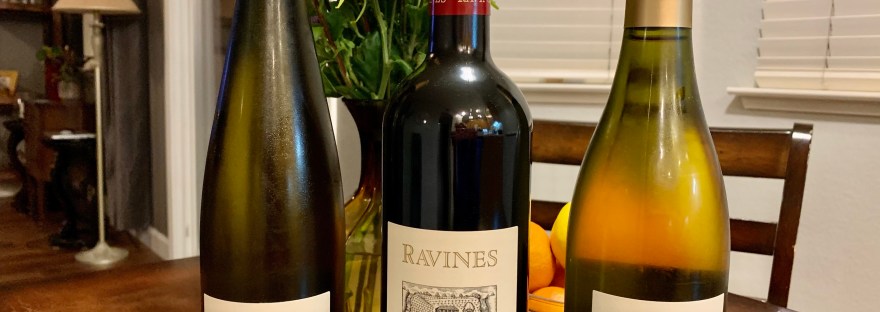
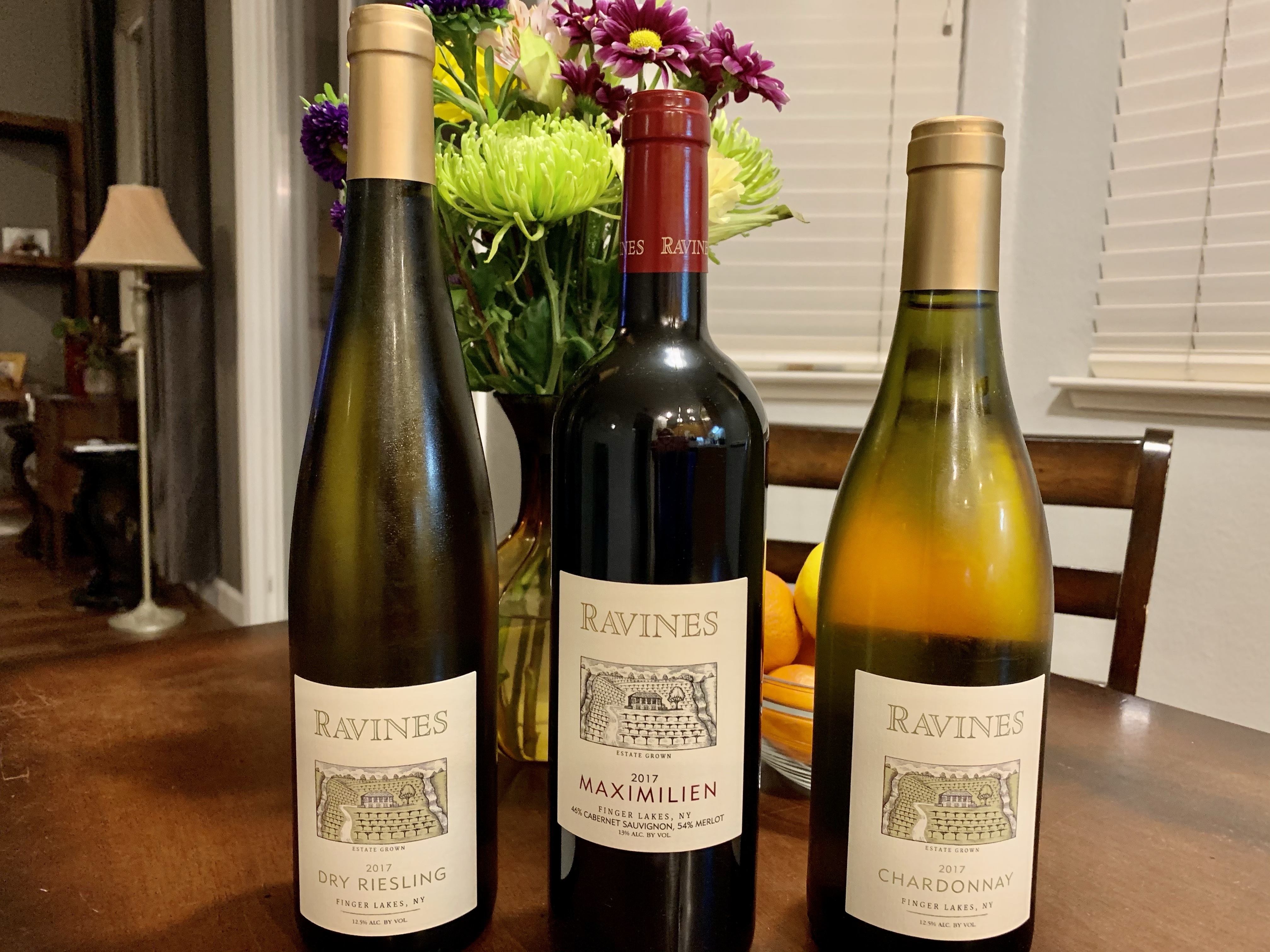
Our sample pack from Ravines Wine Cellars included three wines; a 2017 Chardonnay, the flagship 2017 Dry Riesling, and their Bordeaux-style red blend, Maximillen 2017. These, and all of their portfolio wines are available for purchase on their website.
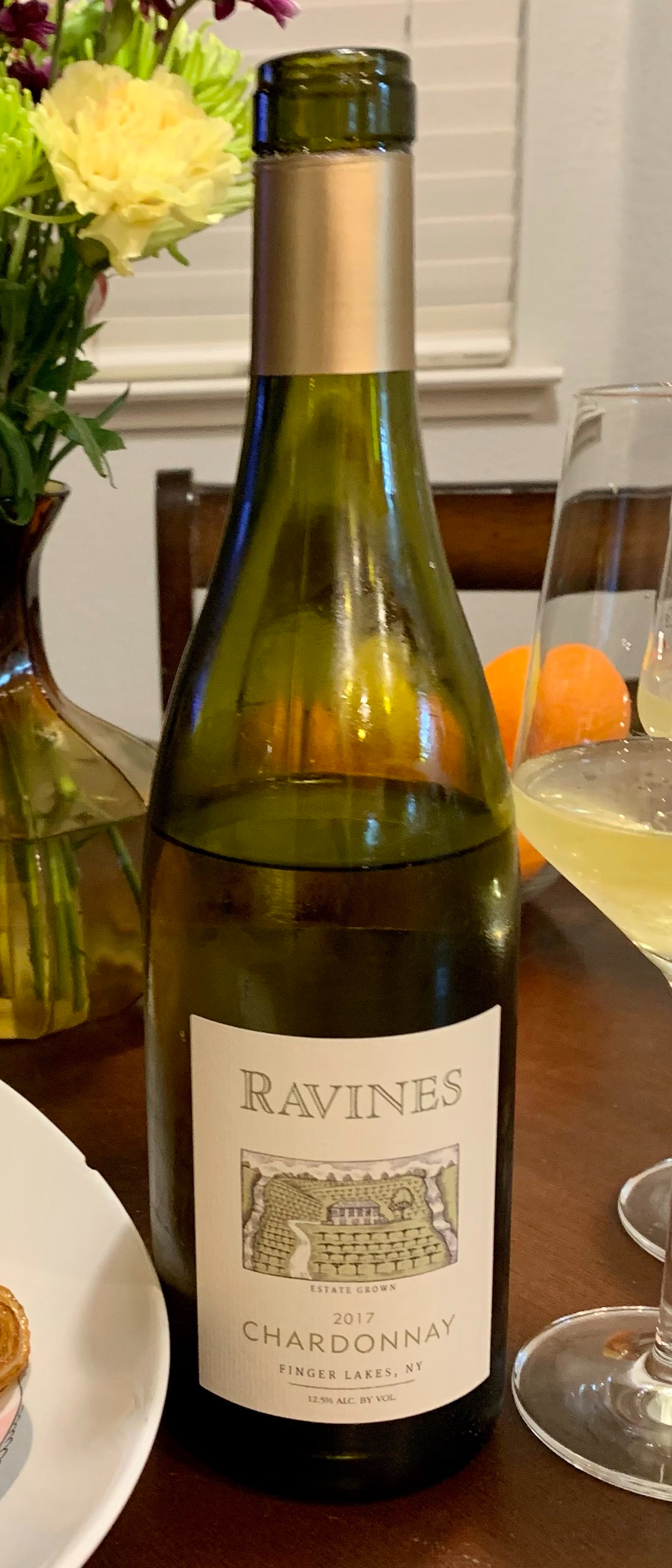
2017 Chardonnay (SRP $19.95)
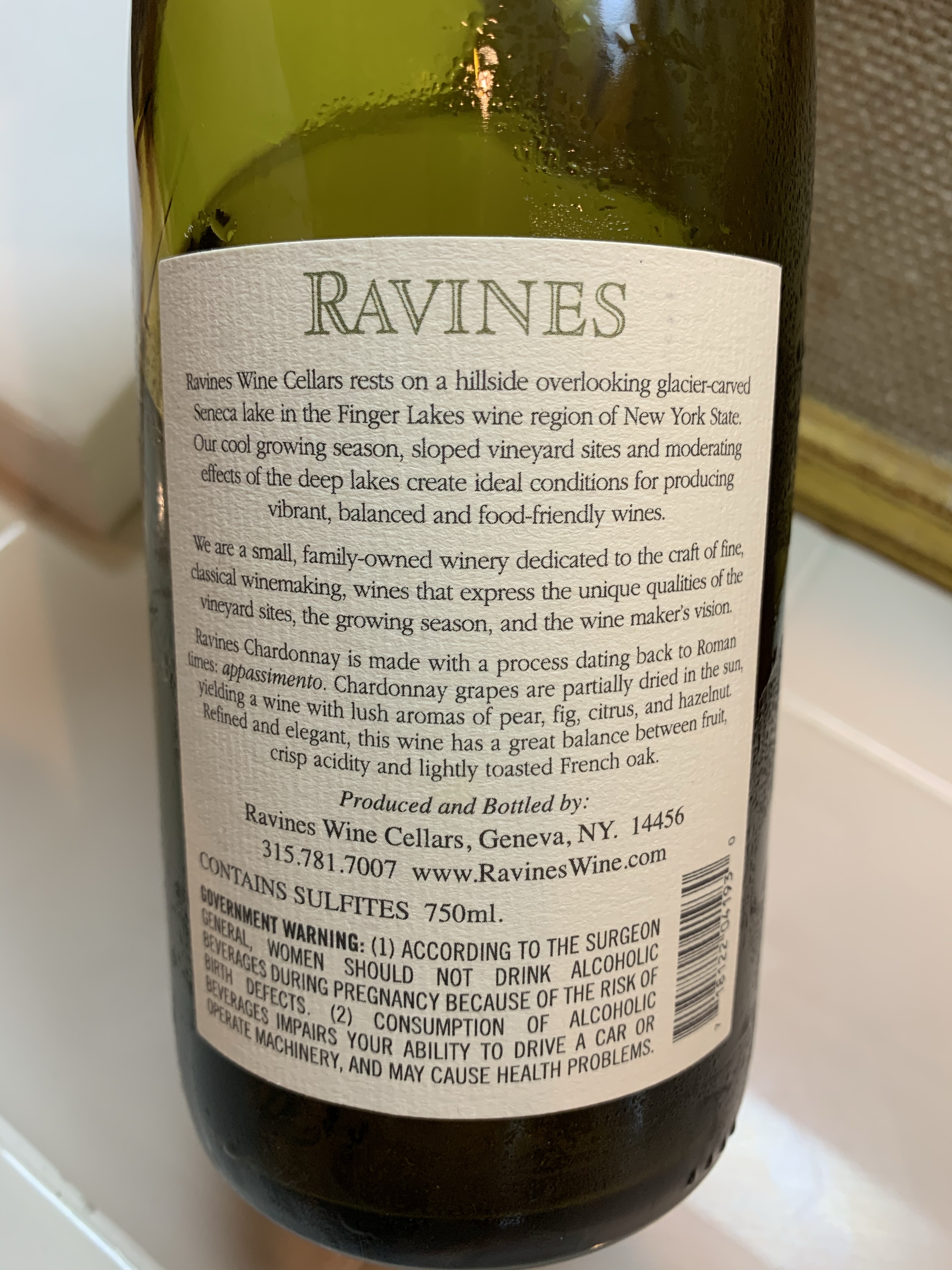
A unique Chardonnay, made in the appassimento method by partially drying the grapes before pressing. The appassimento method is of Italian origin, and is used in making the rich and concentrated Amarone wines.
Clear golden color. Aromas of ripe apricot, mild citrus, and pear. On the palate, there are flavors of grilled lemon, pear, peach, and citrus. Medium body with vibrant acidity. The finish lingers with fresh citrus and just a hint of toasty warmth at the end. Excellent paired with roast chicken.
Dry Riesling 2017 (SRP $17.95)
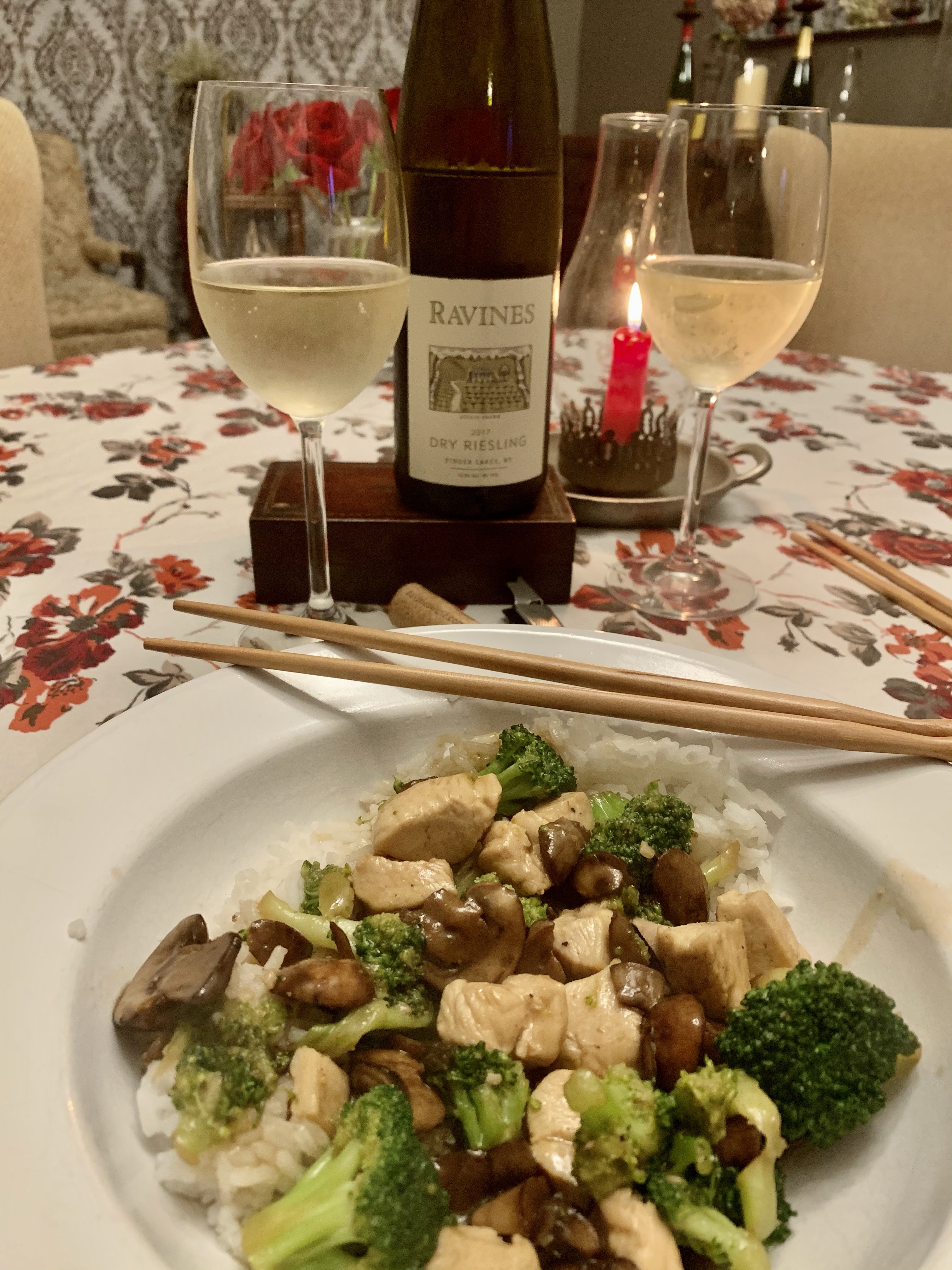
Clear, golden color. Aromas of pear, apple, and citrus, with floral notes. On the palate, there are flavors of Bartlett pear, yellow apple, lemon lime, and lychee, with hints of honeysuckle and lemon blossom. Light body with brisk acidity and a lingering finish. Paired well with chicken and broccoli stir fry.
Maximilien 2017 (SRP $24.95)
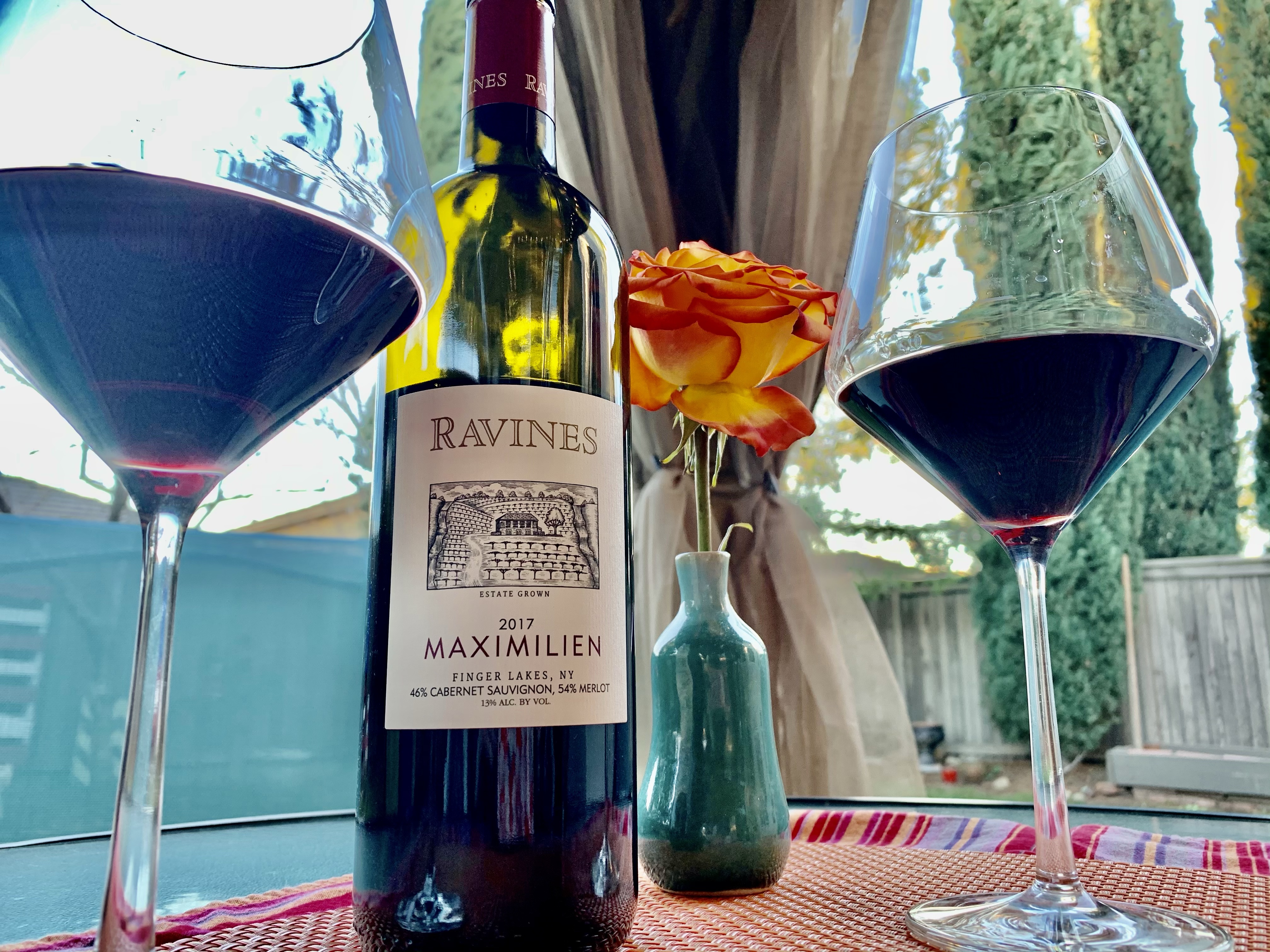
54% Merlot, 46% Cabernet Sauvignon.
This is a classic Bordeaux blend. A New World wine with a distinctly Old World vibe. Ruby-garnet color. The nose is earthy, cherry, raspberry, and ripe plum. On the palate, smoky with blackberry, black cherry, ripe raspberry, and red currant, with black pepper, tobacco, cigar box, and wisps of bell pepper. Medium-plus body, with grippy tannins and bold acidity. Long finish of black fruit and spice. Somebody please get me a ribeye!
Thank you.
We found each of the Ravines Wine Cellars wines to be distinct, expressive, and downright delicious. We are happy to have more Riesling in our lives, and will remember Ravines Wine Cellars when it’s time to re-stock that corner of the cellar.
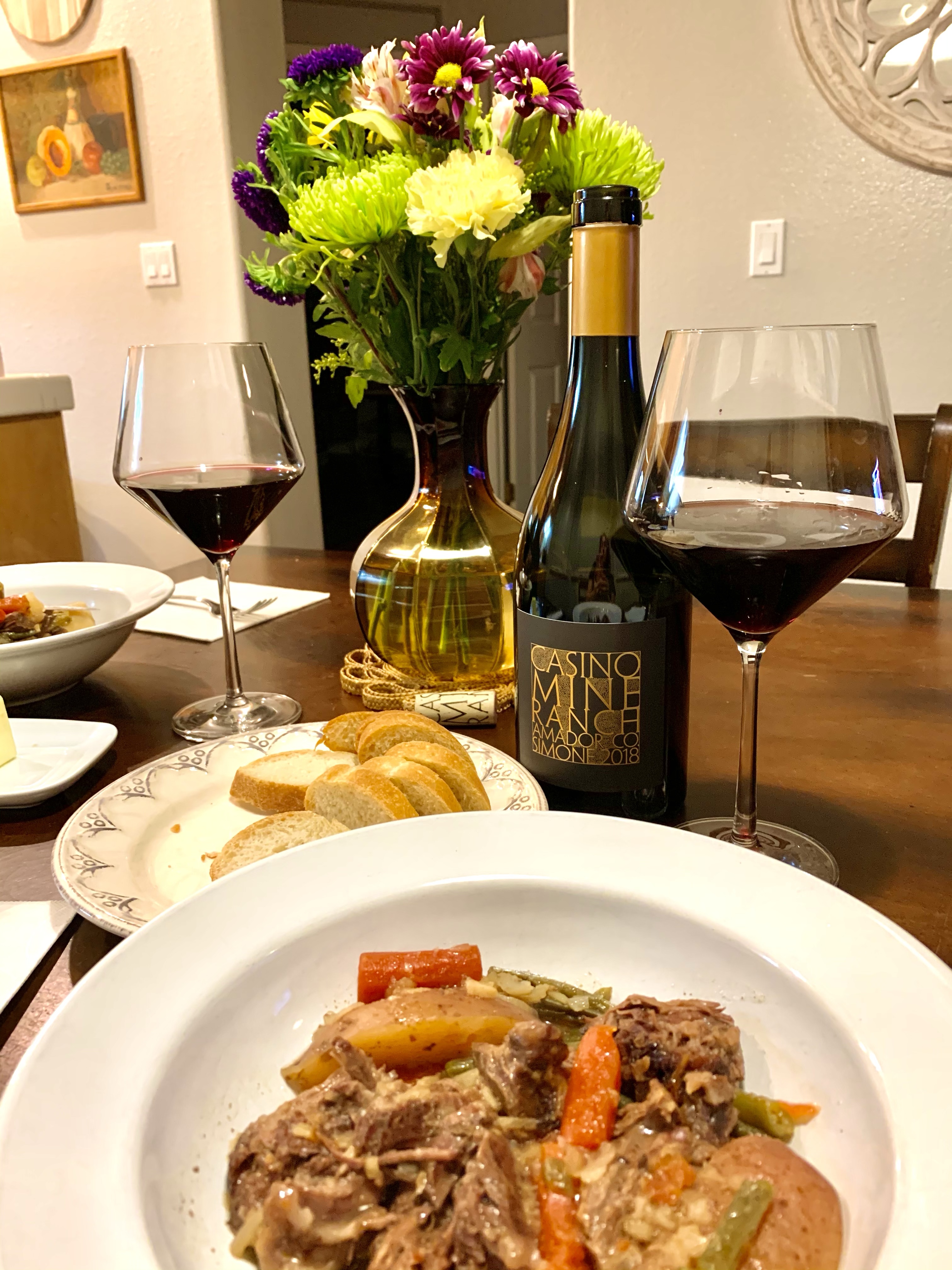
This week, our Wine of the Week was an easy choice. Not that any of the other wines were bad, but the Casino Mine Ranch Simone 2018 was hands down the best of the week. We have been fans of Casino Mine Ranch and their entire portfolio of wines since our first visit a little over a year ago. We were so impressed, we even wrote about it!
The Simone wine is a tribute to Simone Vanophem Shaw, who founded the ranch in 1936. Simone is Great Aunt to Rich and Jim Merryman, the current owners of the ranch. Simone’s is a fascinating life story, filled with adventure and elegance; from living with her father at his Alaskan fold mine, to jet-setting to New York, Los Angeles, Paris, and other glamorous destinations, to later buying and managing this beautiful, rugged ranch property in Amador County. The Simone wine embodies the lady. As the Casino Mine Ranch website describes it:
“Like its namesake, it’s elegant yet tough, and brims with joie de vivre. It’s a wine for feasting, both opulent and earthy, best enjoyed while wearing dungarees and boots. Or, alternately, diamonds, furs, and pearls.”
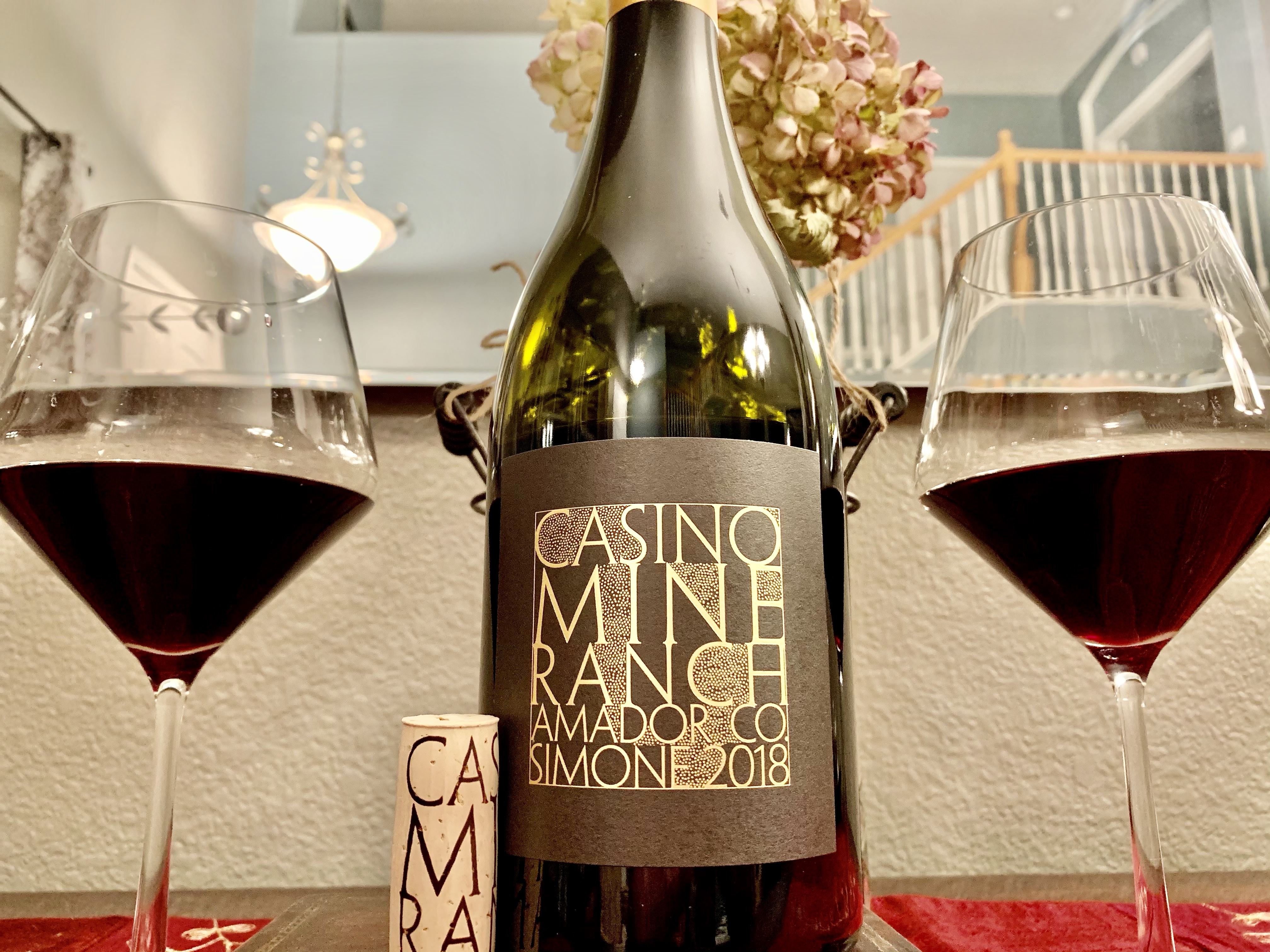
The Casino Mine Ranch Simone 2018 is a blend of 57% Mourvèdre and 43% Grenache Noir. As with all of their wines, Simone is made with 100% estate grown fruit. It is a rich, lush, powerhouse of a wine, perfect for cold winter nights and pot roast.
Ruby color. Aromas of raspberry, cherry, and smoke. On the palate, flavors of blackberry bramble, raspberry, cherry, cola, tobacco, white pepper, and smoke. Medium body, lively acidity, and smooth tannins. Magical paired with pot roast.
We wish we could have met Simone, we know we would have loved her. But at least we can enjoy the wine made and named in her honor.
Selecting our wine of the week this week was pleasantly challenging. We had to choose between two wines that were both equally impressive. The deciding factor in our decision was the fact that we have another bottle of one of them, so we can revisit it to feature in a future week. And so it is, that our wine of the week is La Playa Sauvignon Blanc 2020, from the Curico Valley in Chile.
We’ve become big fans of Sauvignon Blanc in the past few years. Light, crisp, and refreshing, it is also quite versatile in food pairing. Often considered a summertime wine, we enjoy Sauvignon Blanc year-round. While New Zealand, specifically Marlborough, has taken center stage in the world of Sauvignon Blanc, the grape originated in France, and is now planted world wide. (Fun fact: Sauvignon Blanc is one of the parent grapes of Cabernet Sauvignon, the other being Cabernet Franc.)
In general, at least to our palates, we have concluded there are three overarching styles of Sauvignon Blanc:
The French style found White Bordeaux, or Sancerre and Pouilly-Fumé from the Loire Valley – often blended with Semillon, resulting in a fuller, rounder wine, with gooseberry, green apple, pear, and citrus.
The New Zealand style – grassy, cut straw, grapefruit, lemon, and occasionally cat pee (yes, this is actually a desirable quality in a Sauvignon Blanc!) with light body and zesty acidity.
The Northern California style – bursting with tropical fruit; pineapple, mango, passionfruit; and stone fruit; apricot, peach, nectarine; with a bit more body and softer acidity.
As we said, this is a general observation. Plenty of New Zealand Sauvignon Blanc have pineapple or other tropical fruit flavors, and NorCal can show grassy, apple and pear notes. With Sauvignon Blanc, style transcends location. Any of these styles can be produced in any of the growing regions. We’ve just come to associate these styles with these places.
Make no mistake, we enjoy all the different styles. Thus is the approachability and appeal of Sauvignon Blanc. However, we each have our preferences. Robyn prefers the fresh, clean citrusy style from New Zealand, while Kent favors the tropical and stone fruit from NorCal.
Always eager to explore new wines, we thought we’d try the La Playa Sauvignon Blanc 2020 with our meal of grilled fish tacos. A bargain at just $8.99 from Wine.com, we’d put this up against Sauvingon Blancs at three times that price! The biggest surprise was that we had expected more of a New Zealand style, as most of our Chilean Sauvignon Blanc experiences have been, but La Playa is decidedly NorCal, in our estimation.
Pale golden color. Aromas and flavors of fresh tropical fruit; pineapple, mango, and lychee; with citrus, including lime and quince. Soft mouthfeel with medium acidity and a pleasing finish.
La Playa Vineyards produces only sustainably farmed wines, using native yeasts. They also produce Chardonnay and Viognier, along with a red wine lineup of Cabernet Sauvignon, Merlot, Carmenere, and a red blend. We have tasted their Dry Rosé of Cabernet Sauvignon, several months ago, and it was equally delicious.
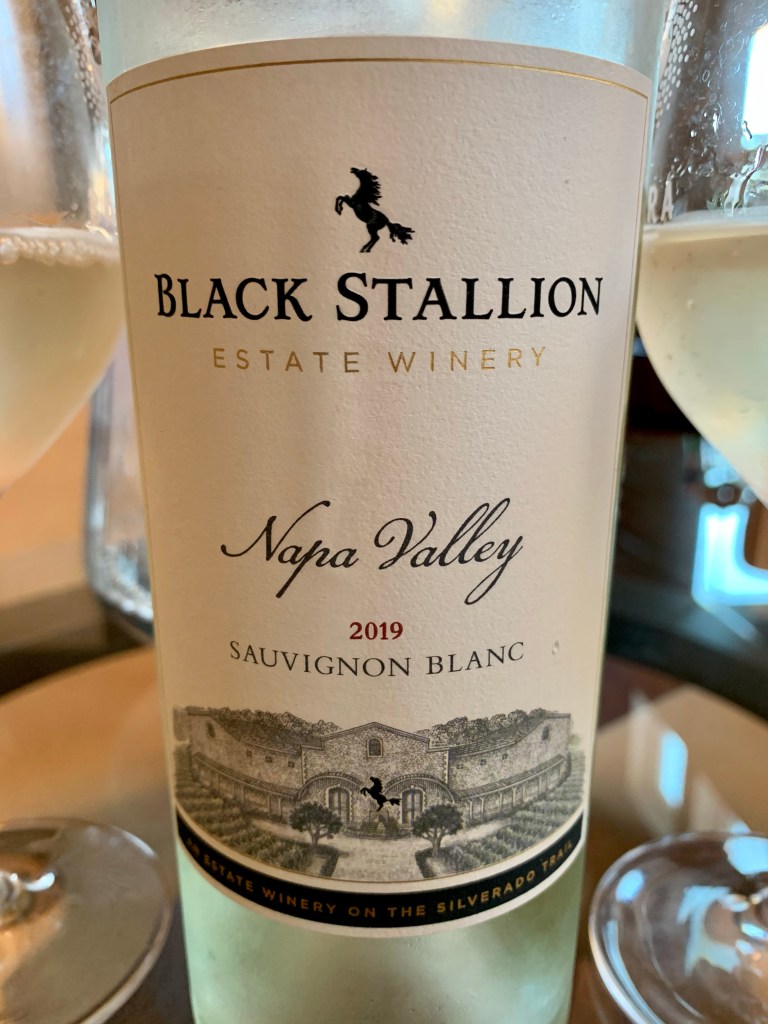
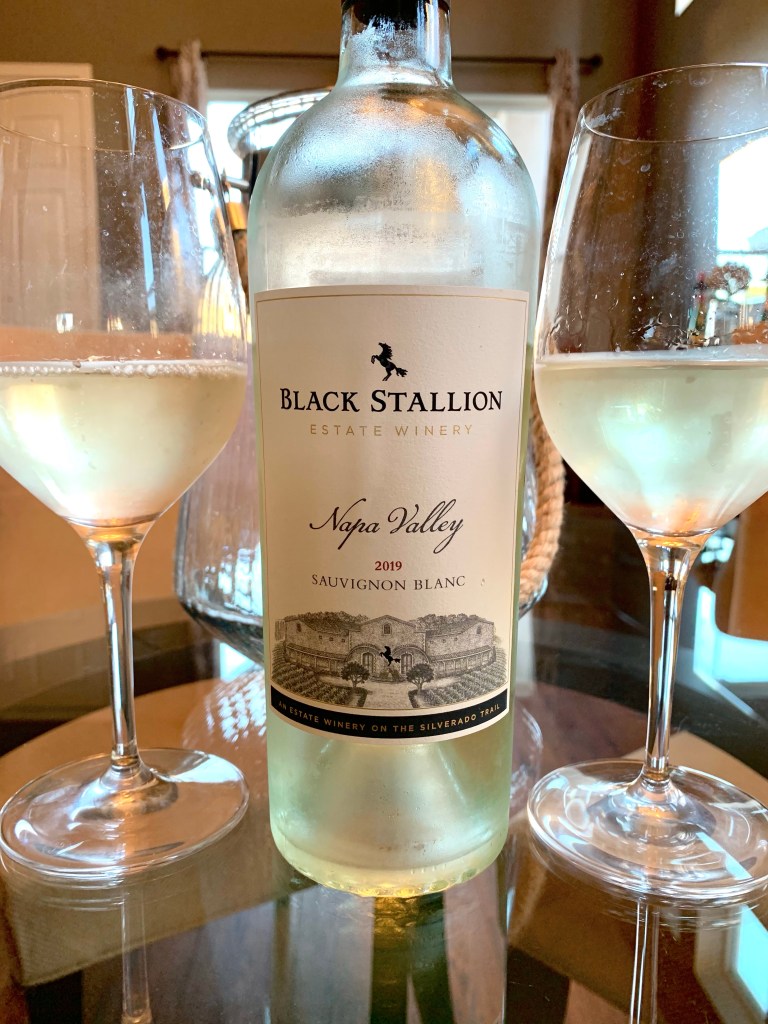
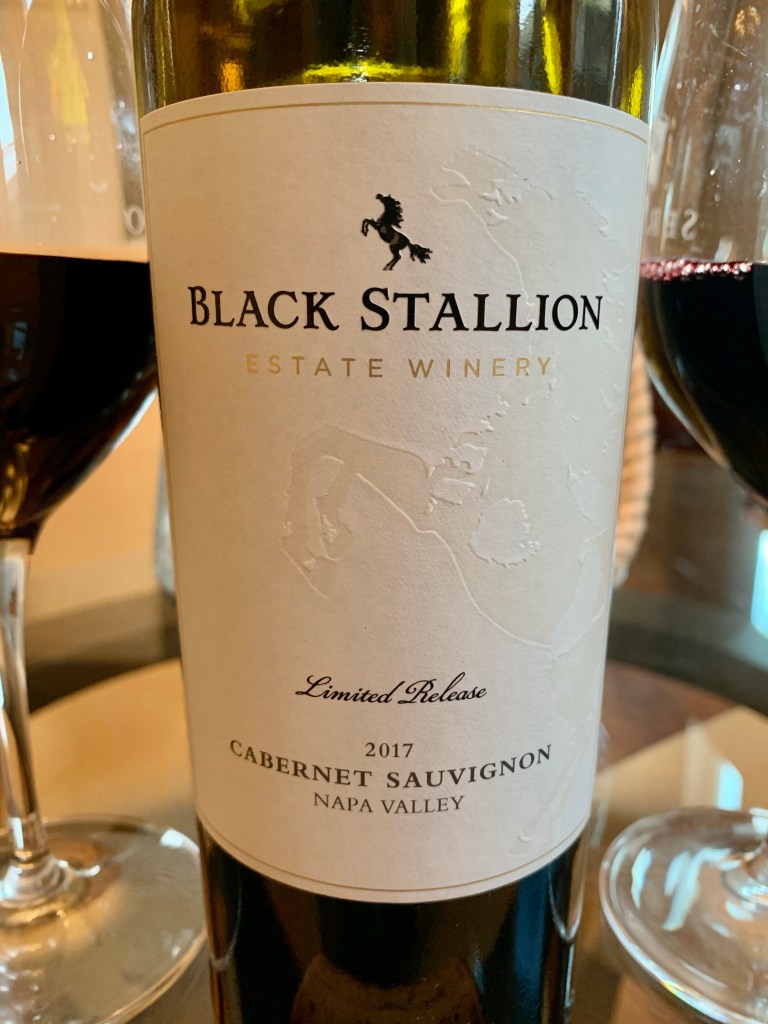
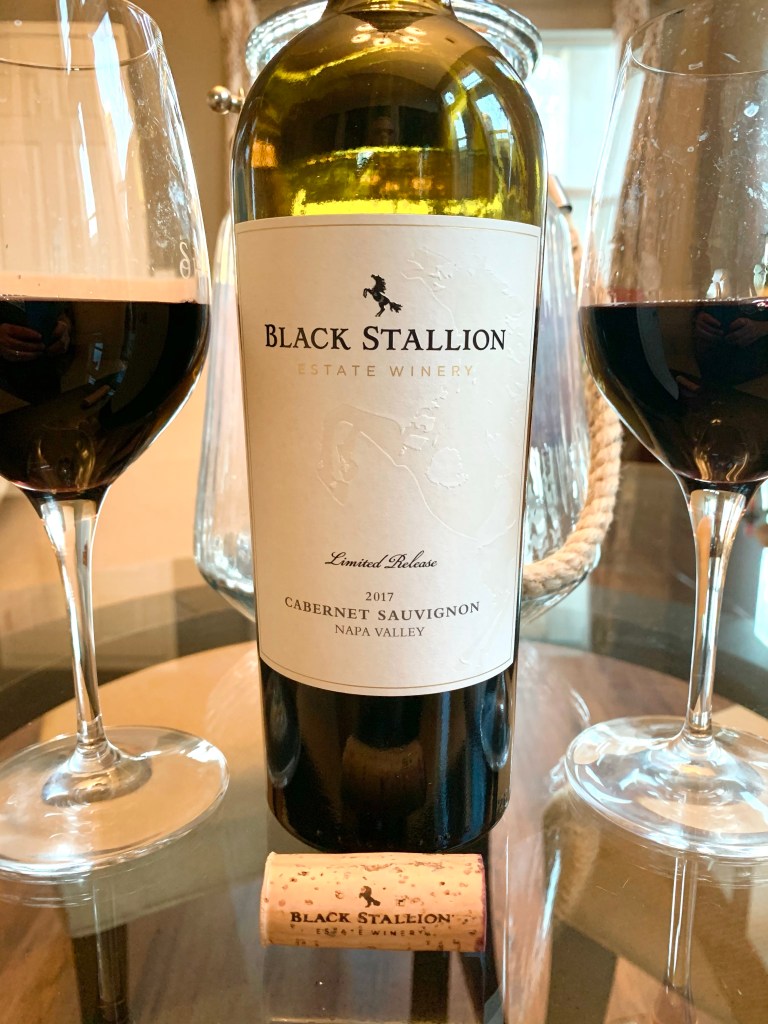
Even during a pandemic, and with wineries and tasting rooms shut down due to regional stay-at-home orders, the work of the farmers, winemakers, and winery staff continues. Though nobody can visit, vines are tended, grapes harvested and crushed, and wine production must press on. (See what we did there?) So it is at Black Stallion Estate Winery. We were fortunate enough to receive samples of two of Black Stallion’s wines recently: Black Stallion Napa Valley Heritage Sauvignon Blanc 2019, and Black Stallion Limited Release Napa Valley Cabernet Sauvignon 2017.
The following wines were provided as media samples for review. All reviews, descriptions, and opinions are our own. We received no additional compensation.
We’ve been intrigued by Black Stallion Estate Winery’s history since we first heard of them. Located along the Silverado Trail, on the east side of the Napa Valley, the property was once the Silverado Western Center. The equestria center was home to prize-winning horses, and complete with an indoor riding track and outdoor arena. The original equestrian center has been converted and is now the winery’s production facility.
Crafted by winemaker Ralf Holdenried, these wines are classic Napa Valley; complex but decidedly drinkable and delicious. Ralf has more than 20 years of harvest experience, and this translates into the quality of the finished product.
Black Stallion Napa Valley Heritage Sauvignon Blanc 2019 (SRP $22)
Pale straw color. The nose is a burst of fresh pineapple with some citrus/lemon. On the palate, the pineapple continues with quince, lemon lime, white peach, and a hint of chalky minerals. Fresh and lively with zesty acidity. Nicely balanced with a crisp finish.
Black Stallion Limited Release Napa Valley Cabernet Sauvignon 2017 (SRP $60)
Opaque purple color. Aromas of plum, blackberry bramble, black cherry, and vanilla. On the palate, blackberry, stewed plum, cassis, black cherry, vanilla, and caramel, with white pepper and baking spice. Medium-plus body, soft tannins, and medium-minus acidity. Soft, creamy mouthfeel and a long finish of black fruit and spice. Outstanding paired with grilled lamb chops.
After tasting these wines, we have no doubt that despite the challenges of this past year, the wines of the 2020 vintage will be stunning! We can hardly wait to try them.











 Appetite for Wine