Do you believe in miracles? How about angels? Or mythical creatures? I do. I believe in all three. You see, not long ago, I met a Unicorn…
Not my actual Unicorn
She told me about a wondrous land populated with angels, cherubs, and cheerful leprechauns. But no trolls. There are no trolls in this land, which, as my fellow bloggers and anyone who participates in social media will agree, is the second best part about this marvelous place. The best part is that spectacular, world class wines are available for miraculous prices. Pennies on the dollar in some instances! Intrigued?
No, this is not fantasy. I have not delved into the realm of fictional novels. This place is real. The name of this land should be “Winevana.” Perhaps it is, but only to “The Chosen.” To the rest of the world, this place is known as: Grocery Outlet.
Okay, okay, I know. Until about six months ago I had never thought of Grocery Outlet as being a reliable source of quality wines. However, I wisely trusted my Unicorn, and ventured in. There, I was introduced to the local wine genie, Jerry. Jerry is the wine buyer for our local Grocery Outlet. Jerry is quite a character, and Jerry knows his wine! He has some amazing connections with distributors and producers, and has an uncanny ability to score some amazing deals on some amazing wines. I don’t know how he does it, but he knows his stuff. He’s tasted almost every wine in the store, so when you ask him for a recommendation, he can provide you solid choices.
A couple of weeks ago, Jerry sent out his weekly e-mail, touting his latest screaming finds. Angelic wines at fantastic prices! I scurried in to fill my cart. Jerry handed me a bottle, and told me I just had to try it. Who am I do argue with a mythical wine genie?
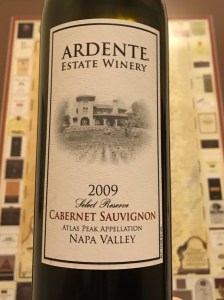
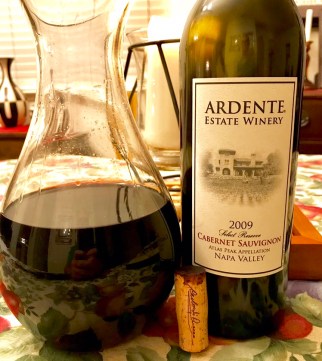
The wine? Ardente Estate Winery Cabernet Sauvignon Napa Valley 2009. Not just Napa Valley, though. Atlas Peak Napa Valley! Online sources price this bottle at as much as $55.00. Jerry’s Winevana price? $11.99. Score!
Ardente Estate Winery was established in 1996, on 20 acres in the hills of Atlas Peak. Their website proclaims: “ardente [ar’ dεnte]From the latin for pyre; a burning desire, passionate, flaming. This is the word that Carlo Di Ruocco felt best described his relationship to the land and the wine that is his “Ardente”.”
Information about the 2009 vintage is scarce; that was the last year the webpage was updated; but sometimes all you need to know about a wine is how it tastes. Euphoric. Heavenly. Otherworldly. Spectacular! If you enjoy a solid, rich, full-bodied Napa Cabernet, seek out this angelic being. Here are my notes:
This is a spectacular Napa Cab. Deep purple color with slight ruby rim. On the nose, enticing aromas of creme de cassis, blackberry, and soft oak. After a quick 30 minute decant, the flavors exploded on the palate: ripe blackberry, black cherry, plum, cassis, and chocolate melding with vanilla, oak, and hints of ripe raspberry. The tannins are velvety smooth, and the acidity medium and balanced. The rich, full mouthfeel complemented our grilled NY strip steak to perfection. The long finish of blackberry, cassis, and black pepper. Outstanding!
If you have a Winevana…I mean Grocery Outlet…store in your town, I encourage you to stop in. Your wine genie may not be named Jerry, but I’ll bet he or she is just as miraculous!
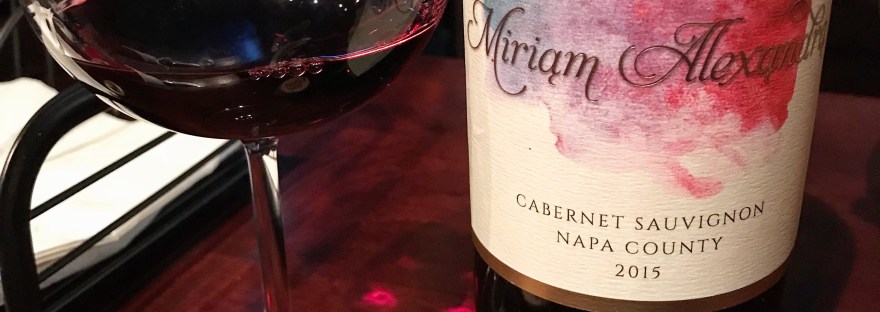
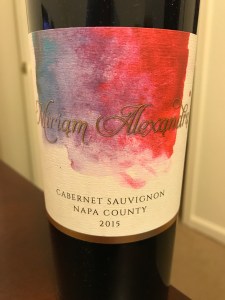
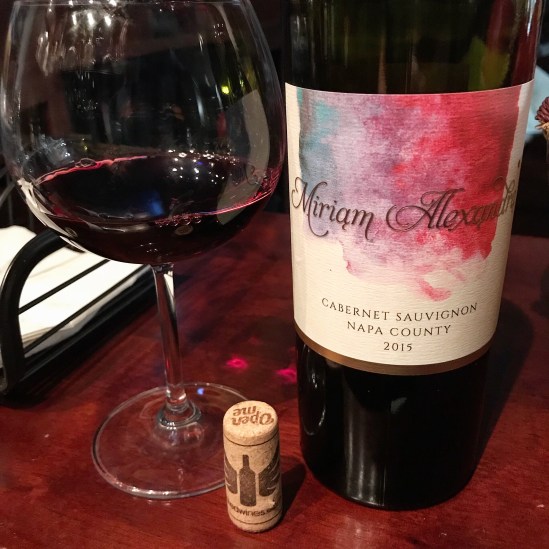
By now you probably know that I am a long-time customer of NakedWines.com. One of the things I like about the NakedWines.com business model is that the company encourages employees, who have an interest in winemaking, to pursue their dream. A number of wines available through NakedWines.com are made by winemakers who also hold staff positions within the company. One such winemaker is Alexandra (Alex) Farber, who produces her wines under the Miriam Alexandra label. Alex’s first wine was a 2014 California Chenin Blanc. Prior to tasting that wine, my only knowledge of Chenin Blanc was my memory of the jugs of cheap wine my folks would drink when I was little. My first taste of Alex’s Chenin opened my eyes to the wonder of today’s Chenin Blanc, and sparked an appreciation for this amazingly delicious wine! I’ve enjoyed three successive vintages of Alex’s Chenin Blanc, each one better than the last. This year, Alex released her first red wine, a 2015 Napa County Cabernet Sauvignon. When I saw it, I knew I had to try it.
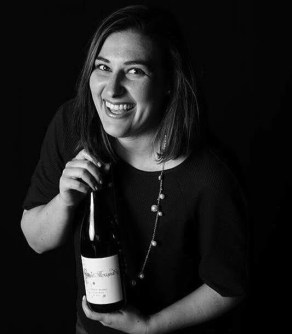
I have had the pleasure of meeting and visiting with Alex on several occasions. Recently I had the opportunity to ask her about her story, and her journey into winemaking. My first question was about the label name, Miriam Alexandra. The “Alexandra” is pretty obvious, but where does the “Miriam” name come from? Her response is interesting, and sheds some insight into her entry into the wine business.
Miriam Farber was my great-grandmother. She was an Art institute of Chicago graduate, and an incredible artist. She did lots of watercolor, and that is where the inspiration of my label comes from. Alexandra, was my mom’s first choice of first names for me, but didn’t like the way Alexandra Miriam sounded, and liked the idea that on a resume my name could be written as M. Alex Farber (gender neutral!), so I could go under the radar and be a successful female in business. Times have changed a little bit since then, so showcasing my full name was very important to me. Hence, Miriam Alexandra on my label.
How long have you been in the wine business, and how did you get your start?
I went to Davis for college and entered straight from high school into the V & E program. I worked my way through every quarter getting further away from all the pre-med pre-rec. classes and closer and closer to the wine classes. They were so interesting, challenging, and fun. So, I just kept going. Eventually graduating and getting an internship in Napa.
Do you have a family history in wine?
There is no family history in wine, other than lots of drinkers! I come from a family full of insurance brokers, bankers, lawyers, and accountants.
When did you bottle your first wine, and what varietal or style was it?
My first wine was bottled with NakedWines.com, my Chenin Blanc! I learned to make Chenin Blanc during my three year stint with Pine Ridge Vineyards as their Enologist. I spent those years in the Clarksburg Chenin Blanc vineyards and it is the wine I really wanted to make on my own with my own twist.
Have you worked at any wineries other than NakedWines.com?
Yes, I started as a harvest intern the summer/fall after I graduated from Davis at Trefethen Family Vineyards, I then went down to Chile and worked for Veramonte Wines, came back and was harvest enologist for Trefethen (for a year!), then did a very short time over the summer with Round Pond Estate, and finally took a full time job as Enologist for Pine Ridge Vineyards. Ultimately, I wanted to do something more than just be in the lab, I wanted to be in the vineyards, work with winemakers to learn more, and contribute more to the wine industry, that is when I found NakedWines.com, and I have been working here since then. Both as a winemaker and now as our Head of Planning.
What is your favorite grape varietal? Why?
This is such a tough question for me to answer. If you are asking me what I like to make the most, it’s probably Cabernet Sauvignon. It is so expressive of place, it tells its own story through the winemaking process, and I love the age-ability. If you’re asking me what I like to drink the most? It’s Grenache, Syrah, Rhone Varietals, Pinot Noir, Champagne – a variety of its own :).
When Alex isn’t busy making wine and fulfilling her staff duties at NakedWines.com, she is committed to giving back to the community. Two projects she is passionate about are Service Dogs, and empowering young girls to become strong, independent women. To further the first passion, Alex is raising Maui, an energetic and adorable Black Lab puppy. She told me how she got involved in this project:
Isn’t he cute?
I have been involved with puppy-raising for Guide Dogs for the Blind out of San Rafael for quite a few years now. I took a break after having shoulder surgery, and recently wanted to get back into it. An opportunity came up with a fellow guide dog raiser, who is now training diabetic alert dogs, to take Maui for a few months as a puppy. He is now about 8 months old, and is well on his way to becoming a canine diabetic alert dog for a type 1 diabetic child.
In Alex’s other project, she serves on the board of directors of the Napa and Solano County chapter of Girls on the Run. Alex said that she wanted to get involved in the non-profit world so she could give back to the community in a way that would provide life-changing impact on young peoples’ lives. She found Girls on the Run, an after school program for girls in grades 3 through 8, that teaches life skills and promotes individual identity. Through exercise, discussion, and teaching, the 10-week program empowers the girls, develops an appreciation for health and fitness, and provides important skill they will carry throughout their lives. Alex started as a volunteer Life Coach, meeting with girls twice per week. Once she started her job with NakedWines.com, she had fewer hours available to volunteer, so she became a board member. She’s been on the board for about three years now, and says the organization will impact more than 1,000 girls in 2017.
Finally, I asked Alex if she wanted to add anything else about her exciting journey into winemaking. Here’s what she had to say:
Because of NakedWines.com, I had the opportunity to become a winemaker much sooner than I had ever dreamed of, and it has been so incredible. I had four vintages of wine as a winemaker under 30! Without the support of Angels, and their trust in me as a winemaker, I wouldn’t have ever been able to make the wine I get to make today. It’s been such an honor and I can’t wait to continue making wine.
So now that you know a bit more about Alex, the winemaker, let’s explore Miriam Alexandra Cabernet Sauvignon Napa County 2015, the wine.
The wine is a deep purple color with a brick colored rim. The nose is a delight of blackberry, cassis, and oak aromas. On the palate, I was greeted with flavors of fresh blackberry, cherry, cassis, oak, and vanilla, with some red currant and chocolate notes. As expected for such a big, yet young wine, the tannins are firm and edgy, providing a mouth-drying punch but offering a deep, pondering complexity. The tannins will soften with age, but if you can’t wait, I recommend at least an hour decant before tasting. With medium acidity and mouthfeel, the finish lingers long with black fruit, spice, and vanilla. With aging potential of 5-10 years, or longer, this is a spectacular value for a Napa Cab.
I brought this to a house party a few weekends ago, and we opened and tasted it sans food. Everybody enjoyed the wine, and commented on the solid fruit structure and compexity. Once we drained this bottle, the hosts opened a different Napa Cabernet, a 2012 from a small boutique winery in Napa. They boasted that their bottle set them back $80 (4x the Angel price for Alex’s offering.) While the 2012 was nice and had good fruit flavor, it lacked the oomph, complexity, and structure of the Miriam Alexandra. I can imagine that in a blind tasting, Miriam Alexandra would beat out the older boutique wine.
Though I didn’t get to taste this bottle with food, this is a wine that would pair exceptionally well with a marbled rib-eye or prime rib. The fat would help tame the tannins and the wine would enhance the deliciousness of the meat. Fortunately, I have a few more bottles, so I can experience the magic of the meal I just recommended.
If you would like to try one of Alex’s wines, click on this link, or the logo below, to receive a voucher worth $100 of a first-time order of $160 or more.
Our Wednesday evening drive over to Santa Rosa for the 10th Annual Wine Bloggers Conference (#WBC17) was dark and rainy. We were unsure what to expect when we awoke Thursday morning for our excursion to Hanna Winery and Vineyards; other than an exciting and educational winery tour, and delicious catered meal with wines to match, of course.
Thursday dawned dry and only partly cloudy. It was a perfect day for a trip to wine country. As we rode on the bus out to Alexander Valley and the Hanna Winery and Vineyards Tasting Room, we saw the results of the devastation of the fires that had ravaged the area just weeks before. Yet we also saw the rebuilding that had already begun. With the sun peeking through the clouds, we could almost feel the hope and resilience we saw around us.
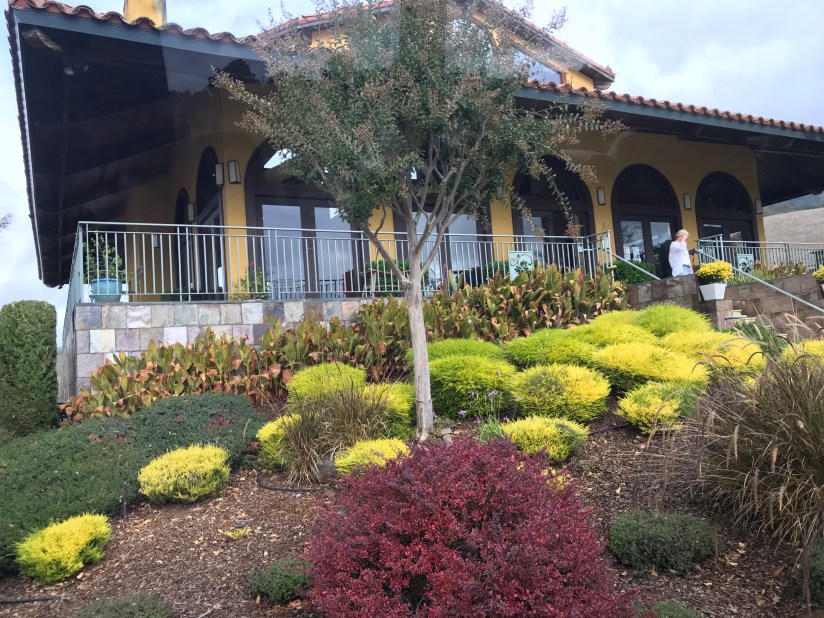
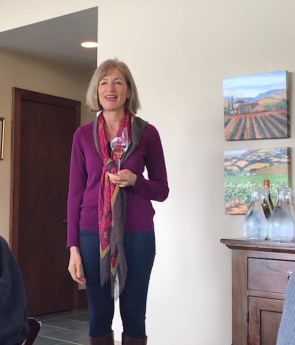
The drive through the autumn colors of the vineyards was breathtaking, and turning up the driveway to climb the hill to the Tasting Room we were taken by the beauty. Hanna Winery and Vineyards sits atop a hill with a 360 degree of the surrounding valley. The views were amazing! As we entered, we were greeted by friendly, smiling staff with a glass of Sauvignon Blanc. Soon, our host, Christine Hanna welcomed us and provided some history of the family winery.
This slideshow requires JavaScript.
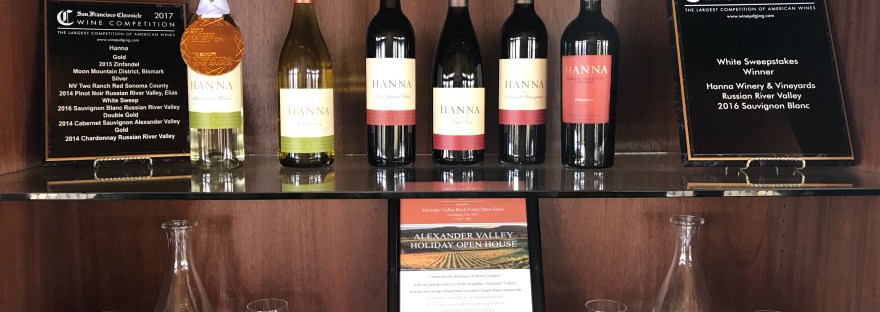
Founded in 1985 by Dr. Elias Hanna, Christine’s father, the land was originally planted to French Colombard grapes. Soon, the family discovered that the land was well-suited to other grapes that could be crafted into world-class wines. As the operation grew, Christine took the reigns as president in 1993, and has continued to lead the way as the winery has grown and expanded its influence.
Hanna Winery and Vineyards wines are estate grown on three vineyards in the area. In the Russian River Valley, the flagship Home Ranch Vineyards grows Chardonnay and Pinot Noir on its 25 acres, while Slusser Road Vineyard, 50 acres in size, is planted to Sauvignon Blanc and Chardonnay. Red Ranch Vineyard, in Alexander Valley, is 88 acres of Cabernet Sauvignon, Merlot, Malbec, and Petit Verdot. Bismark Mountain Vineyard, high in Sonoma Valley in the Moon Mountain AVA, grows Zinfandel and Bordeaux varietals.
Christine related the story of how, in an effort to develop the Bismark Mountain Vineyard site, she had to overcome the challenges of accessing a high mountain site without the benefit of such amenities as roads and electricity. Helicopters were involved, and she was successful in bringing this spectacular vineyard into existence.
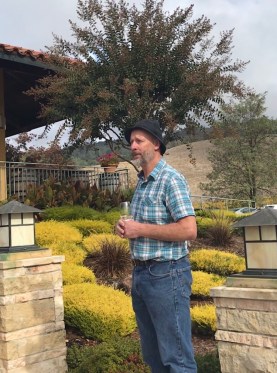
Christine introduced us to Hanna’s winemaker, Jeff Hinchliffe, who took over the presentation and eventually led us down to the fermentation and barrel room on site for some barrel tasting. Jeff has been the winemaker since 1998. He explained how the varying terrain of the vineyards influences the flavor and profile of the grapes and wines. Jeff is clearly passionate about winemaking, while remaining distinctly humble. Jeff says that “wine will make itself, if you let it.” Jeff is especially enthusiastic about Malbec. He says Malbec wines are easy to make, but the grapes are not easy to grow. Still, he and Hanna Winery are quite successful at it, and produce a number of Malbec varietal wines. In addition, their Cabernet blend contains 25% Malbec.
Perhaps the highlight of the barrel tasting was our opportunity to sample one of the rarest vitis vinifera grapes in the world. Once common in Bordeaux wine production, St. Macaire was virtually wiped out by the phylloxera epidemic, and thought to be extinct. However, St. Macaire was not ready to be relegated to an historic footnote. Jeff discovered that a nearby vineyard had a half-acre planted to the grape. The vineyard owner provided some cuttings, and Jeff planted a half-acre of St. Macaire at Hanna. They plan to release their first vintage of this wine soon, but we were able to get a taste of the still-developing juice. The wine is inky purple, nearly black in color. Though still very young, with high acidity and tight tannins, the wine was aromatic and flavorful. At this stage, there were significant green, spicy, vegetal notes along with some black fruit. Jeff asked around the room for descriptors. Responses included cassis, eucalyptus, and menthol. I hope to get a sample of the finished product once bottled and released.
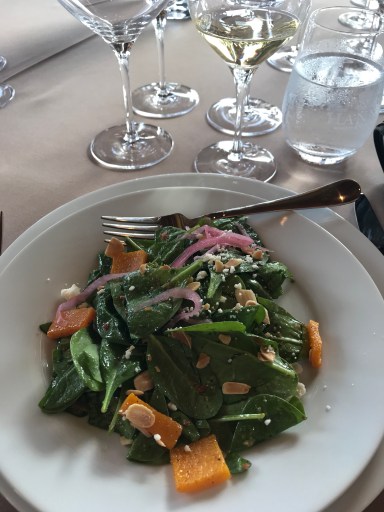
Back upstairs and into the tasting room, it was time for a delightful lunch. The table was exquisitely set, and the multiple stemware glasses at each place setting spoke of good things to come! The meal was exquisitely catered by Chef Heidi West, with each course paired with one or two Hanna Winery selections.
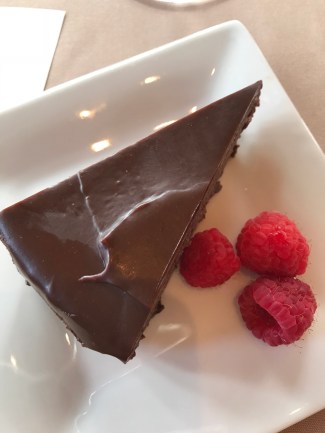
The meal was superb, the setting spectacular, and the hosts unparalleled in warm hospitality. Enjoy the photo montage of the meal, and try not to drool on your screen!
FIRST COURSE PLATED
2015 Hanna Russian River Chardonnay
Baby Spinach Salad with Roasted Butternut Squash, Toasted Sliced Almonds, Pickled Red Onion and Warm Bacon Dressing
MAIN COURSE FAMILY STYLE
2015 Elias Pinot Noir/2014 Alexander Valley Cabernet Sauvignon
Porchetta with Salsa Rosamarina, Soft Creamy Polenta with Fresh Corn, Marscapone, Pecorino and Parmesan
Haricot Vert with Extra Virgin Olive Oil and Sea Salt
DESSERT PLATED
2014 Bismark Cabernet Sauvignon
Flourless Chocolate Cake with Fresh Raspberries
If you are in Sonoma County wine country, it’s definitely worth a trip to visit the fantastic people at Hanna Winery and Vineyards. Take in the spectacular views, and enjoy some amazing wines.
That seems an appropriate way to open a story about a trip to Santa Rosa, home to the Charles Shultz museum. Charles Shultz, of course, was the creator of the Peanuts comic strip, and everybody’s favorite beagle, Snoopy.
Our “easy” drive to Santa Rosa was hampered by the first significant rain storm of the season. The roads were slick, and glare from oncoming headlights was blinding, so everyone was driving extra cautiously. And slow. But we made it, and spent the last three days enjoying the activities and adventures of the 10th Annual Wine Blogger’s Conference, #WBC17.
It was our first time attending WBC, but it will not be our last! It was a fun, informative, and engaging event. This post will be a general overview of events, with more detailed posts of the highlights in coming days and weeks.
Our first event was an excursion to Hanna Winery. Located on a hilltop with gorgeous, sweeping views of the valley, Hanna Winery has been in operation since 1985. We were greeted by our host, Christine Hanna, who gave us some history, and then winemaker Jeff Hinchcliffe took us down to the barrel room for some tasting. Following this, we enjoyed an amazing lunch, paired with several Hanna wines. Welcome to Sonoma County, indeed!
Upon our return to Santa Rosa, we participated in a Wine Discovery Session with Mark Beringer, Chief Winemaker at Beringer Vineyards. He led us through a tasting of their Private Reserve Cabernet Sauvignon, starting with four of the single vineyard wines that go into the final blend. Once we had established the baseline, we “worked” our way through a decade vertical tasting of the Private Reserve wines, starting with 2014 and travelling back in time to the 2004, 1994, and finishing with the 1984 vintage. The evolution of these powerhouse wines was amazing to behold.
Later in the day, we journeyed around the world with A Study of Pinot Noir. Our tour guide was Senior Winemaker John Priest, from Etude Winery. He took us from Sonoma County, north to the Willamette Valley, then all the way south to New Zealand in our exploration of this incredibly versatile grape. It was a wonderful trip!
The wine education sessions were followed by an opening reception, where we met many of the bloggers we have been following, as well as new friends. Thus ended day one!
The following day, we attended educational seminars covering writing tips, legal and ethical issues, wine vocabulary, and developing relationships with wine companies. Lunch was hosted by El Dorado Wines. Nearly 30 El Dorado County winemakers lined the back of the conference room, and then poured samples of their wines.
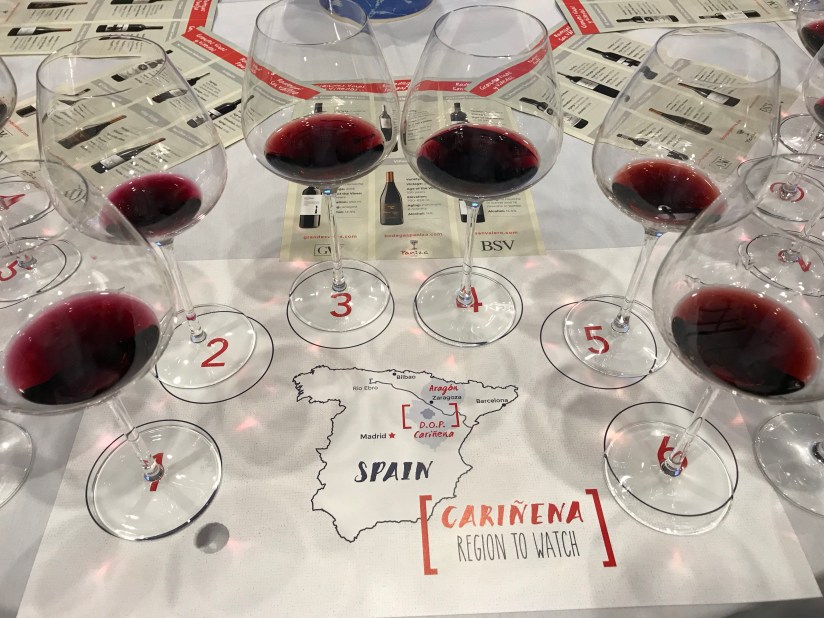
After lunch we enjoyed a Wine Education Seminar, presented by Lyn Farmer, about the “Region to Watch,” DOP Cariñena in Spain. We were immediately enamored with the region, and have added DOP Cariñena to our list of “Must Visit” destinations. We tasted through an amazing flight of Garnacha, with one Cariñena varietal wine (you may know it as Carignan) mixed in for interest. These are some amazing, affordable wines. You’ll want to try some as soon as possible!
Following a captivating keynote address by Doug Frost, we participated in our first Live Wine Blogging event. Wineries get five minutes at each table to pour tastes, and we blogged, Tweeted, or Instagrammed our impressions of the wines. It was kind of like speed dating, but with wine! A high-energy and raucous time, we tasted some amazing wines! The Friday speed-tasting was whites and rosés.
Friday ended with what was the absolute highlight: a Wine Cave Dinner at the Thomas George Estate. It was a first class affair! It was an amazing, “check-it-off-the-bucket-list” adventure. We’ll write more about this later, but suffice it to say this was among best meals we have ever had!
This slideshow requires JavaScript.
Saturday opened with more educational sessions, including Social Media tips, photography and video, and panel discussions covering relations with PR firms, and ideas for monetizing a wine blog. (If you’re into that whole, making money doing what you love thing.) We also attended a presentation about the devastating wild fires that ravaged the area only one month earlier. The destruction was unprecedented, but the recovery and rebuilding has begun, and Wine Country is open for business.
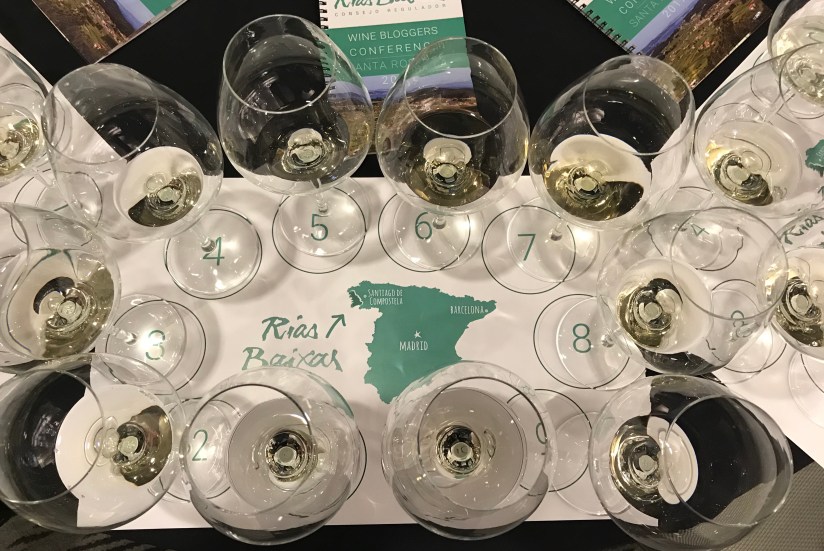
Following lunch, we returned to Spain with our host, Lyn Farmer, to explore DO Rías Baixas, and the spectacular Albariño wines being produced there. We tasted through 10 (yes, ten!) different expressions of this amazing white wine. I can’t say enough about Lyn Farmer and his friendly, comfortable teaching style and encyclopedic knowledge of Spanish wines.
After another round of Live Wine Blogging, AKA speed-tasting, this time with red wines, the conference concluded with a banquet hosted by NakedWines.com. As you probably know, I am a long-time customer of NakedWines.com, so it was fun to see many of the winemakers and staff I have come to know over the years.
Even with all the fun and wine (did I mention we had wine?) the biggest take-away for us is the comradery, support, and encouragement that exists in the wine blogging community. From big name bloggers and writers, who have thousands of followers and are making a living writing about wine, to brand new members who have yet to post their first blog, we were warmly welcomed and embraced as part of the family.
Summer is the traditional season for Rosé wine. There is a movement afoot to encourage wine lovers to enjoy Rosé all year, and I’m all on board. I do enjoy Rosé wine year around. Nevertheless, lighter bodied, crisp wines taste best to me (any many others) when the weather is warmer. Poolside, lakeside, or parkside, a refreshing Rosé is a great way to enjoy a summer afternoon.
Rosé wine comes to the plate with two strikes against it. First of all, many people I know still think all Rosé wine is like the syrupy sweet White Zinfandel popular in the 80’s and 90’s. This is simply not true. The reality is that a good many of the Rosé wines available today are crafted in the classic, Provençal style: dry, crisp, and refreshing. Still, some simply aren’t willing to give dry Rosé a try. I say their loss is my gain: more for me!
Strike two is that there are a lot of low quality Rosé wines out there, lacking in flavor, interest, or character. I suppose this is to be expected when a product suddenly becomes as popular as Rosé has in recent years. Everybody wants a piece of the action; to ride the wave while it is high. So they’ll rush to put something, anything out there to enter the market before the tide turns. (I’m detecting a surf theme here. Appropriate, given that Rosé is a great beach wine!)
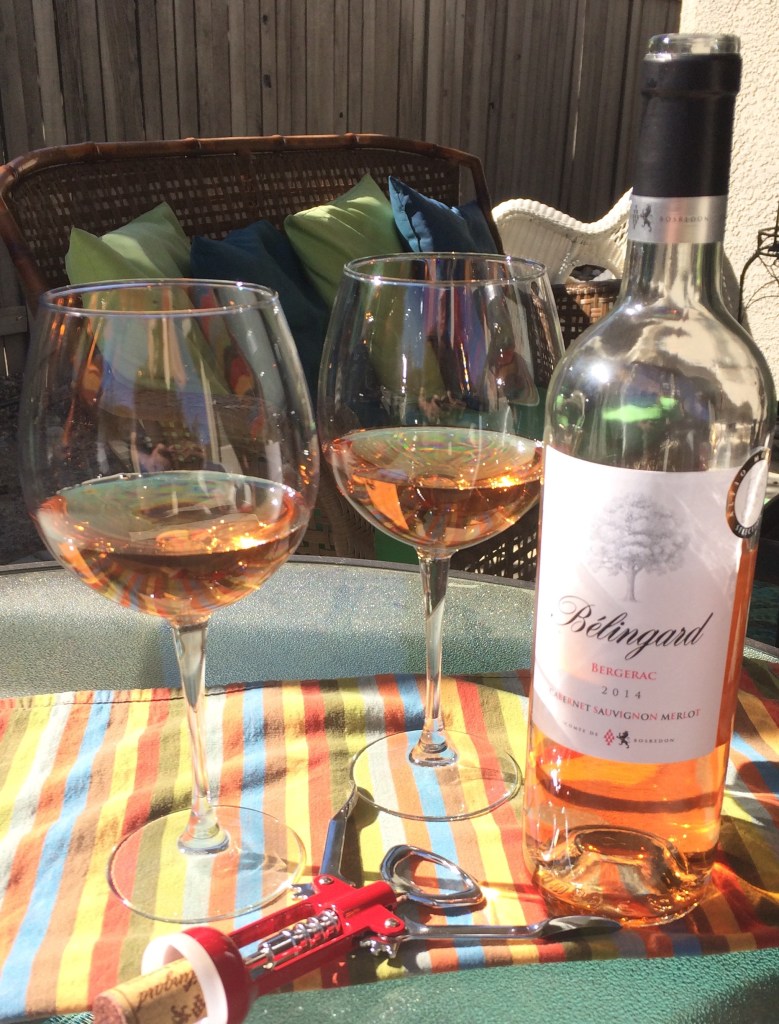
Fortunately, there are also many excellent Rosé wines available! I found one of them recently at my local Total Wine & More store. Château Bélingard AOC Bergerac Rosé (Retail: $11.99) is a blend of 70% Cabernet Sauvignon and 30% Merlot. As one might expect from the use of these two big, bold red grapes, this Rosé has a bit more body and heft than most. Make no mistake, though; this is still a dry, crisp, refreshing wine!
Founded in 1820, Château Bélingard is located in Southwest France, in the Bergerac appellation, east of the more famous Bordeaux region. While Bergerac wines are made predominantly with the same varietals as those of Bordeaux – Cabernet Sauvignon and Merlot based red wines, and Sauvignon Blanc and Sémillon based whites – Bergerac wines are often considered softer and less serious. I don’t take this as a criticism in any way! On the contrary, these are high quality, value wines! Not everyone is a collector or connoisseur, and there is definitely a need for affordable, easy-drinking, everyday wines.
In addition to this Rosé, Château Bélingard produces an impressive portfolio of reds and whites, including a Sauvignon Blanc/Sémillon/Muscadelle blend, and several levels of Cabernet Sauvignon/Merlot blends. Below is my review of the Rosé, which we recently enjoyed as a cool refresher on a 102°F Sunday evening.
Salmon, almost orange color. Aromas and flavors of tropical fruit including mango and passion fruit, with a hint of mandarin, along with light red berry flavors of strawberry and ripe raspberry. Dry with medium body and a soft, round mouthfeel and lively acidity make this a refreshing wine, yet big enough to pair with grilled tri-tip steaks or other summer BBQ fare.
We really enjoyed this wine! I rated it 4.5 out of 5 stars (92 – 94 points).
Check your local retailer and seek out some of this amazing Rosé wine! You’ll be glad you did!
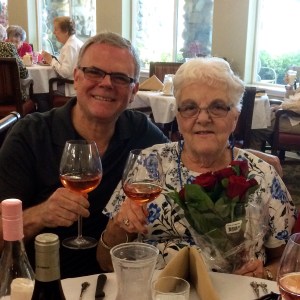
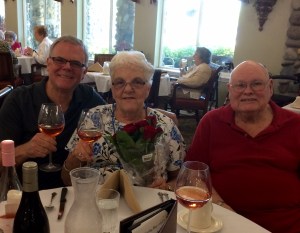
Today is Mother’s Day in the United States. I am fortunate, in that both of my parents are alive and healthy, in their early 80’s. What’s more, they live in a beautiful retirement apartment complex just a few minutes from my home. Over the years, we have not always lived so close; so many Mother’s Days were spent remotely. So I’m pleased to be able to celebrate this day over a meal and wine with both my mother and dad.
Contrary to popular belief, at least by me, Mother’s Day is not just another “Hallmark Holiday.” Indeed, the day we know today was started in 1908 by Anna Jarvis, to honor the sacrifices mothers make for their children. Hallmark wasn’t founded until two years later in 1910! In 1914, President Woodrow Wilson signed a declaration establishing Mother’s Day as the second Sunday in May. Yet celebrations of motherhood date much further back than that. The ancient Greeks and Romans held festivals honoring the mother goddesses Rhea and Cybele. More modern Christian celebrations of “Mothering Sunday” eventually evolved into the holiday we enjoy today.
I like to refer to the community where my parents live as a “land-based cruise ship.” It’s pretty much all-inclusive, with three meals a day, housekeeping services, social activities, recreation, and a shuttle bus for day trips and running errands. In fact, the apartments themselves don’t even have kitchens! Management is always gracious and invites guests for special occasion meals. Mother’s Day is no exception! Lunch is the big meal of the day, and there is always a main entrée, as well as an alternate in case you don’t care for the main. Mind you, these are chef-prepared meals so they’re always enticing and tasty!
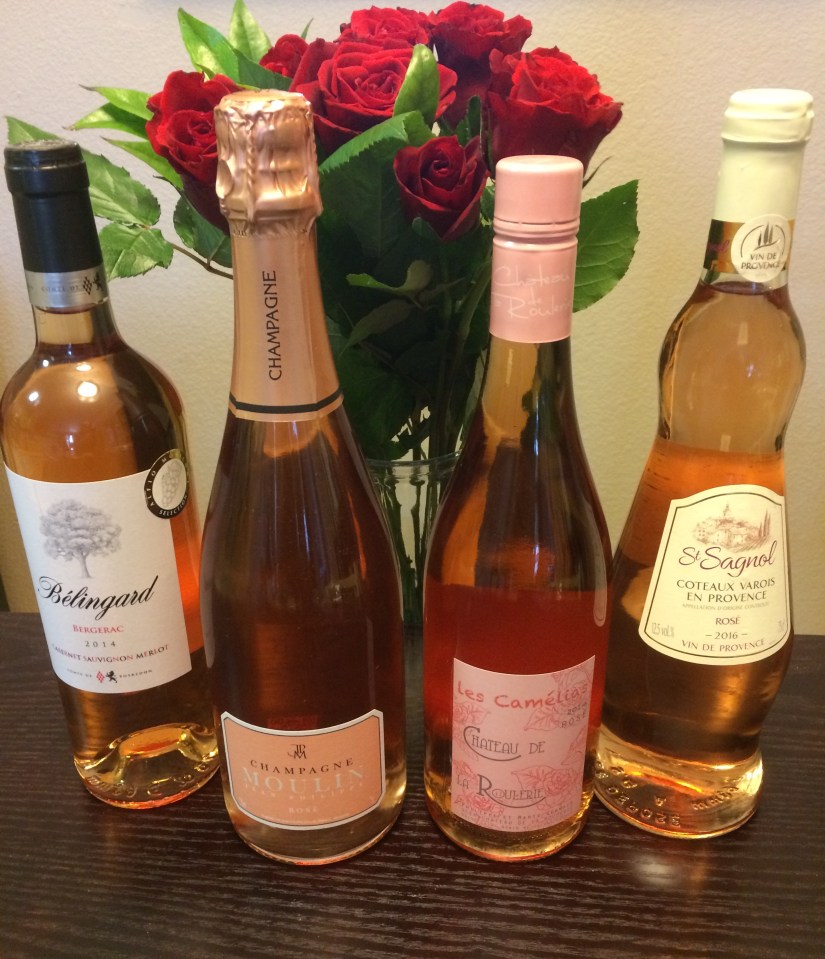
Today’s main entrée was marinated flank steak with hoisin sauce, with arepas and artichoke timbales. If you’re not feeling like beef, the alternate was crab cakes with papaya pepper puree and citrus dill aioli. When I come over for special meals, I always like to bring a bottle or two of wine to pair with the meal. After all, I am a wine guy, so my folks appreciate my recommendations! I went in assuming we would all want the flank steak, so I brought a Cabernet Franc; the Le Pré Vaujour Chinon 2016. However, it was possible that my mom would surprise me and order the crab cakes. Besides, this is Mother’s Day, so we have to have a Rosé, right? As you can see in the photo above, we had several Rosés to choose from. In keeping with the Cabernet Franc theme, we opted for the Château De La Roulerie Les Camelias Rosé 2014, a blend of 50% Cabernet Franc and 50% Cabernet Sauvignon.
Roses and Rosé for Mother’s Day! OK, props to dad, too. Without him, she wouldn’t be my mother!
As expected, the meal was delicious! We started with a salad of spring greens, micro greens, and Belgian endive with peach-basil vinaigrette. Although we all ordered the flank steak, we opened the Rosé for the salad course. It was an amazing pairing! When the main course arrived, we chugged the remaining Rosé in our glasses to make room for the red wine. Honestly, I was a little apprehensive. I hadn’t realized until I got the bottle home that the Chinon was a 2016 vintage. The grapes in the bottle were on the vine only a few months ago! I needn’t have worried, though, as the pairing was heavenly! For dessert we enjoyed homemade tiramisu and sipped on the last of the Chinon. Yum!! It was a very pleasant and enjoyable way to celebrate the sacrifices my mother made in raising my sister and me. Mainly my sister. (Just kidding, sis!)
This slideshow requires JavaScript.
The Wines
Château De La Roulerie Les Camelias Rosé 2014
Salmon color in the glass. Aromas and flavors of strawberry, red raspberry, and red currant. Bright acidity with medium body. Light and lively. Red berry, including cranberry on finish. Excellent pairing with the spring and micro greens salad with endive.
4.0 Stars (88 – 91 points)
Le Pré Vaujour Chinon 2016
Yes, 2016. Very young, but very good! Bright purple color in the glass. Aromas and light mouthfeel are reminiscent of a Beaujolais Nouveau: Fresh raspberry, red currant, and violet, with some spice, and a bit of freshly tilled earth, with just a hint of oak influence. Surprisingly soft and smooth for such a young wine, with lively acidity and medium body. The acidity made it perfect with the flank steak, and led to a long, pleasing finish. Very good now, with aging potential for several years.
4.0 Stars (88 – 91 points)
My hope is that each of you enjoyed celebrating your mother as much as I did mine. Let me know in the comments what you did with your mom, and what wines you paired with it!
Total Wine & More bills itself as “America’s Wine Superstore.” I would have to agree. The first two times I walked into a Total Wine store, I walked out empty handed. It was simply overwhelming. Those of you fortunate enough to live near one of their 135 stores in 18 states know what I mean. They stock more wine, beer, and spirits on their shelves than anywhere else I’ve ever seen. Simply walking through the store can be disorienting to the uninitiated. I recommend hiring a guide. If you’re ever in the Sacramento area, drop me a line and for a small fee (a bottle of sumpin’ sumpin’) I will gladly help you navigate the labyrinth.
Like so many retailers these days, Total Wine has a loyalty rewards program; they call the Total Discovery Program. Basically, you earn points for each dollar spent in the store. You start at the “Select” level, which basically gets you coupons. Rack up enough points and you level up to the “Reserve”, then “Grand Reserve” levels. At these levels, you receive discounts on products and classes, and invitations to complimentary Members-Only events.
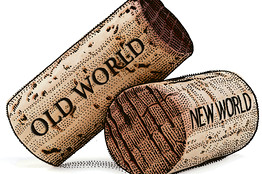
But this post is not intended to be free advertising for this magical place. Rather, it is about an event I attended there yesterday evening. Apparently, even though most of my wine comes to me via online retailers, I buy enough product from Total Wine to have recently achieved “Reserve” level status. Thus, I received an invitation to their Sip & Mingle event, The Great Cab Debate: Old World vs. New World Cabernet Sauvignon. Not one to turn down an opportunity to taste world-class wine for free, I naturally submitted my RSVP accepting the invitation.
As one might imagine, this event pitted four Left Bank (Cabernet based) Bordeaux against four California Cabernet wines, in the spirit of this year’s 40th anniversary of the famous Judgment of Paris tasting. This was not a blind tasting, and as the name of the event, Sip & Mingle, implies, it was as much a social evening as a wine tasting. At these events, participants are encouraged to chat, socialize, and nibble on the snack foods provided. Sure, there were a couple of serious wine tasters present, who stood quietly in a corner sipping, spitting, and jotting notes without interacting much. But for the most part, the 20 or so people there relaxed at the tables and enjoyed the wine and conversation. It was certainly a pleasant way to spend a couple of hours on a Friday evening.
Now I know what you’re thinking: “What about the wine?” Ah, yes, the wine. Most of my Bordeaux experience has been Right Bank, Merlot based, so I was anxious to try some of the prestigious Left Bank Chateau creations. These hailed from the Médoc, Haut-Médoc, Pessac-Léognan, and Pauillac appellations. The California wines included one from Paso Robles, and three from the general Napa Valley AVA. In order of recommended tasting, here’s what I thought of them:
Sextant Cabernet Sauvignon Paso Robles 2014
Brick red, ruby rim. Nose of blackberry and red currant. Flavors of blackberry, red currant, black pepper and spice. A little hot but smooth tannins. Long, spicy finish.
Retail $19.99
4.0 out of 5 stars (88-91 points)
Château Pierre de Montignac Médoc Cru Bourgeois 2011
Brick red, ruby rim. Plum and earth on the nose. Flavors of raspberry, sour cherry, soft oak, and spice. Bone dry with firm tannins and a medium finish.
Retail $19.99
4.0 out of 5 stars (88-91 points)
Courtney Benham Cabernet Sauvignon Napa Valley 2011
Purple color with brick rim. On the nose, green bell pepper, light blackberry, and dusty earth. Blackberry, black plum flavors with soft, smooth tannins and light acidity. Medium finish with berry and white pepper.
Retail $24.99
3.5 out of 5 stars (85-87 points)
Château Landat Vieilles Vignes Haut-Médoc 2012
Ruby color. Nose of raspberry and blackberry. Flavors of ripe raspberry, plum, red currant, earth, and spice. Supple tannins, medium acidity, and a medium, spicy finish.
Retail $29.99
4.0 out of 5 stars (88-91 points)
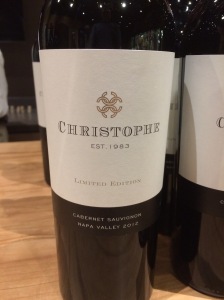
Christophe Limited Edition Cabernet Sauvignon Napa Valley 2012
Purple color with ruby rim. Aromas of ripe blackberry and soft oak. On the palate juicy blackberry, cassis, and white pepper. Super soft tannins and light acidity. Medium finish of dark berry.
Retail $35.99
4.5 out of 5 stars (91-94 points)
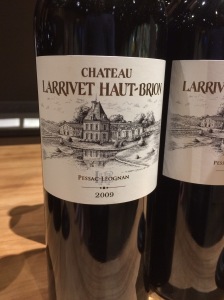
Château Larrivet Haut-Brion Pessac-Léognan 2009
Deep purple color with ruby rim. Nose is fig, mushroom, and cedar. Flavors of ripe blackberry, cassis, black pepper, and black plum. Soft, velvety tannins and balanced acidity with a long, fruity, spicy finish.
Retail $39.99
4.0 out of 5 stars (88-91 points)
Baldacci IV Four Sons Fraternity Napa Valley Red 2012
Deep, inky purple color. Aromas of blackberry, bramble, cassis, and a hint of licorice. On the palate, blackberry, cassis, black pepper, and spice. Rich and fruity, with soft tannins and balanced acidity. Long finish with berry, cocoa, and spice. My favorite of the evening.
Retail $46.99
4.5 out of 5 stars (91-94 points)
Château d’Armailhac Grand Cru Classé Pauillac 2012
Ruby color with brick rim. On the nose, herbal notes with green bell pepper and blackberry. Flavors of blackberry, bell pepper, earth, spice, and cedar. Still young, the tannins are edgy and its a little acidic. This one needs a few more years in the cellar.
Retail $44.99
3.5 out of 5 stars (85-57 points)
This was a fun evening. Although not a blind tasting, it was interesting to compare Old World v. New World Cabernet Sauvignon based wines. Overall, as in ’76, Napa won the evening. At least for me! I look forward to my next invitation to a Total Wine & More Sip & Mingle event!
This is the first review in my Judgment of Paris wines series. I came up with the ridiculous idea of sampling recent vintages of each of the 10 reds and 10 whites represented in the famed blind tasting of 1976. This will probably take a couple of years to complete, but they say it’s good to have goals, right?
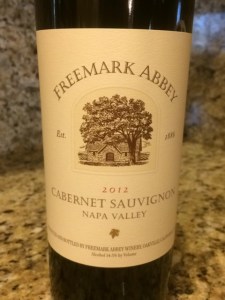
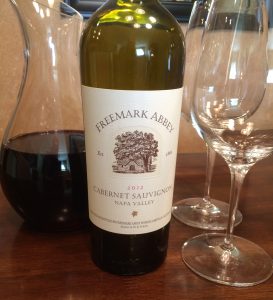
Freemark Abbey was one of 11 wineries representing Californian wine at the 1976 blind tasting event. In addition, Freemark Abbey has the distinction of being the only producer to have wines represented in both the reds (Cabernet Sauvignon/Bordeaux) and whites (Chardonnay/White Burgundy) competitions. The wines entered were hand-selected by the organizer, Steven Spurrier. Each of the wines chosen were considered the best of the best, and was selected over hundreds of others. So even though the Freemark Abbey Cabernet Sauvignon placed 10th out of 10 entries, it’s still a very impressive showing.
Photo Credit: FreemarkAbbey.com
Freemark Abbey has no connection to nuns or monks, or any religious institutions for that matter. Nevertheless, the winery has an intriguing past, with many notable mileposts. Freemark Abbey Winery’s history dates back to 1886, when Josephine Tychson, a Victorian widow, built a redwood cellar on the site, becoming the first female winemaker in the Napa Valley. 12 years later, in 1898, a friend of Ms. Tychson named Antonio Forni bought the winery. He renamed it Lombarda Cellars in honor of the Italian town of his birth. Forni constructed the winery building which still stands today. The current name came about in 1939, when three southern California businessmen bought the winery. Charles Freeman, Marquand Foster, and Albert “Abbey” Ahern combined their names to form Freemark Abbey. Of course the role Freemark Abbey had in the 1976 Judgment of Paris, and the impact that event had on the Napa Valley, remains one of the winery’s crowning moments.
Here’s my review of this historic Napa Valley Cabernet Sauvignon:
I decanted the wine for a little over an hour. Deep, inky purple color. Aromas of ripe blackberry, Marionberry, and cassis, with soft oak. As the wine opened up, the luscious aromas filled the room, and some light violet scent emerges. On to the tasting! This is a rich, full-bodied wine. There are flavors of blackberry, cassis, black plum, mild oak, and pepper. The tannins are soft and smooth. The berry and oak flavors continue into the medium-long finish, with the addition of some baking spice and dark chocolate. There is also a little lingering alcohol on the finish. Paired well with grilled ribeye and roasted rosemary potatoes.
4.0 Stars (88-91 points)
Total Wine & More: $32.99
So, one down, 19 to go! Now it’s on to the next one. Wish me luck!
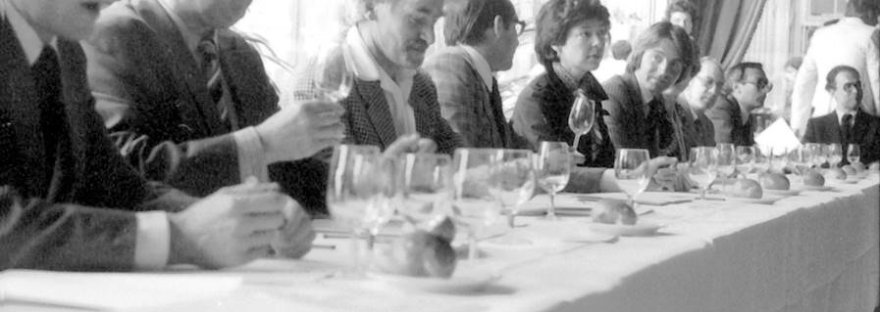
It was 40 years ago this week that Steven Spurrier, a British wine merchant living in Paris, held a wine tasting event, the results of which shocked the wine world. Spurrier gathered nine expert judges, all of them French, for a head-to-head blind tasting of the best of Bordeaux and Burgundy against relatively unknown wines from California. Spurrier and an associate, American Patricia Gallagher also participated in tasting and judging the wines. At the time, the commonly held belief was that French wines were the standard of quality, and anything else was inferior. The tasting was originally intended to simply generate publicity for Spurrier’s wine shop and school. Therefore, there was not a lot of outside interest in it, and only one journalist attended the event; George M. Taber, from Time Magazine (Taber, 2005).
Photo Credit: Wikipedia
There were two separate competitions: White Burgundy vs. California Chardonnay, and Red Bordeaux vs. California Cabernet Sauvignon. In each category, there were four French wines, and six from California. The outcome is now well known – a California wine won top honors in both categories. The event changed the landscape of the Napa Valley, figuratively and literally. Taber later compiled the experience in his book: Judgment of Paris: California vs. France and the Historic 1976 Tasting that Revolutionized Wine (Taber, 2005). It is a fascinating and educational account, not only of the tasting event, but also of the history of wine in France and the Napa region. The tasting was also dramatized in the movie Bottle Shock in 2008. It’s worth seeing if you haven’t, but keep in mind this is a motion picture dramatization, complete with editorial and creative license. If you want to really explore and learn about the history, I recommend reading the book!
Photo Credit: Amazon.com
Below are the results of the famous 1976 tastings, in order of their ranking:
White
Chateau Montelena, 1973, Napa
Meursault Charmes Roulot, 1973, Burgundy
Chalone Vineyard, 1974, Monterey County
Spring Mountain, 1973, Napa
Beaune Clos des Mouches Joseph Drophin, 1973, Burgundy
Freemark Abbey Winery, 1972, Napa
Bâtard-Montrachet Ramonet-Prudhon, 1973, Burgundy
Domaine LeFlaive, 1972, Burgundy
Veedercrest Vineyards, 1972, Napa
David Bruce Winery, 1973, Santa Cruz Mountains
Red
Stag’s Leap Wine Cellars, 1973, Napa
Château Mouton Rothschild, 1970, Bordeaux
Château Haut-Brion, 1970, Bordeaux
Château Montrose, 1970, Bordeaux
Ridge Vineyards Monte Bello, 1971, Santa Cruz Mountains
Château Léoville-Las-Cases, 1971, Bordeaux
Mayacamas Vineyards, 1971, Napa
Clos Du Val Winery, 1972, Napa
Heitz Cellars Martha’s Vineyard, 1970, Napa
Freemark Abbey Winery, 1969, Napa
Among my more cockamamie ideas, it occurred to me that it might be fun to taste each of the wines featured in the Judgment of Paris. Of course, I’ll have to purchase current vintages, but so be it. Many of the châteaux and wineries represented in the competition continue to produce stellar wines, and their prices and scarcity reflect the prestige. Others have remained more affordable and are readily available. In 2004, Chalone Vineyards was purchased by global conglomerate Diageo, which took the brand in the direction of mass-produced table wine; neglecting its historic importance. Fortunately, earlier this year the winery was purchased from Diageo by Foley Family Wines. Spokesman Bill Foley says that Foley Family Wines will work to restore the estate’s reputation and highlight its place in history (Worobiec, 2016).
As much as I’d like to, I won’t be able to recreate the blind tasting, but instead will have to purchase and sample the wines individually over several months. This may prove to be an insurmountable challenge, simply due to the availability (or lack thereof) and cost of some of the famous French wines. Nevertheless, other than those that are clearly out of my range (Château Moutin-Rothschild, for as much as $1,100 for recent vintages, comes to mind) I am determined to seek out and taste them all! Watch for reviews coming soon!
———————————————————————————————————————-
Works Cited
Taber, G. M. (2005). Judgment of Paris: California vs. France and the Historic 1976 Paris Tasting that Revolutionized Wine. New York: Scribner.
Cabernet Sauvignon. The king of the grapes. The stuff of Grand Cru Bordeaux, and Napa legends. From poets to journalists, critics to bloggers, much has been written about this most famous varietal, and much more will be in the future. None of the words put to print can adequately capture the magic that happens when a skilled winemaker plies his art on this noble grape, and produces the fine elixir sought by kings and paupers alike.
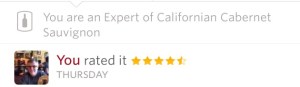
Ah, but I wax poetic. Who am I kidding? That’s not my style! Let me just say that Cabernet Sauvignon is some darn fine wine! It is one of my favorite varietals, and if you believe the stats, it is my #1 favorite. And you can’t argue with stats! I had always considered Zinfandel my favorite, but looking back on my wine apps, I have consumed and rated more Cabernet Sauvignon than any other varietal! So much so, that Vivino considers me an Expert of California Cabernet Sauvignon! I don’t know that I’m an expert of much of anything, but if Vivino says it of me, I’ll take it!If you follow my blog, or have read my very first post, Appetite for Wine, (found under the About tab), you know that I tend to live in the Under-$35 world of retail wine prices. Most of my purchases are in the sub-$20 region. At this price point, you can find quality, but a lot of Cabernet Sauvignon in this range is rather one-dimensional and uninspiring. Not that it’s all bad…many have very good flavor, but are often blends that dilute the unique terroir, and/or spend very little time in oak, which I consider to be very important for Cabernet. As I discussed in a previous post, A Cabernet is a Cabernet. Or Is It?, not all wines are created equally, and things like climate, soil, and blending can change the character of wines made from the same varietal. Generally speaking, as with most things in life, the higher the quality, the bigger the price tag.
Another thing you probably know about me is that I am a NakedWines.com Angel. NakedWines.com is a crowd funded winery, whose winemakers produce high quality, boutique wines, which they sell directly to Angels. By avoiding the costly and archaic three-tier system, NakedWines.com is able to pass their savings to the Angels by selling at reduced prices. Therefore, Angels get better quality for the price. NakedWines.com seeks out the best and brightest winemakers. Many of them have worked in big name wineries, and have years or decades of experience.
The wine I am reviewing today is an excellent example of both Napa Cabernet Sauvignon, and what makes NakedWines.com such a great deal. The winemaker, Richard Bruno, has more than 20 years of experience, making award-winning wines at such notable wineries as Francis Ford Coppola and Sebastiani. He is a recent addition to the NakedWines.com family, and this is the first of his wines that I have tried. It will not be my last!
Since Vivino considers me a California Cabernet expert, I am making an “Expert Recommendation” for this wine!
Oh wow! I had to double check the Angel price on this beauty! $19.99? Must be a typo. This is at least a $40-45 bottle of Napa Cabernet!
This wine is a great example of why Cabernet Sauvignon is the king of grapes. Deep garnet in the glass, the nose is a basket of freshly picked boysenberries, blackberries, and blueberries. On the palate these berries are joined by deep, dark black currant, spice, and hearty oak. The oak enhances, but does not overpower the wine. This is a dry wine with bold tannins. But even straight from the bottle without decanting or aerating, (yes, into a glass! I’m a oenophile, not a wino!) the tannins are not harsh, but are smooth and chewy, and balanced with bright acidity. After decanting for an hour, the tannins are even smoother, the flavors enhanced, and the acidity nicely balanced. The finish lingers long with berry, spice, leather, and smoke.
This wine will age gracefully for several years, but if you have a slab of beef or lamb laying around that needs grilling, open this one up and find out what everybody is talking about. 4.5 hearts (92-94 points) now. Definite 5.0 with a couple years of age.
If you’d like to try this, or any of the other outstanding wines available from NakedWines.com, click here for a voucher worth $100 off a first-time order of $160 or more. You’ll be glad you did.


















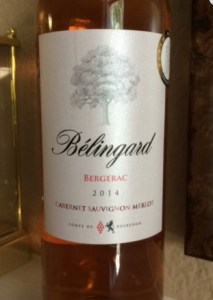 Salmon, almost orange color. Aromas and flavors of tropical fruit including mango and passion fruit, with a hint of mandarin, along with light red berry flavors of strawberry and ripe raspberry. Dry with medium body and a soft, round mouthfeel and lively acidity make this a refreshing wine, yet big enough to pair with grilled tri-tip steaks or other summer BBQ fare.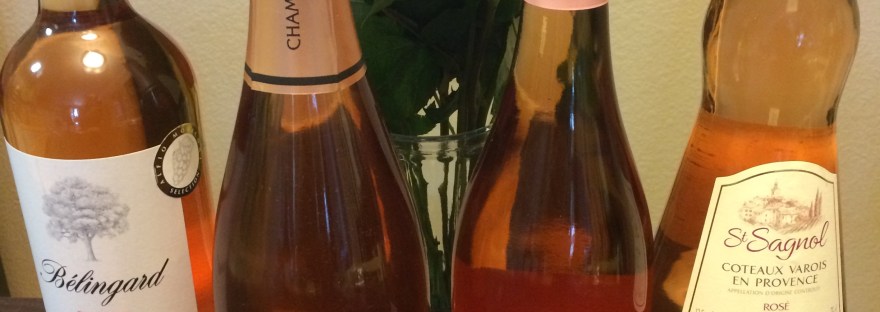



 Apparently, even though most of my wine comes to me via online retailers, I buy enough product from Total Wine to have recently achieved “Reserve” level status. Thus, I received an invitation to their Sip & Mingle event, The Great Cab Debate: Old World vs. New World Cabernet Sauvignon. Not one to turn down an opportunity to taste world-class wine for free, I naturally submitted my RSVP accepting the invitation.
 Brick red, ruby rim. Nose of blackberry and red currant. Flavors of blackberry, red currant, black pepper and spice. A little hot but smooth tannins. Long, spicy finish.
 Brick red, ruby rim. Plum and earth on the nose. Flavors of raspberry, sour cherry, soft oak, and spice. Bone dry with firm tannins and a medium finish.
 Purple color with brick rim. On the nose, green bell pepper, light blackberry, and dusty earth. Blackberry, black plum flavors with soft, smooth tannins and light acidity. Medium finish with berry and white pepper.
 Ruby color. Nose of raspberry and blackberry. Flavors of ripe raspberry, plum, red currant, earth, and spice. Supple tannins, medium acidity, and a medium, spicy finish.
 Purple color with ruby rim. Aromas of ripe blackberry and soft oak. On the palate juicy blackberry, cassis, and white pepper. Super soft tannins and light acidity. Medium finish of dark berry.
 Deep purple color with ruby rim. Nose is fig, mushroom, and cedar. Flavors of ripe blackberry, cassis, black pepper, and black plum. Soft, velvety tannins and balanced acidity with a long, fruity, spicy finish.
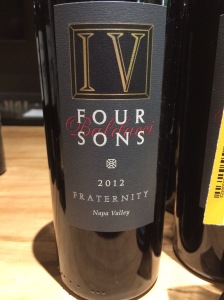 Deep, inky purple color. Aromas of blackberry, bramble, cassis, and a hint of licorice. On the palate, blackberry, cassis, black pepper, and spice. Rich and fruity, with soft tannins and balanced acidity. Long finish with berry, cocoa, and spice. My favorite of the evening.
 Ruby color with brick rim. On the nose, herbal notes with green bell pepper and blackberry. Flavors of blackberry, bell pepper, earth, spice, and cedar. Still young, the tannins are edgy and its a little acidic. This one needs a few more years in the cellar.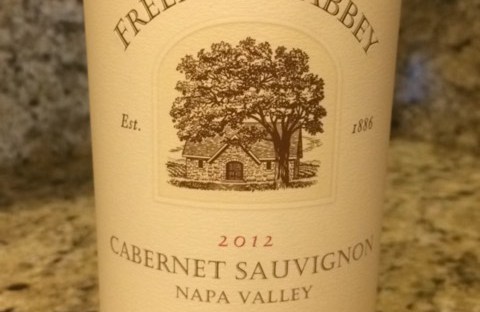


 If you follow my blog, or have read my very first post,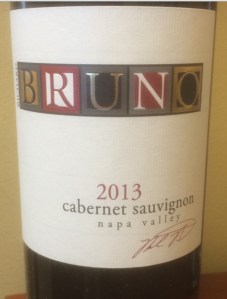

 Appetite for Wine