LoCA, Lodi Winegrape Commission, National Zinfandel Day, Wine, Wine Review, Wine Tasting, Zinfandel, Zinfandel Advocates and Producers

Celebrating National Zinfandel Day in Lodi Style

Though Zinfandel is not the most popular varietal wine, it is certainly one of my favorites! I may have waded into my wine journey pool with Pinot Noir, but when I first tasted a quality, red Zinfandel wine, it was like diving head first from the high dive!

Today is the third Wednesday in November, which means it’s National Zinfandel Day! In celebration, I encourage all of you to drink some Zinfandel today. You’ll be glad you did! Done right, Zinfandel is a balance of bold, fruity, and spicy. It is a great wine to pair with food, especially casual fare, making it the perfect bottle to crack open on a Wednesday evening. Pizza, burgers, barbecue, steak, and even rich chicken dishes all pair with Zinfandel.
old-vine-social
Photo Credit: VinePair

The Zinfandel Events website, powered by ZAP (Zinfandel Advocates and Producers), has this to say:

“Bold and celebratory, independent and unpretentious, versatile and individual, Zinfandel has charted a course all its own, and National Zinfandel Day offers many ways for our members to chart their own course to help celebrate and draw positive attention for America’s Heritage grape.”

“Zinfandel Day is a worldwide celebration of the Zinfandel grape variety, intended to give Zinfandel lovers around the globe a platform to express their passion for grape and the wines made from it.”

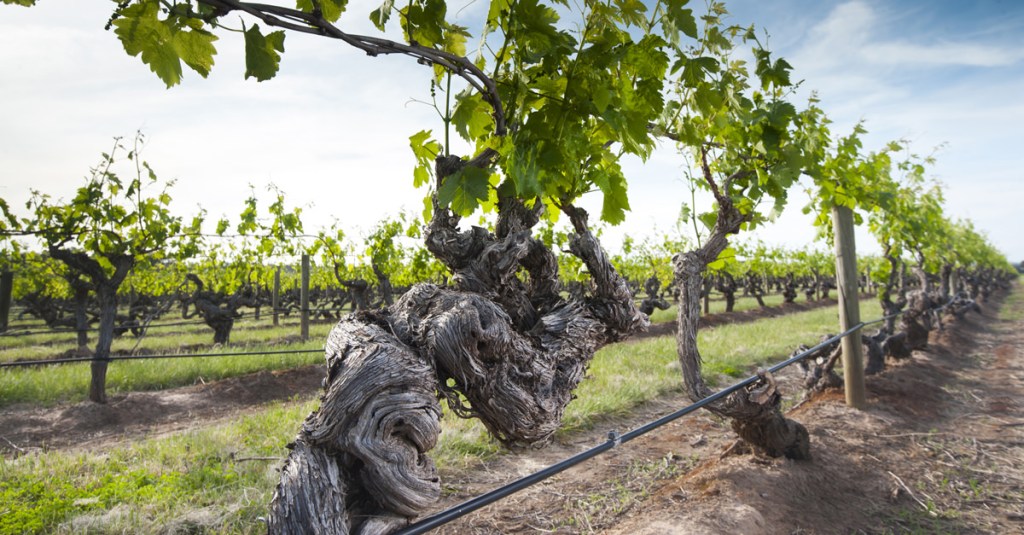
Throughout California, Zinfandel grows well in a number of regions. It was introduced in the Sierra Foothills during the California Gold Rush by resourceful entrepreneurs who realized the hoards of miners were getting mighty thirsty in their backbreaking quest for riches.  They were right. Zinfandel gained a strong foothold, and is now knows as “America’s Heritage grape.

One of the most famous Zinfandel regions in California is Lodi. In fact, Lodi has declared itself the Zinfandel Capital of the World. Roughly 40% of the Zinfandel grapes grown in California come from the Lodi AVA. That’s about 110,000 acres under vine, tended by 750 grape growers!

Over the years, Zinfandel’s reputation has ebbed and flowed. We all know about the White Zin craze that started in the 1970s. In fact, I’d bet that White Zin was the first wine many of you tried. I know I drank my fair share of it before my first Pinot Noir encounter! As more wine drinkers started embracing red Zinfandel, and production increased in the Central Valley, many Zinfandels produced were in the jammy, high-alcohol, fruit-bomb style. You know the ones; open with corkscrew, consume with tablespoon! Jammy! While the masses loved this style, more discerning wine lovers abandoned Zinfandel. (Is my snobby showing?)

It is true that during this time, more subtle and restrained versions of Zinfandel were available in other California regions, and even some from the Central Valley, they were somewhat difficult to find, and often outside the price range of the average consumer. In recent years, however, a group of Lodi producers have started to revisit the more nuanced, minimalist approach to Zinfandel. The Lodi Native Project started as a collaborative project by six Lodi wine growers who are committed showcasing the merits of the heritage plantings. Their goal is to highlight the terroir of the vineyards themselves, and to produce small, artisan wines that reflect the character of the grape.

Just in time National Zinfandel Day, I received two samples of Lodi Zinfandel for review. Both were subtle, restrained, and delicious. I can heartily recommend either, or both.

 img_0331

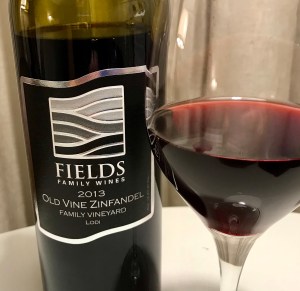
Fields Family Wines 2013 Old Vine Zinfandel – Family Vineyard

Mokelumne River AVA

Retail: $28.00

Brick color with pale ruby rim. Earthy nose with restrained raspberry and cherry aromas. On the palate, bright, juicy flavors of raspberry, bing cherry, and plum, with spice, black pepper, and a hint of licorice. Medium body and tannins with a bite of zesty acidity. The finish lingers with red fruit and spice. We paired this with Margarita pizza and it was delightful. A very nice example of what Lodi can do with a lighter, more restrained version of Zinfandel.

 img_0478

Tizona by Bokisch 2014 Old Vine Zinfandel – Kirschenmann Vineyard

Mokelumne River AVA

Retail $32.00

Deep ruby color with brick rim. On the nose, soft aromas of blackberry bramble, black cherry, and a hint of anise. This is going to be something special! On the palate, the magic continues with a soft, round mouthfeel and flavors of blackberry jam, black cherry, white pepper, and baking spice. The tannins are silky smooth, and there is light acidity. The finish goes on for days, with raspberry and spice notes. This one went down way too easily with a combo pizza. Noticing a trend? We really don’t eat that much pizza! But…Zinfandel! This easily falls into the category of best Zinfandels I’ve ever had! Spectacular!
Head on over to the Zinfandel Events page for five suggestions on ways you can participate in the celebration today. On the top of the list, of course, is “Share a Bottle with Your Friends!” I can’t think of any better advice!

Please share in the comments what bottle (or bottles) you opened for National Zinfandel Day!

Cheers!

(Both of the wines in this article were submitted for review. I received no other compensation, and all reviews, opinions, and observations are my own.)

  • By Kent Reynolds
#WBC17, Santa Rosa, Sonoma County, Wine, Wine Blogger Conference, Wine Cave Dinner, Winery

Pulling the Cork on WBC17

It was a dark and stormy night.

Snoopy

That seems an appropriate way to open a story about a trip to Santa Rosa, home to the Charles Shultz museum. Charles Shultz, of course, was the creator of the Peanuts comic strip, and everybody’s favorite beagle, Snoopy.

Our “easy” drive to Santa Rosa was hampered by the first significant rain storm of the season. The roads were slick, and glare from oncoming headlights was blinding, so everyone was driving extra cautiously. And slow. But we made it, and spent the last three days enjoying the activities and adventures of the 10th Annual Wine Blogger’s Conference, #WBC17.

WBC17Badge

It was our first time attending WBC, but it will not be our last! It was a fun, informative, and engaging event. This post will be a general overview of events, with more detailed posts of the highlights in coming days and weeks.

Our first event was an excursion to Hanna Winery. Located on a hilltop with gorgeous, sweeping views of the valley, Hanna Winery has been in operation since 1985. We were greeted by our host, Christine Hanna, who gave us some history, and then winemaker Jeff Hinchcliffe took us down to the barrel room for some tasting. Following this, we enjoyed an amazing lunch, paired with several Hanna wines. Welcome to Sonoma County, indeed!

Upon our return to Santa Rosa, we participated in a Wine Discovery Session with Mark Beringer, Chief Winemaker at Beringer Vineyards. He led us through a tasting of their Private Reserve Cabernet Sauvignon, starting with four of the single vineyard wines that go into the final blend. Once we had established the baseline, we “worked” our way through a decade vertical tasting of the Private Reserve wines, starting with 2014 and travelling back in time to the 2004, 1994, and finishing with the 1984 vintage. The evolution of these powerhouse wines was amazing to behold.

Later in the day, we journeyed around the world with A Study of Pinot Noir. Our tour guide was Senior Winemaker John Priest, from Etude Winery. He took us from Sonoma County, north to the Willamette Valley, then all the way south to New Zealand in our exploration of this incredibly versatile grape. It was a wonderful trip!

The wine education sessions were followed by an opening reception, where we met many of the bloggers we have been following, as well as new friends. Thus ended day one!

The following day, we attended educational seminars covering writing tips, legal and ethical issues, wine vocabulary, and developing relationships with wine companies. Lunch was hosted by El Dorado Wines. Nearly 30 El Dorado County winemakers lined the back of the conference room, and then poured samples of their wines.

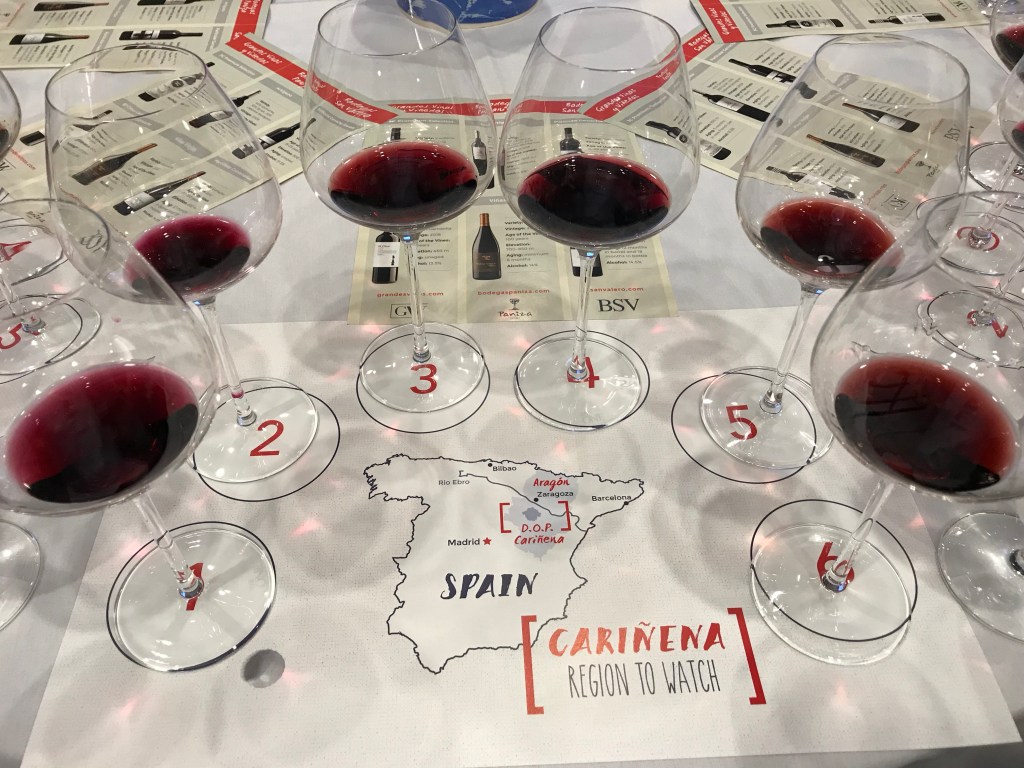
After lunch we enjoyed a Wine Education Seminar, presented by Lyn Farmer, about the “Region to Watch,” DOP Cariñena in Spain. We were immediately enamored with the region, and have added DOP Cariñena to our list of “Must Visit” destinations. We tasted through an amazing flight of Garnacha, with one Cariñena varietal wine (you may know it as Carignan) mixed in for interest. These are some amazing, affordable wines. You’ll want to try some as soon as possible!

img_0386

Following a captivating keynote address by Doug Frost, we participated in our first Live Wine Blogging event. Wineries get five minutes at each table to pour tastes, and we blogged, Tweeted, or Instagrammed our impressions of the wines. It was kind of like speed dating, but with wine! A high-energy and raucous time, we tasted some amazing wines! The Friday speed-tasting was whites and rosés.

Friday ended with what was the absolute highlight: a Wine Cave Dinner at the Thomas George Estate. It was a first class affair! It was an amazing, “check-it-off-the-bucket-list” adventure. We’ll write more about this later, but suffice it to say this was among best meals we have ever had!

This slideshow requires JavaScript.

Saturday opened with more educational sessions, including Social Media tips, photography and video, and panel discussions covering relations with PR firms, and ideas for monetizing a wine blog. (If you’re into that whole, making money doing what you love thing.) We also attended a presentation about the devastating wild fires that ravaged the area only one month earlier. The destruction was unprecedented, but the recovery and rebuilding has begun, and Wine Country is open for business.

Following lunch, we returned to Spain with our host, Lyn Farmer, to explore DO Rías Baixas, and the spectacular Albariño wines being produced there. We tasted through 10 (yes, ten!) different expressions of this amazing white wine. I can’t say enough about Lyn Farmer and his friendly, comfortable teaching style and encyclopedic knowledge of Spanish wines.

img_0446

After another round of Live Wine Blogging, AKA speed-tasting, this time with red wines, the conference concluded with a banquet hosted by NakedWines.com. As you probably know, I am a long-time customer of NakedWines.com, so it was fun to see many of the winemakers and staff I have come to know over the years.

Even with all the fun and wine (did I mention we had wine?) the biggest take-away for us is the comradery, support, and encouragement that exists in the wine blogging community. From big name bloggers and writers, who have thousands of followers and are making a living writing about wine, to brand new members who have yet to post their first blog, we were warmly welcomed and embraced as part of the family.

Finally, the dates and location for next year’s Wine Blogger’s Conference were announced. Walla Walla, here we come! We hope to see you there!

Cheers!

  • By Kent Reynolds and Robyn Raphael


#WBC17, Fire Recovery, Santa Rosa, sonoma, Wine, Wine Blog, Wine Blogger, Wine Blogger Conference

We’re Off to the Wine Bloggers Conference #WBC17

And away we go!

Tonight I am packing for the 2017 Wine Bloggers Conference. What to pack? What to wear?

img_1463

#WBC17 will be held in Santa Rosa, California, in the heart of Sonoma wine country, from Thursday, November 9 through Saturday, November 11. I’ll be in the company of my associate and fellow wine lover, Robyn Raphael. This will be our first time attending a Wine Blogger Conference. Last year, it was held in Lodi, just 45 minutes from my home, but scheduling conflicts prevented attending. Fortunately, the 2017 event is still local for us; just a 2 hour drive away! An easy trek compared to the cross-country or international travel many of my associates will endure. We are excited to be going, and looking forward to meeting so many of the bloggers we have been reading for several years.

WBC17Badge

As you may be aware, Santa Rosa, and much of the Napa and Sonoma wine regions, was ravaged by wildfires last month; historic fires that were the most destructing and deadly on record. Yet, the people there are resilient and strong, and are already in the process of rebuilding. The bloggers who will be descending on the region will be helping in the recovery in one of the most practical ways possible: visiting wineries, buying wines, and dining in the area restaurants. While the conference has been planned for more than a year, the timing, relative to the fires, allows attendees to dig deep and support the region.

Among other activities, we will be going on a wine excursion to Hanna Winery, complete with wine-pairing, catered lunch; a wine cave dinner at Thomas George Estates that will cross off a bucket-list item (dinner in a wine cave); and a banquet at the host hotel hosted by NakedWines.com. We will attend wine education sessions, including one hosted by Beringer Vineyards, in which we will experience a vertical decade tasting of their Private Reserve Cabernet, from 2014 all the way back to the iconic 1984 vintage; and an exploration of Pinot Noir, hosted by Etude Wines. There will be gourmet foods, and spectacular wines. I anticipate we will not want to come home!

Through it all, we will be attentive to the destruction, loss, and hardship around us. We will honor the resilience of the local residents. We will contribute to the recovery and rebuilding with our words and our wallets. We will unite as bloggers and journalists, and meet new friends. All in all, this will be an amazing weekend! We are grateful to be able to attend, and look forward to experiencing every moment.

If you are attending WBC17, we look forward to meeting you in person. If you aren’t, stay tuned for live-blogging updates, and follow along on Instagram or Twitter for up-to-the-moment coverage.

Cheers!

  • By Kent Reynolds and Robyn Raphael, 11/7/2017
Form and Function, Spirale, Vacanti, Wine, Wine Accessories, Wine Glasses

Review: Vacanti Spirale Wine Glasses

I’m really enjoying the upsurge in artistic, yet functional wine accessories. From corkscrews, to decanters, to stemware, form is becoming as important as function. Recently, Patrick Vacanti contacted me with exciting news about his new, innovative wine glass. The Vacanti Spirale wine glass is designed to capture sediment and solids in a specially designed reservoir at the bottom of the glass. If you enjoy aged, unfiltered, or rustic wines, but don’t care for that gritty last sip, this could be the glass of you.  

Patrick and his wife spent five years developing this glass. After sending out more than 600 samples out for review and feedback, and two patents, they recently launched sales of the Vacanti Spirale wine glass on Kickstarter, or via the Vacanti Wine Glasses website.  

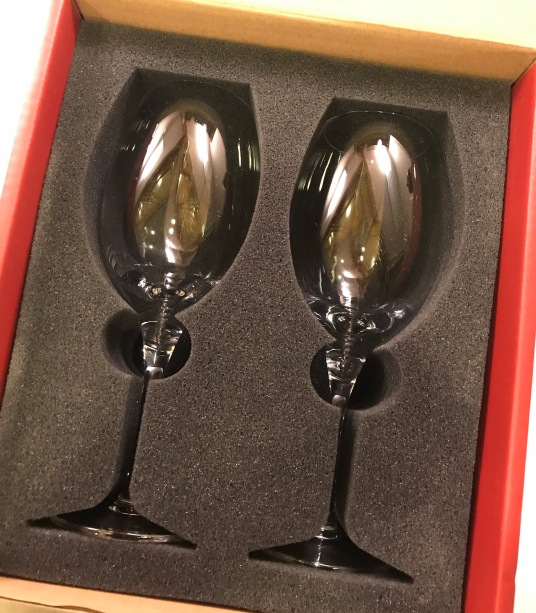
My pair of Vacanti Spirale glasses arrived in an unassuming brown cardboard shipping box. Yet, when I opened that box, I was greeted by a beautiful, burgundy-red package declaring my two wine glasses were waiting inside. Opening this product box, I was impressed to find my glasses tightly nestled in dense foam packing, keeping them safe and secure.  

img_0281img_0286img_0282

Each glass is hand-crafted, giving them a unique, individual feel. Like an individual bottle of wine, each Vacanti Spirale wine glass is distinctive; similar to others in the batch, but uniquely different. When I lifted the glasses out of their traveling nest, I was amazed at how sturdy and strong they felt. They are quite hefty, thicker than most wine glasses I’ve handled. However, they maintain an elegant flair due to their attractive design.  

Beyond the aesthetic appeal, however, is the functionality. We put the Vicanti Spirale wine glasses to the test at a special occasion dinner at home. To accompany our grilled Rib Eye, baked potato (with all the trimmings, of course), and fresh green salad, I opened a bottle I’ve been holding awhile, for just such an occasion: 2007 Silver Oak Cabernet Sauvignon Alexander Valley.  

Once poured, the red wine makes the Spirale reservoir much more visible at the bottom of the bowl. The design of the glass makes swirling and sniffing a breeze, and efficiently delivers the delightful juice from the glass into the lucky recipient’s palate. As the wine rests in the glass between sips, any sediment in the glass settles to the bottom where it is captured by the swirls in the Spirale reservoir. When the inevitable sadness descends as the wine runs out, rather than ruin that last sip with a mouthful of gritty muck, the sediment remains in the reservoir. Genius!  

An excellent addition to the stemware collection for any serious wine-o, the Vicanti Spirale wine glass is as artistic as it is functional. If you enjoy unfiltered or aged wines, but abhor the sediment, pick up a pair of Vicanti Spirale wine glasses and give them a whirl!  

img_0285
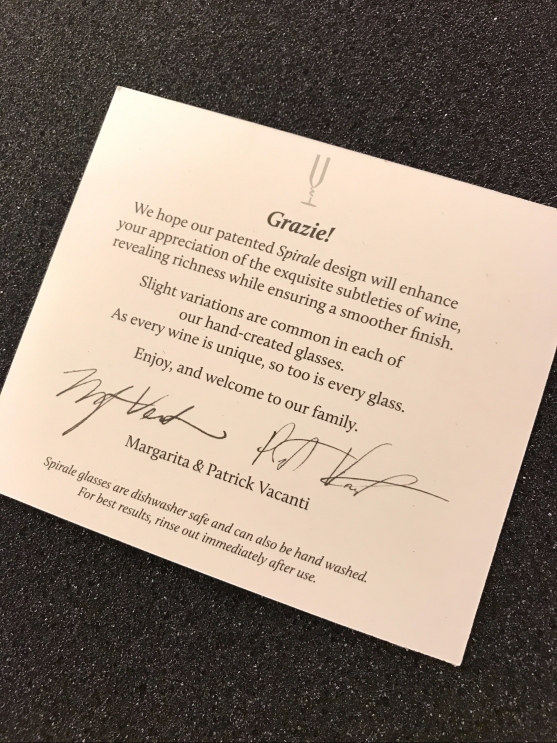
Thank you note included.

* The Vacanti Spirale wine glasses I received were submitted as samples for review. No other compensation was provided. All reviews, comments, and opinions are my own. 

Heros, Human Spirit, Mendocino, nakedwines.com, Napa, sonoma, Wildfires, Wine

My 100th Post

For my 100th Blog Post, I was planning on something reminiscent, like revisiting the wine that started my journey all those years ago.

However, with the devastating fires ravaging Northern California’s wine country, it seems more appropriate to share a way you, my readers and fellow wine lovers, can help.

https://www.instagram.com/p/BaHIWvqHXMC/?taken-by=appetite_for_wine

I’m moved by the bravery of the first responders. You may not know this about me, but  I am former law enforcement. As such, I know what it is like to leave loved ones behind during a disaster and give of oneself to help strangers.

Living in NorCal, but well out of harm’s way, I’m very impressed by the resilience of the human spirit already arising out of the wildfires. Even as the fires rage out of control, people are looking ahead toward recovery and rebuilding. I am amazed and appreciative of the groundswell of support that has started. I’ve seen GoFundMe pages, numerous national and regional charities, and now NakedWines.com stepping up.

https://www.instagram.com/p/BaIPwp9HHy6/?taken-by=appetite_for_wine


As you probably know, I am a supporter and customer of NakedWines.com. Champions of winemakers around the world, NakedWines.com is hosting a site where you can donate to support those affected by these disastrous wildfires. Many of the other donation sites I’ve seen are area-specific, and there’s nothing wrong with that. The NakedWines.com effort covers the whole region. The main recipient of the funds raised will be the Napa Valley Community Foundation, but others will include the Red Cross and other disaster relief agencies in the greater region.

Follow this link if you’d like to contribute: https://us.nakedwines.com/fire-recovery You don’t have to be a NakedWines.com customer to donate, but in doing so, you will truly be an Angel to those in need.

NW Logo

Please give generously to help those affected. If you would prefer to give to a different charity, please do. This is not a competition, and I won’t be offended.

That post about my first taste of good wine? That’ll have to wait until post number 101.

Thank you.

Baja California, Chenin Blanc, Guadalupe Valley, Mexico, Wine

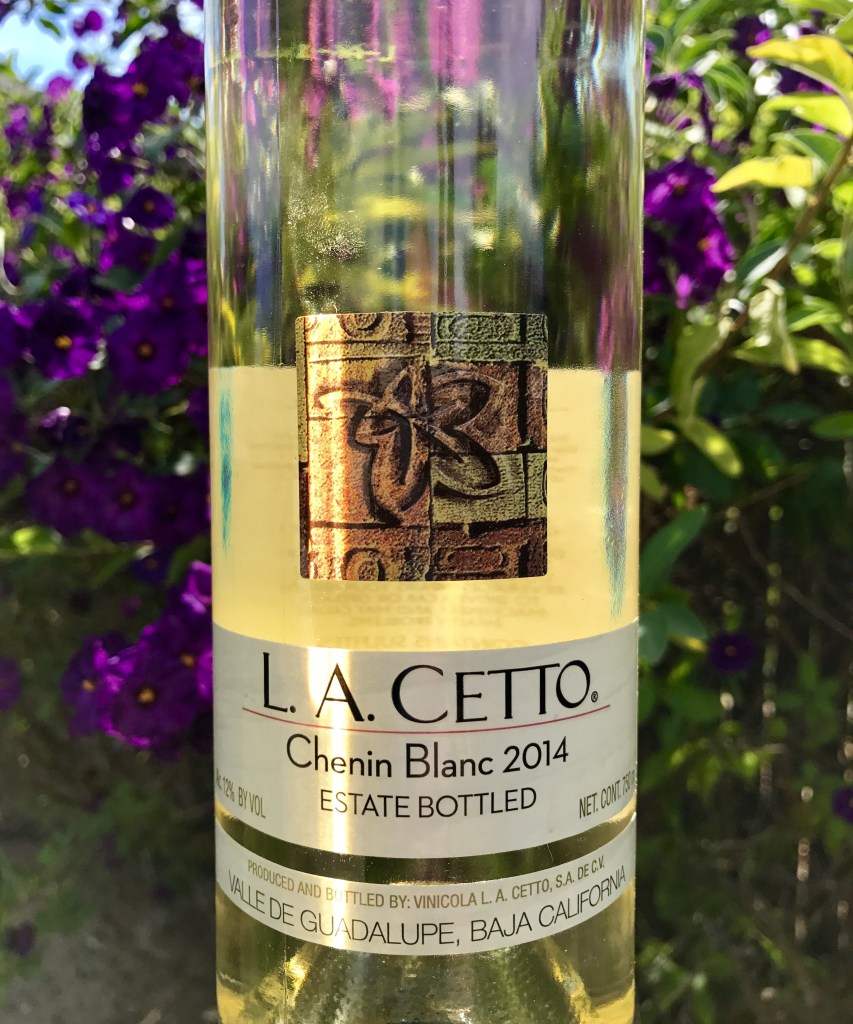
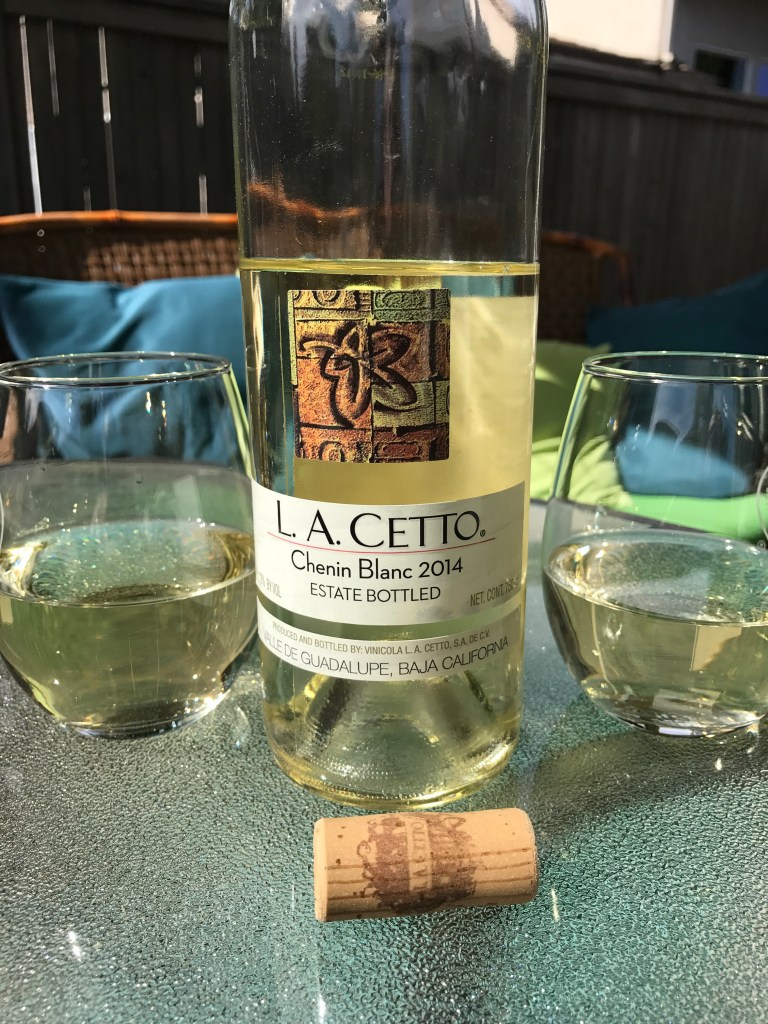
Review: L.A. Cetto Chenin Blanc 2014

If you’ve read my blog more than a couple of times, (thank you), you know that I like variety. More than just variety, I seek out the obscure. Be it a small production bottle, a little-known varietal, or a grape not normally associated with a particular region, if I can get my hands on it, I will buy it and try it.  

Stay with me here, I promise its relevant. A Facebook friend recently posted the following question: “What is your favorite wine?” I assume the idea was to see what kinds of varied responses he would get. Perhaps out of simple curiosity, or maybe as a parlor game. Or maybe he was genuinely looking for ideas or recommendations of what to try. Regardless, I could not provide a simple answer. In my response, I stated that there were simply too many options and variables for me to select a single “favorite” wine. White or red? With what meal would I be serving the wine? The point is, I don’t want to limit myself to a favorite. I crave variety.  

Chenin Blanc seems to be making a comeback in recent months, and I am quite happy with this. Don’t get me wrong; a few years ago, I may have turned my nose up at Chenin Blanc. As a child, I remember my parents drinking Chenin Blanc wine from a gallon jug, so as I got into wine as an adult, I associated Chenin Blanc with cheap, jug wine. It wasn’t until a couple of years ago, when I received a sample of a Clarksburg Chenin Blanc from NakedWines.com that I came to appreciate the delicate, floral, tropical-fruity goodness that is this grape. Since then, I’ve enjoyed a number of bottles from California, South Africa, and its native home, France.  

So there I was, cruising the Italian Wines aisle of my local Total Wine & More store, looking for an interesting white wine to enjoy during the last few hot days of summer. Something caught my eye. L.A. Cetto Chenin Blanc 2014. A Chenin Blanc from Italy? Say no more – into the basket it went. I didn’t even take the time to examine the label.  

img_0199

As I unpacked the wine at home, preparing to log it into my Vivino app before setting it aside in the chiller until the right moment, I noticed something odd. On the label were these words: Valle De Guadalupe, Baja California. Eureka! I had accidentally stumbles across my first Mexican wine! Clearly someone at Total Wine thought L.A. Cetto sounded Italian, so it ended up in the wrong bin. 

The website listed on their label, lacetto.mx, is in Spanish. Fortunately, I took Spanish in high school, Google Chrome has a translation feature, so I could read the information. From the L.A. Cetto website:

“LA Cetto Winery is undoubtedly the Mexican company that is the leader in the production of quality wine. With 88 years of experience acquired by 3 generations, its wines are now found in Mexico and in 27 countries in the world.” 

L.A. Cetto was founded by Don Angelo Cetto. Born Angelo Cetto Carli in Selva di Levico, Trento, Italy in 1900, Don Angelo arrived in Mexico in 1924. It was he who, in 1928, had the vision and planted wine grapes in Baja California. In 1951, Don Angelo’s son, Don Luis Agustin Cetto, took over and grew the company, hiring an Italian oenologist, Camilo Magoni. In 1983, the L.A. Cetto label was introduced to the wine market, and the third generation of the family, Luis Alberto Cetto, joined the team.  

In my quest for variety and the obscure, I was excited to try this new find. So on a recent, warm Sunday afternoon, I liberated the cork and poured a couple of glasses. Here’s what I thought of it:  

img_0200

Light straw color in the glass. On the nose, aromas of apricot and citrus. There are flavors soft citrus, yellow apple, pear, and hints of quince and apricot. The wine has lively acidity and a soft, round mouthfeel. The finish lingers with delightful of tropical fruit notes. A very smooth and easy drinking wine, and a great introduction to the wines of Mexico. At just $8.99, an excellent value, too!  

I encourage you to seek out a bottle of this fun and delicious wine, and give it a try. I hope you enjoy it as much as I do. Let me know your thoughts in the comments!  

Cheers!  

Farm-to-Fork, Golden 1 Credit Union, Sacramento, Sweepstakes, Tower Bridge Dinner, Wine

Dinner on a Bridge (#MWWC35)

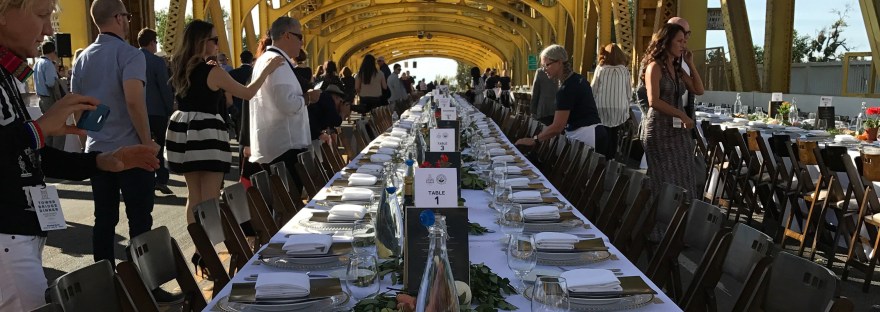
The weather was perfect; sunny with temperatures in the low-80’s as the event started. We were fortunate to be there. This is one of the most anticipated events in Sacramento. It is so popular in fact, that tickets are sold by lottery. I’ve wanted to go in the past, but have not been able to attend. However, this year, for the Fifth Annual Farm-to-Fork Tower Bridge Dinner, I won tickets in a sweepstakes hosted by the Golden 1 Credit Union, one of the sponsors of the dinner.

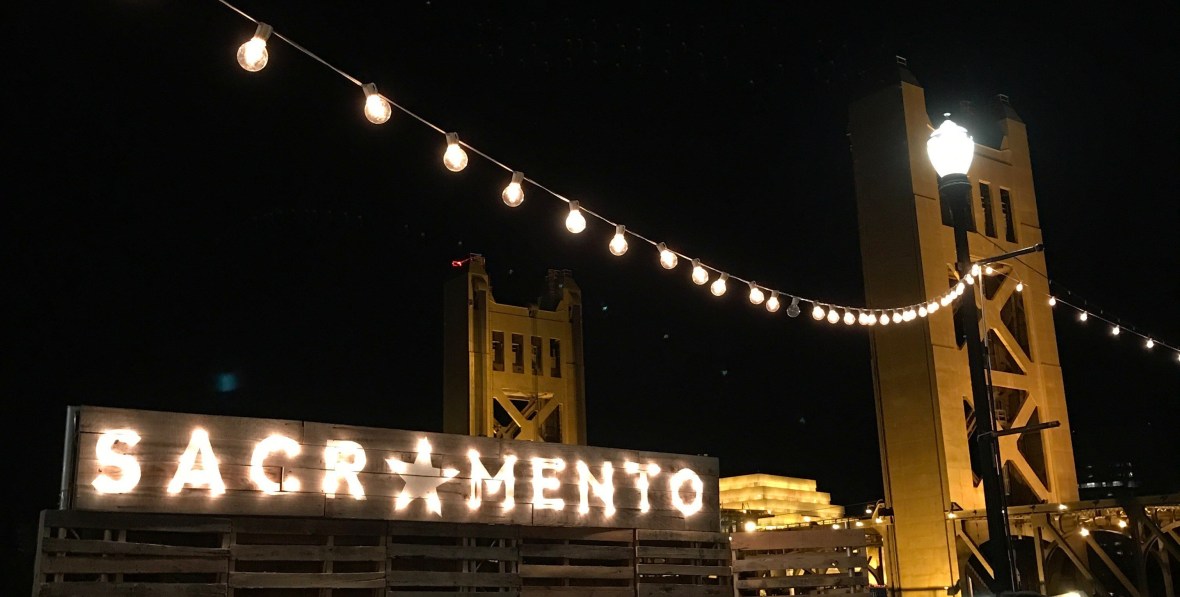
If you read my previous post, you know that Sacramento, California, is the Farm-to-Fork Capital of America. As part of the annual festivities, the Tower Bridge Dinner brings together farmers, farm workers, renown chefs, local celebrities, politicians, and foodies of all stripes, for an epic and magical evening. Dinner on a bridge! The Tower Bridge is an iconic landmark in Sacramento, spanning the Sacramento river from Downtown to the city of West Sacramento. It is an active roadway and drawbridge, yet one evening each year, the bridge is closed to traffic and white-linen covered tables are stretched from end to end. The goal of the event is to be “a truly spectacular culinary event…” A meal that “showcases the incredible bounty being grown and raised by some of our region’s most prolific farmers and ranchers who are at the heart of the farm-to-fork movement.” Some of the region’s best chefs work their magic on the ingredients, and the resulting experience is spectacular!

Upon arrival, guests are welcome to grab a glass of local wine or beer, and wander the bridge while nibbling on a variety of amazing appetizers. We sampled oysters, caviar, carpaccio, and other delicacies. The wine was free-flowing, and throughout the evening we enjoyed glasses of Muddy Boot Clarksburg Chenin Blanc, Conduit Amador County Viognier, Turkovich Yolo County Tempranillo, Divergent Vine Amador County Barbera, and Rancho Victoria Amador County Petite Sirah. Each wine complemented the food and enhanced the magic.

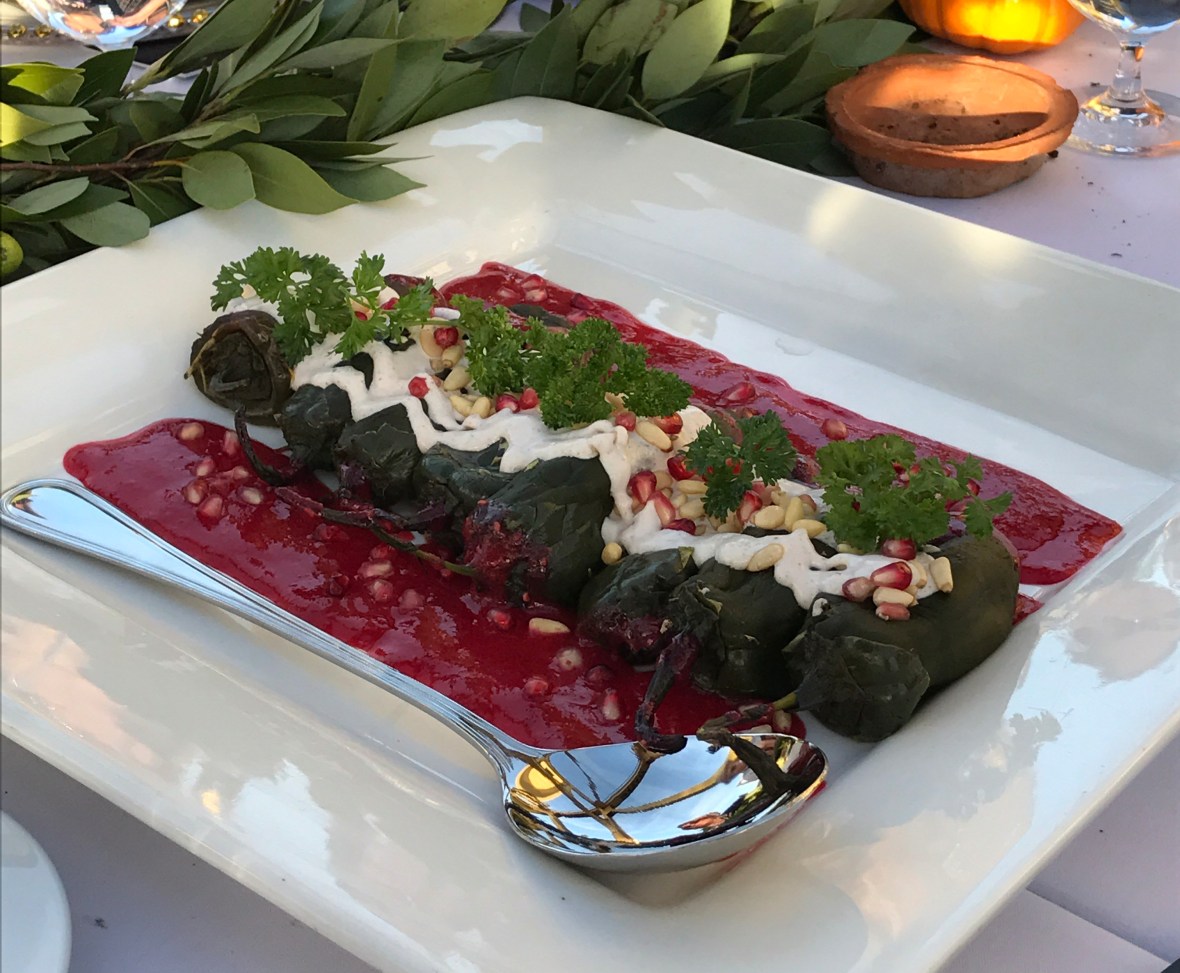
The four-course meal started with Chile en Nogada, a roasted poblano chile with picadillo, and walnut crema, prepared by Chef Ernesto Delgado from the Mayajuel restaurant. The farms that provided the ingredients were were Rancho Llano Seco and Stephens Ranch. The poblano was a little hot for a few folks at our table, but I thoroughly enjoyed it and the Chenin Blanc paired nicely to cut the heat.

img_0215

Next up was Smoked Mount Lassen Steelhead Trout, with cucumber, crème fraiche, flowering herbs, and cured roe. This was prepared by Chef Kurt Spataro from the Paragary Restaurant Group. The trout was sourced by Passmore Ranch, from Mt. Lassen Trout Farm, and the vegetables came from Soil Born Farms. The trout was melt-in-your-mouth tender, and absolutely delicious!

img_0222

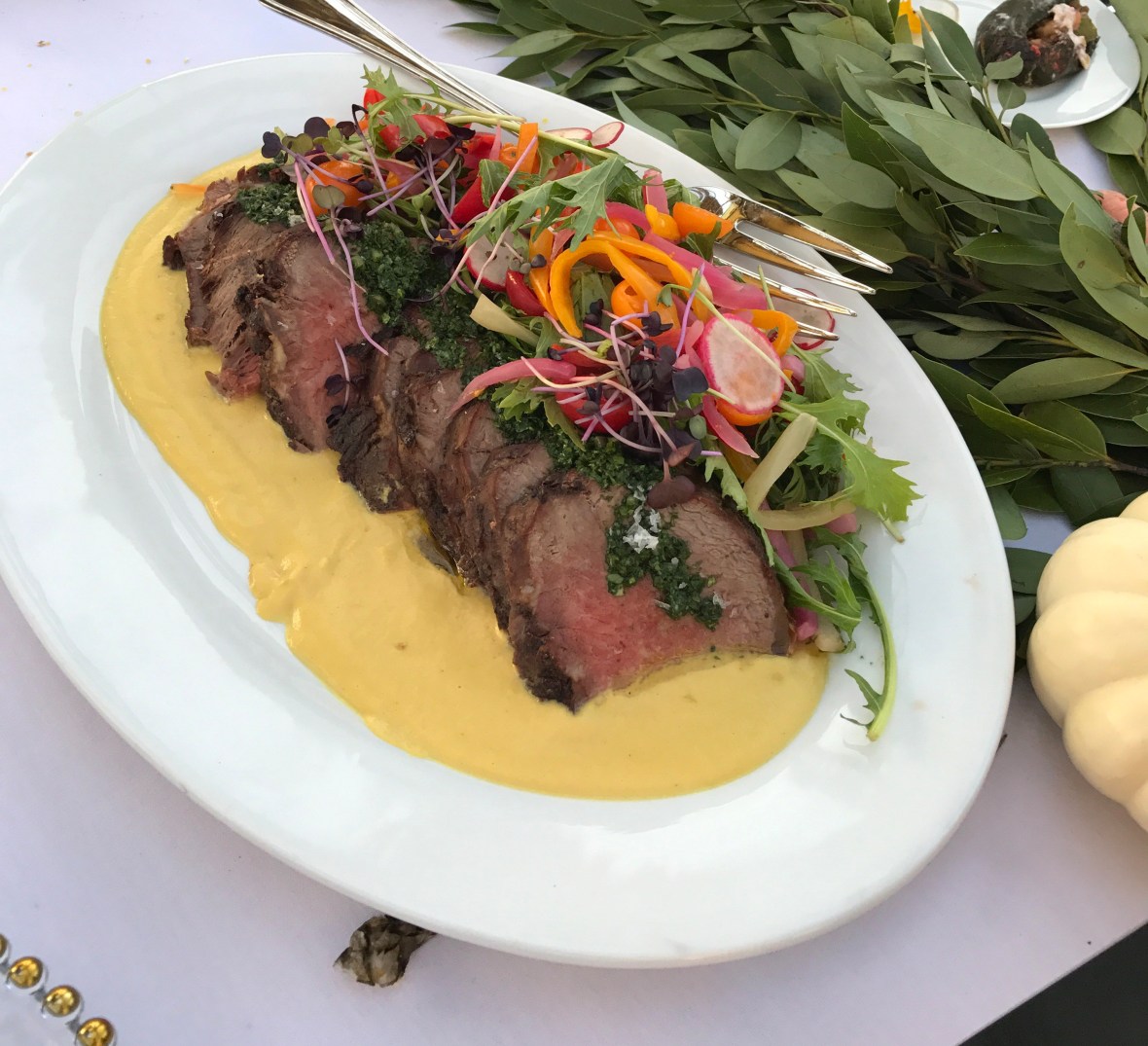
The third course was a Smoked Grassfed Ribeye, with curried turnip puree, pickled onions and sweet peppers, Easter Egg radish, cherry tomato, and chimi-churri sauce. Prepared by Taylor’s Kitchen Chef Casey Shideler, it was cooked to medium-rare perfection and fork-tender. The beef came from Richard’s Grassfed Beef, and the produce from Riverdog Farm and Aldon Leafy Greens. I went with the Petite Sirah with this and it was amazing!

img_0225

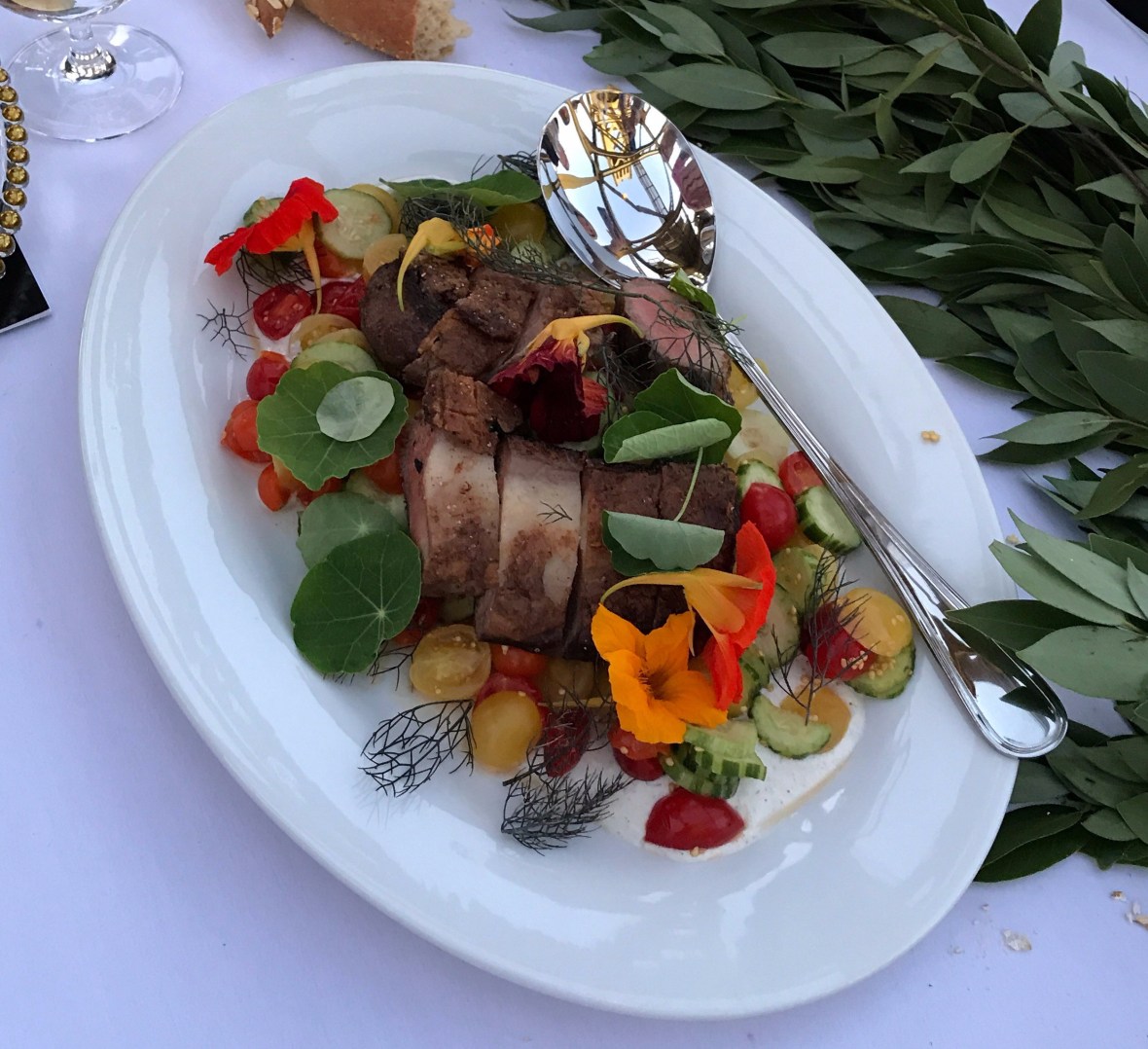
The fourth and final course was a two-parter. First was grilled lamb loin with bronze fennel yogurt, compressed cucmuber and tomato salad, and nasturtium. The farms providing this delectable delight were Azolla Farms, Emigh Lamb Co., and Laughing Duck Farms. The dish was prepared by Chef Chris Barnum-Dann from Localis restaurant. I lack the vocabulary to adequately describe this sensational dish. Exquisite. That’s the best I can do.

img_0227

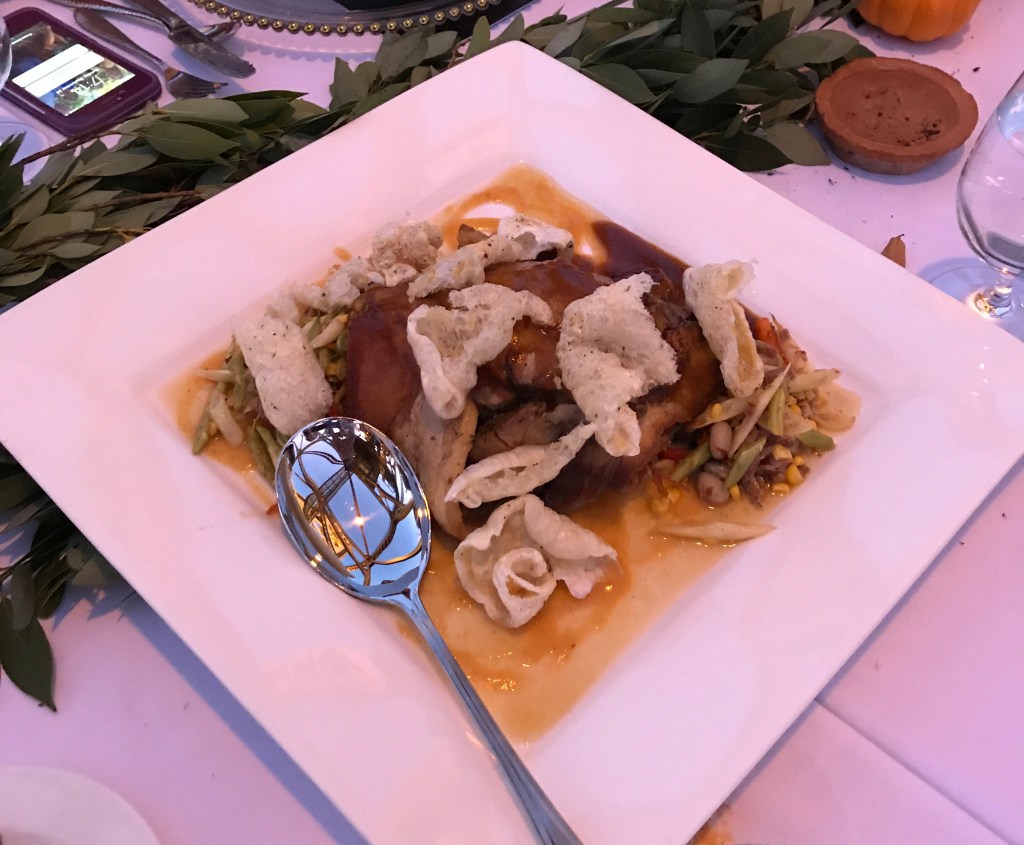
Finally, we ended the meal with “Pork and Beans.” No, not your campfire can of Van Camp’s. This was sliced prochetta with a late harvest corn and bean medley, and stone fruit gastrique. This round was prepared by Chefs Michael Tuohy and Santana Diaz from Legends Hospitality at the Golden 1 Center, Sacramento’s new sports arena. The ingredients came from Rancho Llano Seco, Dwelley farms, and Twin Peaks Orchards. Another amazing dish that was immensely satisfying on all levels.

img_0229

Once dinner was over, guests were invited to stroll the promenade and indulge in small desserts and dessert wines. As if we needed more to eat and drink! Still, we’re not quitters, so we made our way over to enjoy the view of the river, and just a few more bites and sips. The Late Harvest Viognier from Legendre Cellars in Fiddletown was a real treat and a perfect way to end the evening. Completely satisfied, and full of great new memories, we summoned our Uber for the ride home.

img_0231img_0235

I cannot thank Golden 1 Credit Union enough for sponsoring the sweepstakes that allowed us to attend the Tower Bridge Dinner. It was a night we will never forget. The food, the wine, and the wonderful people of Sacramento created a dining experience that has eclipsed all others I’ve enjoyed.

Monthly Wine Writing Challenge

In addition to describing this heavenly event, this post is also my submission into Monthly Wine Writing Challenge (#MWWC35). Last month’s winner, Erik of Red, White & Cru, selected to topic “Eclipse” for this month’s theme. The Tower Bridge Dinner certainly accomplished an eclipse of astronomical proportion in my culinary experience.

Cheers!


Farm-to-Fork, Locavore, Lodi, Sacramento, Sierra Foothills, Wine

Farm-to-Fork Legends of Wine

Among other things, Sacramento, California is known as America’s Farm-to-Fork Capital. Each year, the Sacramento Convention & Visitors Bureau hosts several Farm-to-Fork events, celebrating the region’s agricultural heritage and commitment to farm-fresh, local dining. This includes not only food, but wine as well. This past Thursday, we were fortunate to attend the annual Farm-to-Fork Legends of Wine event.

img_0150

Held on the front steps of the California State Capitol building, the Legends of Wine event features wine tastings of several local wineries from the region. Attendees had the opportunity to sample the some of the best wines produced in the Lodi, Sierra Foothills, and surrounding areas, and enjoy small bites like lamb sliders, gourmet cheeses, fresh-baked bread, and gelato. Many winery owners and winemakers were on hand to pour and answer questions about their wines.

img_0153

img_0161
Darrell Corti, left, and David Berkley, right. Dude taking a picture, in background.

Sacramento’s wine legends Darrell Corti and David Berkley help to prepare the event by selecting the best wines and wineries. One of Mr. Corti’s claims to fame is the long-running Corti Brothers market. Originally opened in downtown Sacramento in 1947, and relocated to its current East Sacramento location in 1970, the store features an authentic Italian deli and one of the best independent wine shops in the region. So beloved is Mr. Corti and the Corti Brothers store that, in 2008 when on the verge of losing the lease, Sacramento’s top celebrity chefs turned out in support and helped keep the market open.

David Berkley started his journey in wine as a part-time wine merchant at Corti Brothers. He went on to open his own wine and specialty-foods store in Sacramento, which sadly closed after 25 years in business. Yet, his story doesn’t end there. Mr. Berkley has served as a wine consultant for the White House, serving President Reagan, both Presidents Bush, and President Clinton.

After several weeks of scorching heat, the weather cooperated and graced us with a perfect, late summer evening. Clear skies, and temperatures in the low-80’s at the start of the event, created a delightful atmosphere for tasting, noshing, and mingling. I lost count, but there were well over two-dozen wineries present. We tasted several old favorites from wineries we know, and found a number of new favorites. Our weekends will be full over the next few months, visiting all the new wineries and winemaker friends we met at the event.

img_0159
Unintended cool photo effects when the flash accidentally went off.

If you happen to be in the Sacramento area in a future September, check out the Legends of Wine event. Perhaps we’ll see you there!

Cheers!

Canned Wine, Pinot Gris, Review, Underwood, Union Wine Company, Wine

Canned Wine – A Review of Underwood Pinot Gris

Wine in a can? Seriously?  

Actually, there are many advantages. Portability is the most obvious. But also consider weight (aluminum weights less than glass, which reduces carbon footprint when shipping), durability (aluminum doesn’t break like glass could), and accessibility (No glass containers allowed at the pool? No problem.) Taking these factors into consideration, it’s definitely worth giving this latest wine trend a try.  

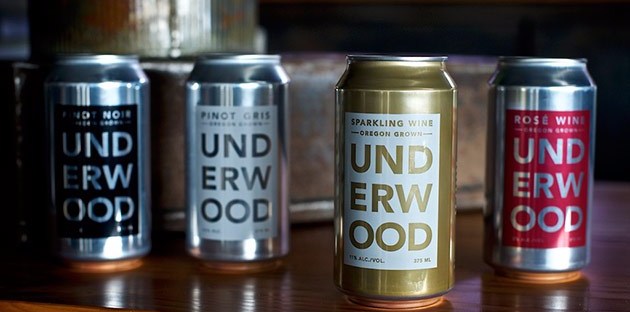
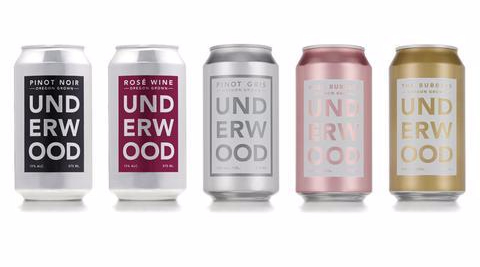
In addition to it’s traditional bottled wines, Union Wine Co., located near Portland, Oregon, produces and markets wine in a can under the Underwood label. You’ve probably seen it in Trader Joe’s, Target, Total Wine & More, or pretty much any other local supermarket. The can is 375 ml, half of a traditional 750 ml wine bottle, and about the same as a standard 12 ounce (355 ml) beer or soda cans. No corkscrew required, as the cans are equipped with the standard pull tab familiar to, well, everyone. Five different wines are produced: Pinot Noir, Pinot Gris, Rosé, Sparking, and Sparking Rosé. As best as I can determine, all are Non-Vintage.  

can_fam_updated_1024x1024_new_grande
Photo Credit: unionwinecompany.com

With reasoning similar to the recent upsurge in boxed wine, Union Wine Co.’s philosophy is that “it’s more important what goes into the glass than what type of glass it is“. That is, the quality of the wine in the vessel is more important than the vessel in which it comes. Concerned about metallic tasting wine? Don’t be. The cans have a liner that prevents the wine from contacting the aluminum.  

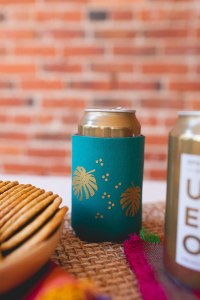
And let’s get real about this. If you were to swig your wine straight from the bottle, you’d get some serious side-eye from your neighbors. From a can? No problem. Half the folks around you probably wouldn’t even notice its wine, and not beer or soda. Slip on a Koozie, and you’re home free!  

Koozie
Hmm. I wonder what’s in that can.

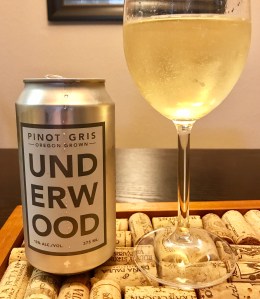
But the all important question is…how’s the wine? On the day I shopped, only Pinot Noir and Pinot Gris were available at my local Trader Joe’s, for $4.99 per can. That makes them the equivalent of a $10 bottle. I picked up a can of Pinot Gris, and after adequate chilling, I gave it a try. Here’s what I thought:   

img_0130
Is it pretentious to pour canned wine into a glass?

Pale straw color. Aromas of green apple, pear, and lemon-lime. On the palate, bright acidity gives it a tangy profile with flavors of green apple, lemon, pineapple, and the slightest hint of stone fruit. Fairly short finish. Less fruity and higher acidity than many PG’s. All in all, pretty good, but not my regular go-to. However, for a picnic, camp out, or other outdoor event where one wants a light weight and portable container, and an easy drinking refresher, this is a nice choice. 

So, while I wouldn’t necessarily buy this to pair with a nice meal or take it to a restaurant (would they charge a “tabage fee?”), it is a solid, affordable wine, and an excellent choice for a day at the lake or pool, weekend camping trip, or “alcohol-permitted” concert in the park. Portable, recyclable, and lighter-weight for easy transport, give Underwood wine-in-a-can a try.  

Have you tried Underwood or any other canned wine? Let me know what you thought of it in the comments.  

Cheers!  

Barrel Tasting, Barrel Theiving, David Akiyoshi, LangeTwins, Lodi, Wine, Wine Tour, Winery

A Visit to LangeTwins

What do you think of when you hear about a family owned winery? If you are like me, you envision a small, mom-and-pop operation, with a quaint, small tasting room, producing perhaps a few hundred cases of wine per year. What you probably don’t expect is a massive winery operation on the scale of LangeTwins. What? Never heard of LangeTwins? That may be because producing their own private label wine is just a portion of what they do here.

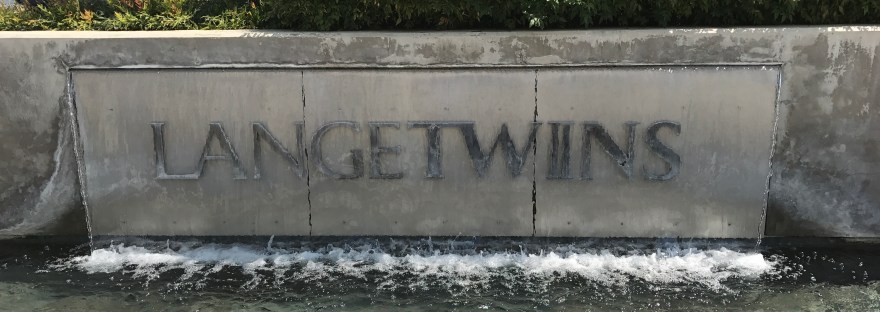
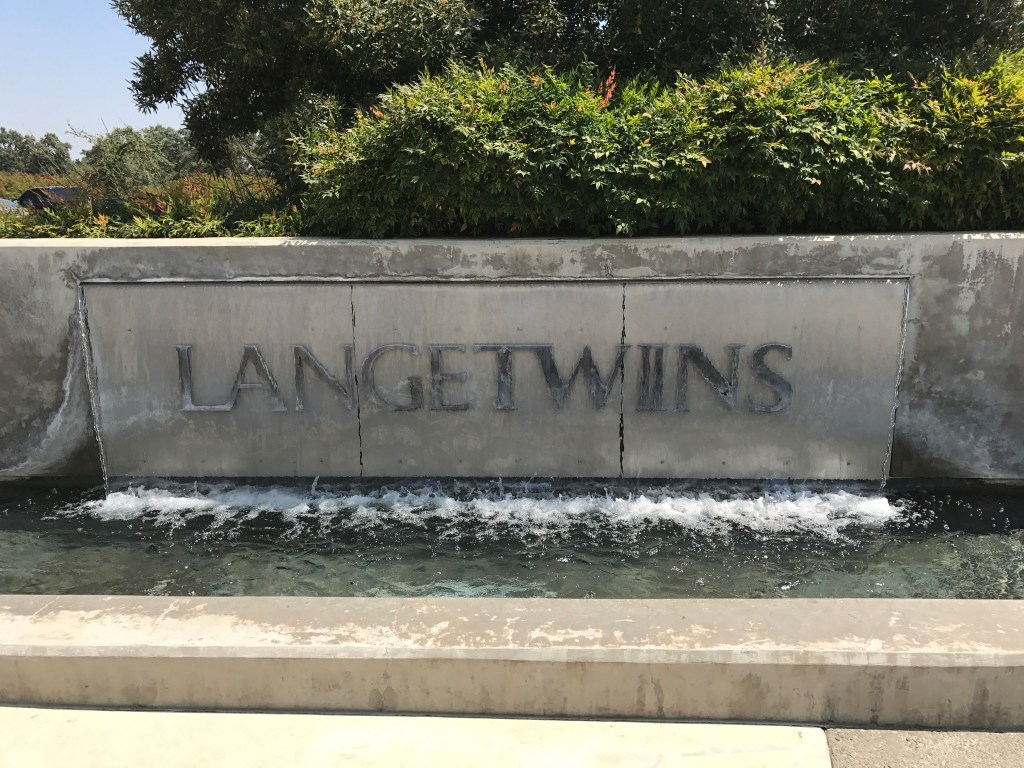
I recently visited LangeTwins Winery, located in Lodi, California, with friends Robyn, Anthony, and Kim. Despite living only about an hour from Lodi for 14 years, and being something of a wine guy (as suggested by this blog), this was my first tasting trip to Lodi. Yes, I am ashamed of myself and have no valid excuses. Anyway, as I rounded the bend and the facility came into view, I thought perhaps I had missed my turn and was arriving at a Gallo or Mondovi facility. Yet the monument sign that greeted us confirmed we were at the right place.
img_0052

We had arranged a winery tour with winemaker David Akiyoshi, who Anthony and I know though our mutual affiliation with NakedWines.com. In addition to his responsibilities and LangeTwins, David also produces wines under his own label that are sold by NakedWines.com. David has worked in the wine industry for more than 30 years. His tenure includes 25 years at Woodbridge. An interesting fact that David shared is that as children, during World War II, his parents were both sent to internment camps. As an adult, David’s father rose to success in the wine industry, including oenology research at U.C. Davis. David later followed his father in a wine career. David is a personable and engaging guide. He is clearly passionate about what he does, and gets great enjoyment in sharing his passion with guests. As a result, what was supposed to be a one-hour tour, stretched into nearly three hours!

The Lange family has been growing grapes in the Lodi area for five generations. In 2006, Brad and Randy Lange – the “Twins” of LangeTwins – started the winery operation. They brought David Akiyoshi in as winemaker and together, they built a state-of-the-art winemaking facility. The Langes gave David virtually free-reign in designing and constructing the operation. As David explained, when he asked for equipment or supplies, the Langes only wanted assurance that they were the best available for the production; they never asked about cost. The result is an impressive, sustainable, and continually expanding winery with the latest in technology and production equipment. The crush pad is topped with bifacial photovoltaic solar panels, capturing both direct sunlight and reflected light from below, while providing shade for workers below. They generate enough electricity to fully power their operation, and provide surplus energy back to the grid.

In addition to their own wines, LangeTwins offers a variety of services to other producers in the region. These include vineyard management, grape sales, winemaking, and bottling. They recently installed the most up-to-date bottling line, capable of churning out 120 bottles per minute, and provide bottling and labeling services to several wineries that you would readily recognize. (For proprietary reasons, those names could not be revealed, and photography in the bottling area is prohibited.)

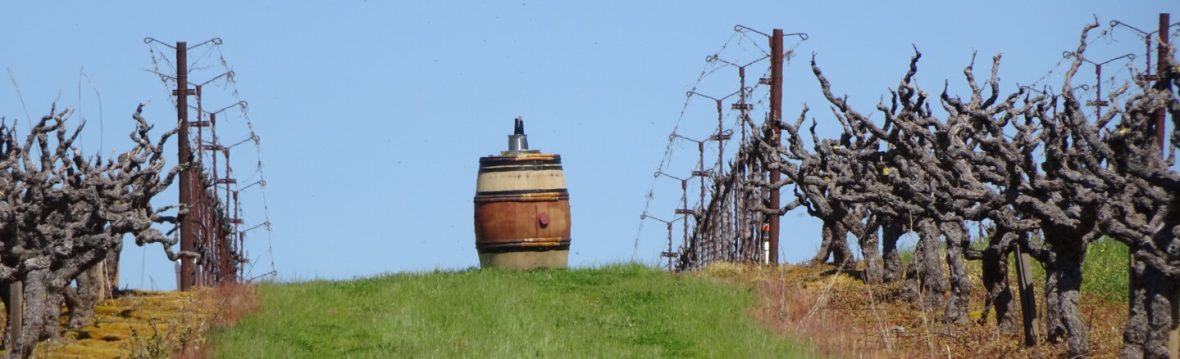
David showed us around the grape hoppers (originally designed for pickling cucumbers but better suited for grapes); conveyers; four massive crushers; fermentation tanks ranging from small-lot to some of the largest, custom built tanks I’ve ever seen; and the barrel room, where we had some fun with barrel thieving.  

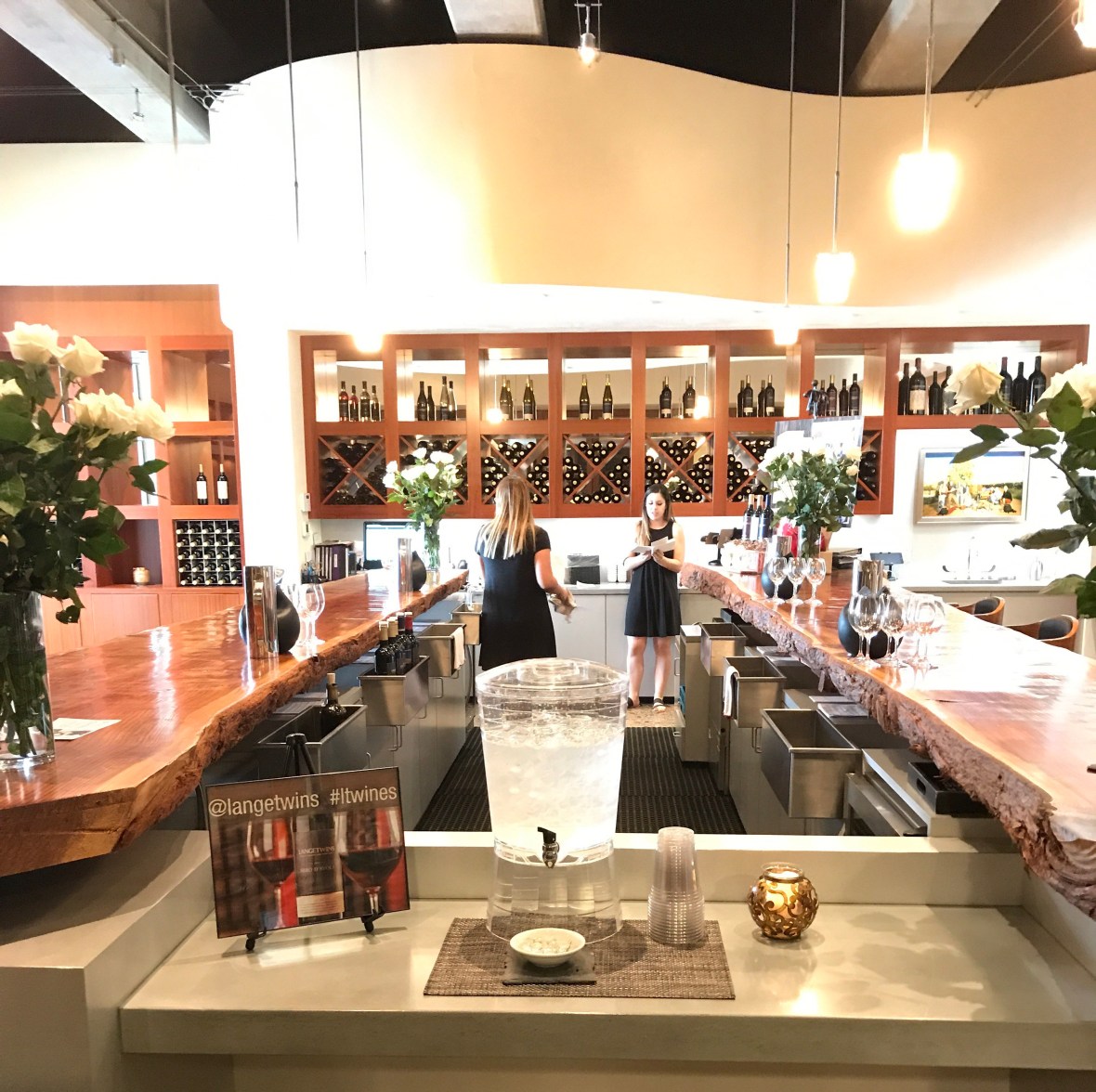
After the tour, David delivered us to the capable hands of the LangeTwins tasting room staff, where we enjoyed samples of the finished product. LangeTwins makes a large variety of wines, from light and lively whites, to a crisp, zesty Sangiovese Rosé, to big, bold red blends and varietal wines. Everything we tasted was exceptional. So much so that we decided to join the wine club, thus ensuring return visits, at least quarterly, for the foreseeable future.

img_0055

No trip to Lodi is complete without a stop at LangeTwins Winery. If you are in the area, I encourage you to stop in for a tasting. If time allows, click here to schedule a private tasting and winery tour. If you happen to run into David Akiyoshi while you’re there, tell him I said “hi.”