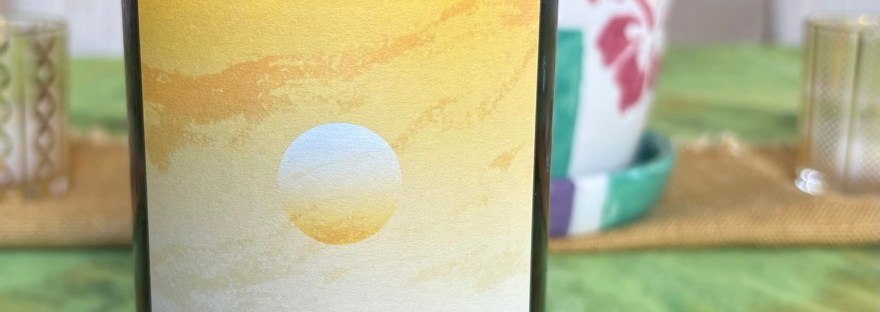
Let’s get this out of the way up front. We’re picky about our Chardonnay. Big, buttery oak bombs? Nope, not for us. We prefer elegant, dry, crisp versions. Lucky for us, the Sanctum Medved Chardonnay 2023 is exactly that.
Burgundian in style, this Slovenian Chardonnay ticks all the boxes. We recently learned, from our esteemed wine poet Tyler at @beyondthefigwine, that as early as the year 1200, French Carthusian monks have been working with Burgundian Chardonnay vines in Slovenia, turning out Burgundy quality wines, completely under the radar! Whole bunch pressed, and fermented with only naturally occurring, native yeast, and aged 12 months in neutral, French oak barrels, this is a wine that truly expresses terroir.
Clear, golden color. The nose is pear, citrus, and tropical fruit. On the palate, crisp yellow apple, green apple, Asian pear, citrus, and minerals with chalky notes. Medium-plus body with crisp acidity and a fresh, vibrant finish.
This is exactly our preferred style of Chardonnay. If it’s your style, we know where you can get some.
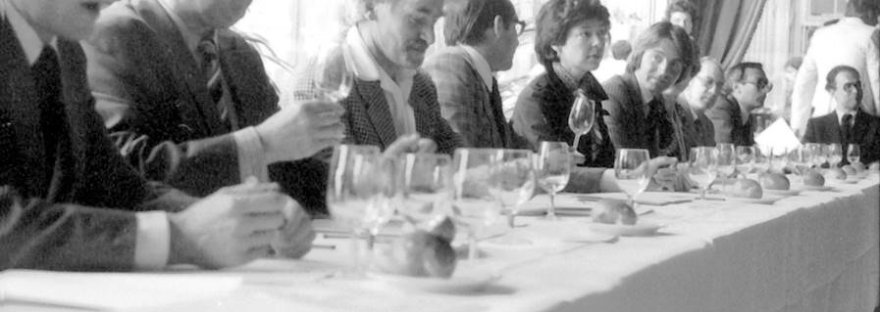
It was 40 years ago this week that Steven Spurrier, a British wine merchant living in Paris, held a wine tasting event, the results of which shocked the wine world. Spurrier gathered nine expert judges, all of them French, for a head-to-head blind tasting of the best of Bordeaux and Burgundy against relatively unknown wines from California. Spurrier and an associate, American Patricia Gallagher also participated in tasting and judging the wines. At the time, the commonly held belief was that French wines were the standard of quality, and anything else was inferior. The tasting was originally intended to simply generate publicity for Spurrier’s wine shop and school. Therefore, there was not a lot of outside interest in it, and only one journalist attended the event; George M. Taber, from Time Magazine (Taber, 2005).
Photo Credit: Wikipedia
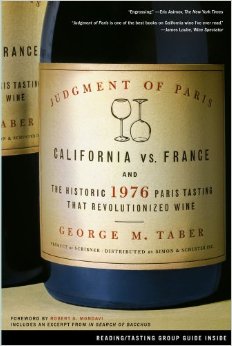
There were two separate competitions: White Burgundy vs. California Chardonnay, and Red Bordeaux vs. California Cabernet Sauvignon. In each category, there were four French wines, and six from California. The outcome is now well known – a California wine won top honors in both categories. The event changed the landscape of the Napa Valley, figuratively and literally. Taber later compiled the experience in his book: Judgment of Paris: California vs. France and the Historic 1976 Tasting that Revolutionized Wine (Taber, 2005). It is a fascinating and educational account, not only of the tasting event, but also of the history of wine in France and the Napa region. The tasting was also dramatized in the movie Bottle Shock in 2008. It’s worth seeing if you haven’t, but keep in mind this is a motion picture dramatization, complete with editorial and creative license. If you want to really explore and learn about the history, I recommend reading the book!
Photo Credit: Amazon.com
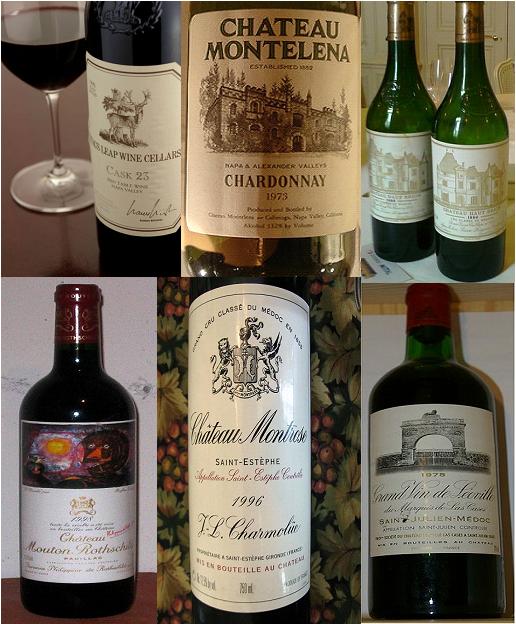
Below are the results of the famous 1976 tastings, in order of their ranking:
White
Chateau Montelena, 1973, Napa
Meursault Charmes Roulot, 1973, Burgundy
Chalone Vineyard, 1974, Monterey County
Spring Mountain, 1973, Napa
Beaune Clos des Mouches Joseph Drophin, 1973, Burgundy
Freemark Abbey Winery, 1972, Napa
Bâtard-Montrachet Ramonet-Prudhon, 1973, Burgundy
Domaine LeFlaive, 1972, Burgundy
Veedercrest Vineyards, 1972, Napa
David Bruce Winery, 1973, Santa Cruz Mountains
Red
Stag’s Leap Wine Cellars, 1973, Napa
Château Mouton Rothschild, 1970, Bordeaux
Château Haut-Brion, 1970, Bordeaux
Château Montrose, 1970, Bordeaux
Ridge Vineyards Monte Bello, 1971, Santa Cruz Mountains
Château Léoville-Las-Cases, 1971, Bordeaux
Mayacamas Vineyards, 1971, Napa
Clos Du Val Winery, 1972, Napa
Heitz Cellars Martha’s Vineyard, 1970, Napa
Freemark Abbey Winery, 1969, Napa
Among my more cockamamie ideas, it occurred to me that it might be fun to taste each of the wines featured in the Judgment of Paris. Of course, I’ll have to purchase current vintages, but so be it. Many of the châteaux and wineries represented in the competition continue to produce stellar wines, and their prices and scarcity reflect the prestige. Others have remained more affordable and are readily available. In 2004, Chalone Vineyards was purchased by global conglomerate Diageo, which took the brand in the direction of mass-produced table wine; neglecting its historic importance. Fortunately, earlier this year the winery was purchased from Diageo by Foley Family Wines. Spokesman Bill Foley says that Foley Family Wines will work to restore the estate’s reputation and highlight its place in history (Worobiec, 2016).
As much as I’d like to, I won’t be able to recreate the blind tasting, but instead will have to purchase and sample the wines individually over several months. This may prove to be an insurmountable challenge, simply due to the availability (or lack thereof) and cost of some of the famous French wines. Nevertheless, other than those that are clearly out of my range (Château Moutin-Rothschild, for as much as $1,100 for recent vintages, comes to mind) I am determined to seek out and taste them all! Watch for reviews coming soon!
———————————————————————————————————————-
Works Cited
Taber, G. M. (2005). Judgment of Paris: California vs. France and the Historic 1976 Paris Tasting that Revolutionized Wine. New York: Scribner.


 Appetite for Wine